Showing posts with label #DownTheRabbitHoleOfResearch. Show all posts

Wednesday, May 31, 2023

Wednesday's Random Slang-o-rama: Scamander

June is upon us—the perfect month to scamander along trails and streets...

>
>
>
>
>
>
>
>
>
>
>
... And if you lived in Victorian times (or happen to have access to a copy of A Dictionary of Slang, Cant, and Vulgar Words, by A London Antiquary, from 1860) you would know that, back then, to scamander meant "to wander about without a settled purpose." Horologicon by Mark Forsyth adds that scamander is the sister word to meander, with both words having their origin in waterways: 

The river Maeander winds, by a preposterously curly-whirly route, through Izmir in Turkey. The ancient Greeks were very taken with the twisting of the Maeander... If you feel that the Maeander isn't the river for you, you may pick the Scamander, another Turkish watercourse now known as the Karamenderes.

Wikipedia notes that Scamander was a river god in Greek mythology and that the Scamander River, named after this god, was the river surrounding Troy. The river deity fought on the side of the Trojans during the Trojan War, and tried to drown Achilles three times. I have long forgotten the details of The Iliad by Homer, so tracked down the section where Achilles squares off with the river god. I must admit that after reading about how Scamander remarks to the warrior that the river is choked with corpses and couldn't Achilles please just do all his hewing and hacking on land, and Achilles pretty much responds, "No way, I'm a killing machine and there's no stopping me!" that I side with Scamander on all this.

Having done a fair job of scamander-ing through this post, I'll stop here.

Have fun as you scamander around this summer, whether in wilderness or city.
Wilderness image by JayMantri from Pixabay ; City image by RD Law from Pixabay


Wednesday, May 10, 2023

Wednesday's Random Slang-o-rama: Bailiwick

"That's not my bailiwick" is something my mother used to say, and I'll admit that this statement pops to mind on occasion (although these days one is more likely to hear "not in my wheelhouse"). So, what is a bailiwick anyway? I truly have no idea. So, let's subject it to the Slang-o-rama microscope!

>
>
>
>
>
>
>
>
>
>
>
>
>
>
The Online Etymology Dictionary is always a good place to start. And yep, here's what they say about the noun bailiwick:

mid-15c., "district of a bailiff, jurisdiction of a royal officer or under-sheriff," a contraction of baillifwik, from bailiff (q.v.) + Middle English wik, from Old English wic "village"... The figurative sense of "one's natural or proper sphere" is by 1843.

I checked my hardcopy of The Barnhart Concise Dictionary of Etymology by Robert K. Barnhart, which says pretty much the same thing, with 1843 being its first appearance (in the figurative sense) in "American English." Vocabulary.com offers a bit more detail for definitions and so on:

A bailiwick is an area of knowledge in which a person or institution has control or expertise — as in "My bailiwick is international relations." There is a faintly old-fashioned, even pedantic air to the term now, so use with caution.

Bailiwick also can mean a geographical area over which someone or some body has legal or political control, though this is a less common meaning nowadays... Britain's central criminal court, the famous Old Bailey, is so named because it lay on the ancient bailey or wall that defined the original City of London.

If you want to do a deep dive into the non-idiomatic origin and use of this word, check out this Wikipedia entry which even includes a list of existing geographical bailiwicks. But hey, since this particular entry doesn't offer a dive into the slang aspects, it's not in my bailiwick....

The Bailiwick of Guernsey? Not what we're looking at here in Slang-o-rama.
Bailiwick of Jersey flag: CC BY-SA 3.0Link      Hand image: RegioTV from Pixabay


Wednesday, April 26, 2023

Wednesday's Random Slang-o-rama: Haywire

 Ever had those times when you've had life go haywire, as in "become wildly confused, out of control, or crazy" (definition courtesy of The American Heritage Dictionary of Idioms by Christine Ammer)?

Well, I'm here to tell you all about it....

>
>
>
>
>
>
>
>
>
>
>
>
... or at least, about the etymology of this bit o' slang!

Ammer offers that go haywire "alludes to the wire used for bundling hay, which is hard to handle and readily tangled." She also places its first appearance in the first half of the 1900s, which is a pretty wide swath of time. For historical fiction writers, there is a big difference as to whether this phrase entered common use in 1901 vs 1950.

Let's see what other references have to say about going haywire...

The Online Etymology Dictionary has this nice entry, starting with its more prosaic definition:

haywire (n) "soft wire for binding bales of hay," by 1891, from hay + wire (n.). Adjective meaning "poorly equipped, makeshift" is 1905, American English, from the sense of something held together only with haywire, particularly said to be from use of the stuff in New England lumber camps for jury-rigging and makeshift purposes, so that hay wire outfit became the "contemptuous term for loggers with poor logging equipment" [Bryant, "Logging," 1913]. Its springy, uncontrollable quality led to the sense in go haywire (by 1915).

So, 1915, eh? Could I then have a character go haywire in a story set during in the early days of Prohibition, for instance?

Not so fast, says The Barnhart Concise Dictionary of Etymology by Robert K. Barnhart, which places the first recording of go haywire in 1929. The Guardian has folks chiming in, offering various dates from "early 1900" to a more recent use in 1940s. 

Enough of this wishy-washy waving of hands. Time to bring out the big guns: Google Ngram. Running down the list of  references, I found a 1916 utterance of this problematic phrase in Nick of the Woods by "Alaska Blacklock" (a pseudonym of George Edward Lewis). In his tale of the still-wild Northwest frontier, the idiomatic term gone haywire is used in dialogue as a bit of wordplay-with-a-wink with the noun haywire:


Hey! (or should I make that "Hay!" 🤣 )... 1916 (or so) works for me! 

Hay wire in a lovely green field or haywire in a crazy day? Depends on how you're feeling!
Left image by Mikhail Timofeev from Pixabay; Right image by David Bruyland from Pixabay


Wednesday, March 29, 2023

Wednesday's Random Slang-o-rama: Shooting the breeze

 Confession: I am *stillI* unpacking from the Left Coast Crime conference (these things take time!), and reliving pleasant memories of catching up with folks in person, and just shooting the breeze

This phrase, meaning to chat idly or informally, sounds very "Old West" to me. I can imagine a couple of Silver Rush characters, hanging out at a street corner in San Francisco's Barbary Coast or in the fictional Silver Queen Saloon in Leadville, just shooting the breeze. However...

>
>
>
>
>
>
>
>
>
>

...according to The Idioms (which claims to be the "largest idiom dictionary... hmmmm), shooting the breeze is of more recent vintage, originating in the U.S. in the early 1900s. As to why "breeze," the entry notes:

A breeze is a light wind, and that’s why the word is used in this phrase to denote a light talk, idle talk, unimportant conversation, or a rumor. ... Sometimes, you can find that “bull” is used instead of “breeze,” but the meaning remains the same. “Shoot the bull” developed from the American institution known as a “bull session,” a gathering of men and it was first recorded in 1908 in prints.

The Online Etymology Dictionary places shoot the breeze even later, at 1938, suggesting it may have originated as military slang. Wiktionary pegs it at 1919, adding that the word breeze alludes to "talking into the wind." Turning to Google Ngram, I tracked down the earliest use of this slang-ish phrase in the 1917 Syllabus of Northwestern University and in the Coopers International Journal of 1918 (which has some awesome photos, if you scroll around through this publication). Of course, it could easily have shown up earlier in newspapers and in speech. Still, I guess I can't have Inez Stannert shooting the breeze in 1879 Leadville or even in 1882 San Francisco...

No, we cannot "shoot the breeze." Come back in 1917 and ask me then.
Image by Prawny from Pixabay.

Wednesday, February 8, 2023

Wednesday's Random Slang-o-rama: Fantods

 I bumped up against the word fantods and thought "Whaaaaaat...???" The context didn't provide any clues as to the word's meaning. That makes fantods a perfect candidate for Slang-o-rama!

>
>
>
>
>
>
>
>
>
>
>
>
According to The Online Etymology Dictionary, fantods—a "jocular formation, possibly based on fantasy"—first appeared in 1835. The definition is offered through this passage from The Metropolitan Magazine, London, October 1835: 

There is an indescribable complaint, which will never allow a moment's repose to mind or body; which nothing will satisfy—which allows of no beginning, and no ending—which wheels round the mind like the squirrel in its cage, ever moving, but still making no progress. It is called the Fantods.

Ah, this is a state of mind that is very familiar to me, and I suspect to others as well! 

Elsewhere, Merriam-Webster defines fantod as "a state of irritability and tension" or "an emotional fit," adding "The exact origin of fantod remains a mystery, but it may have arisen from English dialectal fantigue—a word (once used by Charles Dickens) that refers to a state of great tension or excitement and may be a blend of fantastic and fatigue." World Wide Words  pegs fantods as first appearing in 1839 in the U.S. But I think the 1835 quote that appears on The Online Etymology Dictionary points to an earlier origin from "across the pond," as does an appearance of fantods in William Johnson Neale's book Will Watch, published in 1834.

Such fun! But I must stop dashing about the internet, looking for even earlier appearances, before I have an attack of fantods...

via GIPHY

Wednesday, January 11, 2023

Wednesday's Random Slang-o-rama: Raining pitchforks

 And the deluge continues in California. A few years ago, I did a Slang-o-rama dive into the phrase raining cats and dogs (check it out here). I wracked my brain for another "holy cow, that's a lot of rain" idiom, and thought of raining pitchforks. Having pitchforks thunder down from above sounds pretty dangerous... So let's see what I can find...

>
>
>
>
>
>
>
>
>
The Free Dictionary simply lists it as an "old-fashioned" phrase meaning "to rain very hard and heavy." In its entry on "raining cats and dogs," Wikipedia mentions raining pitchforks along with raining hammer handles as phrases of unknown origin that may have been used just for their "nonsensical humor value." I turned to Google Ngram to get an idea of how far back this expression might go, and saw a fair representation of appearances in books from the 19th century.

Google Ngram results for "raining pitchforks"

Digging around a little more, I found the phrase raining pitchforks in The Love Life of Brig. Gen. Henry M. Naglee, in a letter he wrote to a sweetheart during the Civil War, dated March 15, 1862. (You can view the passage here.) Curious about the book, I turned to the introduction and discovered these letters were published by the recipient, actress Mary Schell, who later sued Naglee for "breech of promise." Hmmmm. I then turned to the Wikipedia entry on Naglee and discovered that he had a strong connection to San Francisco. What serendipity! So, down the rabbit hole I go, while it continues to rain pitchforks outside...

Cozy inside, raining pitchforks outside (Photo: Ann Parker)


Wednesday, October 5, 2022

Wednesday's Random Slang-o-rama: Warm the cockles of my heart

My first question about this phrase is: what the heck are cockles? My second: how did this reference to high-temperature heart cockles come about anyway?

Let's find out....

>
>
>
>
>
>
>
>
>
>
>
>
>
A quick hop over to the Grammarist yields the following:

To warm the cockles of one’s heart means to bestow a feeling of contentment, to kindle warm feelings in a person, especially of happiness and felicity. The term warm the cockles of one’s heart dates back to the mid-1600s, a time when scientific texts were often written in Latin. The Latin term cochleae cordis means ventricles of the heart, and most probably, the word cochleae was corrupted as cockles. This may have been a mistake made by the less learned, or a deliberate joke. Add in the fact that the bivalve mollusk known as a cockle is shaped somewhat like a heart, and the idea of the phrase cockles of one’s heart being more or less a joke gains credence.

My copy of The American Heritage Dictionary of Idioms by Christine Ammer agrees with the Latin origin for cockles and when the phrase first came into use. World Wide Words has its own approach, starting its entry with:

Something that warms the cockles of one’s heart induces a glow of pleasure, sympathy, affection, or some such similar emotion. What gets warmed is the innermost part of one’s being. It’s not that surprising that it should be associated with the heart, that being the presumed seat of the emotions for most people. 

Awww. I like that! A very heart-warming observation. WWW then adds, "But what are the cockles? We’re not sure."

Uh-oh. "Not sure" is not what I wanted to read.

WWW offers the same possible explanations as Grammarist, with some additional fillips, including the fact that the earliest form of the saying was rejoice the cockles of one’s heart. The WWW exploration of the idiom concludes by noting that cochlea in Latin is the word for a snail and suggesting that perhaps we should really be speaking of warming the snails of one’s heart.

Snails?? Uh, no. Just... no.

A case of overheated cockles?
Image by 0fjd125gk87 from Pixabay

Wednesday, August 10, 2022

Wednesday's Random Slang-o-rama: Crack up

I recall the phrase you crack me up and variations of such from my teen years, which is why I thought it must be a recent saying. But as you know, I am more often than not wrong about such things. Thank goodness for research, idiom dictionaries, and the internet...

>
>
>
>
>
>
>
>
>
>
>
>

Crack up actually has several slang-ish meanings, and my trusty copy of The American Heritage Dictionary of Idioms by Christine Ammer runs down the list, providing "first use" dates for a couple of them. There's crack up as in to suffer an emotional breakdown (early 1900s). Then, crack up meaning to damage or wreck a vehicle or vessel and ato experience a crash (no first use dates for those two definitions). Finally we get to the phrase I'm interested in: crack someone up, meaning to "burst or cause to burst out laughing (1940).

American Slang, 2nd Edition by Robert L. Chapman with Barbara Ann Kipfer agrees with the 1940 date for crack up meaning "to have a fit of uncontrollable laughter." Interestingly, the next entry is "crack wise" from the 1920s, which means to make quick pungent, witty, and often malicious remarks. But I digress.

But wait a minute! The Online Etymology Dictionary has this to say about crack up:

The verbal phrase in the meaning "to break up laughing" is by 1967, transitive and intransitive.

Without getting too specific, 1967 is just about right for my teen years... but doesn't line up with what the other dictionaries say. Here's one more data point for you, then: Your Dictionary's page on 1940s slang lists crack up (burst out laughing). So, I think we're safe with going with the 1940s, at least. A good place to stop. 

If you find any other references, please let me know in the comments. Maybe we can push that date back even further into the past?

It's an anachronistic High Renaissance crack up!
Four Laughing People by Bartolomeo Veneto (c. 1510-30) 

**** A tip o' the hat to author Camille Minichino who suggested this Slang-o-rama phrase!****

Image by b0red from Pixabay


Wednesday, July 6, 2022

Wednesday's Random Slang-o-rama: (All) at sea


If you're feeling a little at sea in these uncertain times, I assure you, you are not alone. But before we get a little green around the gills with all the swaying and lurching about in the greater world "outside," let's take a look at the idiom all at sea (because this is, after all, a blog about language and only in the most devious/clandestine way about anything else)...

>
>
>
>
>
>
>
>
>
>
>
>
The American Heritage Dictionary of Idioms by Christine Ammer defines the idiomatic all at sea or at sea to mean "perplexed, bewildered," which is as good a definition as any. The dictionary continues, "This idiom transfers the condition of a vessel that has lost its bearings to the human mind," and dates it to the later 1700s. The Phrase Finder tackles the phrase as well, defining it to mean "in a state of confusion and disorder," and provides an early example from Sir William Blackstone's Commentaries on the laws of England, 1768: "If a court of equity were still at sea, and floated upon the occasional opinion which the judge who happened to preside might entertain of conscience in every particular case." .... Ooookay. I'm no lawyer, and even after slogging through the Wikipedia explanation of "court of equity," I'm still not sure what these courts are. I guess you could say I'm at sea (which reflects my state of being after certain present-day high court decisions, which have me feeling a little sick to my stomach, so there you go).

Batten the hatches, rough seas ahead...
Ocean by Ivan Aivazovsky, 1896, WikiArt


Wednesday, June 1, 2022

Wednesday's Random Slang-o-rama: Eighty-six

Sure, eighty-six comes up when counting to one hundred, but in the world of slang, eighty-six takes on a whole host of meanings.

>
>
>
>
>
>
>
>
>
>
>
Green's Dictionary of Slang provides two general definitions: unwelcome (from 1933) or dead (from 1986). Digging around a little more, I happened on a nifty article in the St. Louis Magazine column "Ask George" in which a reader asks how the term eighty-sixed in the restaurant biz came to mean that an item was unavailable. George responded:

When I first asked that same question, I was told this: that the standard height of a door frame was 8 feet 6 inches, and when an obnoxious guest was shown the door, he was “86’d.” That pacified me until I later heard that it took 86 ladles to empty a pot of soup on an Army mess line. After that number of ladles, the soup was 86’d. Then I did some research and realized the genesis of the term isn’t clear at all...

The article dives into a dizzying number of possible origins for this short bit o' slang. I encourage you to click on the link above and check them all out. I'll list some of my favorites here:

  • The term originated in the soup kitchens of the Great Depression, where the standard pot held 85 cups of soup, so the 86th person was out of luck.
  • The United States also has a Uniform Code of Military Justice that has an Article 86: Absence Without Leave, a.k.a. AWOL. 
  •  Rotary phones had T on the 8 key and O on the 6 key, so to throw out (TO) something was to 86 it.
  • Alcohol in the Old West was 100 proof. When a patron would get too drunk, the barkeep would serve him a less potent, 86 proof liquor, thereby 86’ing him. 
  • There was a speakeasy bar in New York City's Greenwich Village at 86 Bedford Street called Chumley's, with no address on the door and several hidden exits. When the heat showed up, guests were known to 86 it, or remove themselves from the premises immediately.
  • Others say it originated at Delmonico's Restaurant in NYC. Number 86 on their menu was a steak, the most popular item on the menu and one that often sold out. The term morphed into shorthand for being out of any item. 
  •  The term originated with the number codes used by soda jerks: 86 was the code indicating they were out of an item. 
  • There are those who claim the term refers to 86 inches, the standard depth of a grave in the U.S. So to 86 something is to bury it.

In the list, the timeframe of first use of eighty-six as slang seems to vary all over the place. For instance, the reference to the "Old West" would probably push it to 19th century.

Turning to my hardcopy of Random House Historical Dictionary of American Slang, Volume 1, A – G wasn't very helpful. This dictionary offers up two general definitions with a couple sub-definitions: 

  1. (a) dating from 1995: to end; stop; quash; discard or get rid of; (b) from 1978: to eliminate by killing, murder
  2. (a) from 1958: to eject; put out; dismiss; send packing; (b) from 1967:  to get out (used in the sense of an imperative or command)
Merriam-Webster puts on its authoritative/imperative hat and declares that eighty-six first appeared in the early 1930s as soda-jerk slang to indicate an item was sold out.  As to "why" it would have come to mean this? M-W opines (with a shrug), "There is varying anecdotal evidence about why the term eighty-six was used, but the most common theory is that it is rhyming slang for nix." The Online Etymology Dictionary more-or-less agrees, putting first use at 1936.

All I can say is that I guess no one could be eighty-sixed in my nineteenth-century-based series and that I am now craving a root beer float...

Well, it *is* the first of June and almost summer.
By Sarah Afshar - Own work, CC BY-SA 4.0
https://commons.wikimedia.org/w/index.php?curid=84665905

A tip o' the hat to author Camille Minichino, who first mentioned eighty-six in her enlightening Slang-o-rama guest post on Diner Lingo!


Wednesday, May 18, 2022

Wednesday's Random Slang-o-rama: Squinchy

 If something makes you feel squinchy, what does that mean? The word itself has a sort of visceral sound to me, making me think of a vague nausea, a twisting of the stomach. But oddly enough....

>
>
>
>
>
>
>
>
>
>
>
>
>
>
... it has more to do with the face than the gut.

According to Merriam-Webster, squinch has a couple of general definitions. As a verb, squinch means to screw up the eyes or face, or squint, or to make more compact or to crouch down or draw together. As to its origin, Oxford Lexico offers that this version of squinch dates to early 19th century and might have originated as a blend of "squeeze" and "pinch."

But there's more.

Squinch can also be used as a noun. In this case, says M-W, a squinch is (and I quote) "a support (such as an arch, lintel, or corbeling) carried across the corner of a room under a superimposed mass."

 Ooookay.

After reading that, I needed to find some visual examples of architectural/engineering squinches, because I had absolutely no idea what this definition meant. Thanks to Wikimedia, I found a drawing of a squinch...

A squinch!
Pearson Scott Foresman, Public domain, via Wikimedia Commons

...and a lovely photo of a brick-and-tile-decorated squinch.

A decorated squinch!
Andrehmarouti, CC BY-SA 4.0, via Wikimedia Commons

Oxford Lexico notes that squinch as a noun is a late 15th century alteration of the obsolete word scunch, which is an abbreviation of scuncheon, which, according to Collins Dictionary is "the inner part of a door jamb or window frame." Collins goes on to add that scuncheon dates to 15th century and is from the Old French escoinson, and, oh dear, I'm stopping here, because I'm starting to feel a little squinchy.

Definitely squinchy...
Photo by Andrea Piacquadio from Pexels


Wednesday, March 23, 2022

Wednesday's Random Slang-o-rama: Don't fash yourself

Last week, as I was racing to finish a guest post summarizing my "journey into fiction writing" for author Donis Casey's Tell Me Your Story corner, I crashed with a migraine. Later, when I crawled out and did a little whimpering to Donis, she very kindly replied, "As my grandma used to say, don't fash yourself."

Don't fash yourself... now there's a Slang-o-rama expression if ever I heard one!

>
>
>
>
>
>
>
>
>
>

According to The Scotsman, I probably should write that phrase out as dinna fash yoursel, because, yes, it's a Scottish expression. The article explains that fash generally has two meanings: the first being not to get annoyed by a situation, and the other being not to inconvenience yourself with something or someone. As for origin? Here's what The Scotsman says:

Uses of the word in Scots have been recorded as early as the sixteenth century, and appears to be derived from the medieval French verb ‘fascher.’  

For those who don't know French (I didn't), Wordsense offers up that fascher means to anger; to enrage, and is descended from the French fâcher, which means to annoy, to vex or to get angry, fall out. Wordsense adds that fâcher is "probably from Vulgar Latin *fasticāre, from an alteration of Late Latin fastidiāre < Classical Latin fastīdīre, present active infinitive of fastīdiō."

From (Vulgar) Latin, to (Medieval) French to (early modern) Scots... How'd that happen? Linguablog has thoughts on this, and also delves into dinna as well as fash.

And if this is  all going down the rabbit hole a little too far for you... well, don't fash yourself, because I'm done! :-)

Could this be a "fash-in" show pose?
 Scottish Kilt ShopCC BY-SA 2.0, via Wikimedia Commons


Wednesday, March 2, 2022

Wednesday's Random Slang-o-rama: Hokey pokey

 Do any of you remember the song-and-dance "The Hokey Pokey" from your childhood? I do! And for some reason, it's been stuck in my mind for a while now. So, of course, I started to wonder: did the phrase hokey pokey originate from the song that I remember from the 1950s?

Time to do a little research!

>
>
>
>
>
>
>
>
>
>
>
>
>

First, a little background on the song, starting with Wikipedia:

The Hokey Cokey (United Kingdom, and the Caribbean) also known as Hokey Pokey (South Africa, United States, Canada, Australia, and Israel) is a campfire song and participation dance with a distinctive accompanying tune and lyric structure. It is well known in English-speaking countries. It originates in a British folk dance, with variants attested as early as 1826. The song and accompanying dance peaked in popularity as a music hall song and novelty dance in the mid-1940s in the UK. The song became a chart hit twice in the 1980s.

Wow... hokey pokey was rumbling around in the early 19th century?? Really, Wikipedia?? I searched some more, and found this from Etymology Online:

hokey-pokey (n). 1847, "false cheap material," perhaps an alteration of hocus-pocus, or from the nonsense chorus and title of a comic song (Hokey Pokey Whankey Fong) that was popular c. 1830. Applied especially to cheap ice cream sold by street vendors (1884). In Philadelphia, and perhaps other places, it meant shaved ice with artificial flavoring. The words also were the title of a Weber-Fields musical revue from 1912. The modern dance song of that name hit the U.S. in 1950 ("Life" described it Nov. 27, 1950, as "a tuneless stomp that is now sweeping the U.C.L.A. campus"). But a dance of that name, to a similar refrain, is mentioned in a 1943 magazine article (wherein the "correct" title is said to be Cokey Cokey), and the dance is sometimes said to have originated in Britain in World War II, perhaps from a Canadian source.

On a different Wikipedia page, I discovered that, in New Zealand, hokey pokey is a term for a very specific flavor of ice cream—vanilla with bits of honeycomb toffee. The entry continues:

...hokey pokey was a slang term for ice cream in general in the 19th and early 20th centuries in several areas — including New York City and parts of Great Britain—specifically for the ice cream sold by street vendors, or "hokey pokey men". The vendors, said to be mostly of Italian descent, supposedly used a sales pitch or song involving the phrase hokey pokey, for which several origins have been suggested. One such song in use in 1930s Liverpool was "Hokey pokey penny a lump, that's the stuff to make ye jump."

I don't know about you, but I find all this fascinating. From its early-19th-century emergence as a folk dance, to a dismissive term for ratty-tatty material, to an ice cream flavor, and finally to a "modern" 1950s dance, this simple little phrase has had quite the linguistic journey!

Now, doesn't that just make you want to jump up and do the hokey-pokey?? (And maybe have some ice cream afterwards!)

The Hokey Pokey, 1953 ... This is the version *I* remember!

Wednesday, February 2, 2022

Wednesday's Random Slang-o-rama: Monkeyshines

Monkeyshines. Now there's a word with an origin I can't even begin to guess. Time to hit the wondrous world of the internet!

>
>
>
>
>
>
>
>
>
>
>
>
According to the online Merriam-Webster, monkeyshine (which is usually used in the plural) means mischievous or playful activity. The Online Etymology Dictionary gives it an origin date of 1832, adding: 

from monkey (n.) + shine (n.) "a caper, trick" (1835), from an American English slang sense perhaps related to the expression cut a shine "make a fine impression" (1819).... For sense of the whole word, compare Old French singerie "disreputable behavior," from singe "monkey, ape."

 The Word Detective also addresses monkeyshines, in a fascinating (and more lengthy) dive with asides about other monkey-themed phrases:

“Monkeyshine,” a US coinage dating back to the early 19th century meaning a prank, trick or just boisterous behavior, is one of several English words and phrases that draw parallels, usually not very negative, between human and playful simian behavior. “Monkey business,” “monkey around,” “more fun than a barrel of monkeys,” “monkey see, monkey do,” etc., all make being a monkey sound like a lot more fun than it probably is. “Monkeyshines” may land you on probation at college or even cost you your job, but you’re unlikely to land in the slammer by monkeying around (unless “monkeyshines” is used, as it sometimes is, in a sarcastic sense to mean serious ethical or legal violations). 
The “shine” in “monkeyshine” is a colloquial term, also dating back to the early 19th century, with a number of meanings. “Shine” in this sense can mean “a party” (as in “tea-shine”), “a ruckus or commotion,” “a fancy for” (as in “take a shine to”), or simply “a trick or caper” (“‘I’ll boun you pulled ’em out, some o’ your shines,’ said Aunt Chloe,” Harriet Beecher Stowe, Uncle Tom’s Cabin, 1852). The origins of this “shine” are uncertain. It may be simply a specialized use of “shine” in the sense of “radiance.” But it may also be related to the dialectical terms “shindy” and “shinty,” both used to mean “commotion,” and both related to “shinny,” a game similar to field hockey dating back to the 17th century.

Wow... field hockey?? Now there's a connection to monkeyshines that would have never occurred to me. And if you read this little conversation over on The Phrase Finder, there may even be a connection to moonshine, as in illicit liquor. 

Definitely a word with a lot of history and a bit of mystery in its origins...

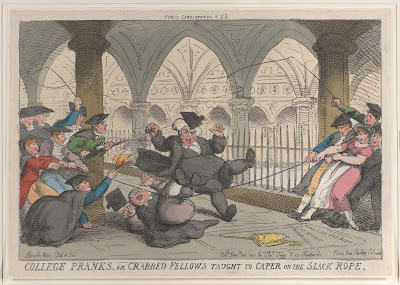
College monkeyshines, before monkeyshines was a word
By Template:Thomas Rowlandson - This file was donated to Wikimedia Commons as part of a project by the Metropolitan Museum of Art. See the Image and Data Resources Open Access Policy, CC0, https://commons.wikimedia.org/w/index.php?curid=92707011

Thursday, January 13, 2022

Wednesday's Random Slang-o-rama: Quanked

 Ah, I'm late with this Slang-o-rama post, although I can hardly blame it on being quanked... more like being unorganized and losing track of what day it is.

"And quanked means... what?" you ask.

Allow me to elucidate (actually, I'll let the references at hand do that).

>
>
>
>
>
>
>
>
>
>
According to The Little Book of Lost Words by Joe Gillard, quanked is a 19th-century adjective meaning "exhausted or fatigued from hard work." I don't know if one could count sitting hunched over a keyboard as "hard work." It's not as if I'm digging ditches here! (Well, maybe metaphorical ditches, but that's a different subject.) This word proved pretty elusive on the internet. I did find quanked in Wiktionary, which noted the word was "UK, dialect, obsolete." Wiktionary also provided the reference "Dartnell and Goddard (1893)."

Where there is a reference, there is a path forward, so forward I go...

And sure enough, Google Books promptly offered up quanked in A Glossary of Words Used in the County of Wiltshire, Issues 1-2, by George Edward Dartnell and Edward Hungerford Goddard (1893). Words specific to the county of Wiltshire? I'd say that's pretty specific! And even though I'm deviating from strictly Slang-o-rama here (or maybe not), I just have to share this from the Preface:

The following pages must not be considered as comprising an exhaustive Glossary of our Wiltshire Folk-speech. The field is a wide one, and though much has been accomplished much more still remains to be done. None but those who have themselves attempted such a task know how difficult it is to get together anything remotely approaching a complete list of the dialect words used in a single small parish, to say nothing of a large county, such as ours. Even when the words themselves have been collected, the work is little more than begun. Their range in time and place, their history and etymology, the side-lights thrown on them by allusions in local or general literature, their relation to other English dialects, and a hundred such matters, more or less interesting, have still to be dealt with. However, in spite of many difficulties and hindrances, the results of our five years or more of labour have proved very satisfactory, and we feel fully justified in claiming for this Glossary that it contains the most complete list of Wiltshire words and phrases which has as yet been compiled. More than one-half of the words here noted have never before appeared in any Wiltshire Vocabulary, many of them being now recorded for the first time for any county, while in the case of the remainder much additional information will be found given, as well as numerous examples of actual folk-talk.

Note that the authors spent FIVE YEARS on collecting "folk-speech" from a single county. My mind boggles, and I get quanked just thinking about it...


Wednesday, January 5, 2022

Wednesday's Random Slang-o-rama: Pull oneself up by the bootstraps

Ohhhh  the holidays are over, and boy do I feel it. January stretches before me, dark and cold. Well, no time for muddling about. It's time to pull myself up by the bootstraps and march forward into 2022.

Speaking of pulling and bootstraps, how old would you guess the phrase pulling oneself up by the bootstraps is? And where it first appeared? It sure has an "Old West" feel to it, don'tcha think?

>
>
>
>
>
>
>
>
>
>
Well, the The Phrase Finder claims this phrase, meaning to improve one's situation (or to succeed) by one's own efforts, was in use by the early 20th century. James Joyce alludes to it in his 1922 tome, Ulysses, in the sentence "There were others who had forced their way to the top from the lowest rung by the aid of their bootstraps." 

This isn't early enough for me, and has me wondering if I should search my Silver Rush books to see if I ever mention bootstraps in this idiomatic manner. However, not all is lost, because Wiktionary puts first use much earlier, claiming 1834:

In original use, often used to refer to pulling oneself over a fence, and implying that someone is attempting or has claimed some ludicrously far-fetched or impossible task. Presumably a variant on a traditional tall tale...

World Wide Words has a long piece on boot and bootstrapping, which talks some about this phrase. (The post also notes that "[a] bootstrap is not a bootlace, by the way, but a pair of loops inside the top of a heavy riding boot, something to pull on to get the foot past that awkward bend at the ankle.") WWW adds details re: the "tall tale" origin as well:

The idea of lifting oneself off the ground by pulling on [bootstraps] is sometimes said to date back to a tall story included by the German writer Rudolph Raspe in his book of 1785, Baron Munchausen’s Narrative of his Marvellous Travels and Campaigns in Russia, in which the famous Baron saved himself by this incredible feat. Some versions of Rudolph Raspe’s book include an incident in which he hauls himself (and his horse) out of the mud by lifting himself by his own hair. This is so similar an idea that it is highly likely that it is indeed the source. But somewhere along the way the story became modified to refer to bootstraps — this seems to have originated in the USA early in the nineteenth century; at least, the phrase was well known in that country by the 1860s.

1860s? That's more like it! And no less a publication than the New York Times provides a link, which names this 1834 reference and provides the quote, as follows (plus many other mid-19th century quotes):

1834 _Workingman's Advocate_ 4 Oct. 1/1 "It is conjectured that Mr. Murphee will now be enabled to hand himself over the Cumberland river or a barn yard fence by the straps of his boots." [APS]  

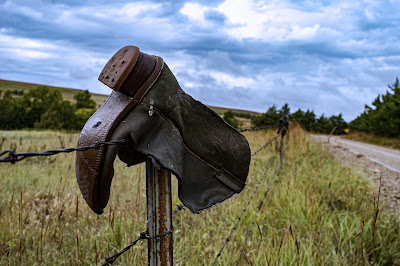
An unsuccessful attempt to make it over a fence using bootstraps.

So, there we go! I think a 19th-century yank on those bootstraps to attempt the impossible and absurd (although maybe not the merely difficult) has been vindicated. Which means we, in the 21st century, can pull ourselves up by our bootstraps and maybe, by current definitions, succeed! (Whereas my 1880s fictional characters, alas, would probably not.)


Wednesday, December 29, 2021

Slang-o-rama takes a break for: New Year's Bits and Pieces

 Since looking up Christmas song firsts was so fun last week, I thought I'd continue my Slang-o-rama break another week and turn my attention to New Year's trivia—musical and otherwise. So, without further ado, do you know:

  1. When was the first New Year's celebrations (that we know of)?
  2. What years was the NYC/Times-Square ball a "no show"?
  3. What is the earliest recording of Auld Lang Syne?

>
>
>
>
>
>
>
>
>
>
>

  1. According to Britannica, the earliest known record of a New Year festival dates from about 2000 BCE in Mesopotamia, where in Babylonia the new year (Akitu) began with the new moon after the spring equinox (mid-March) and in Assyria with the new moon nearest the autumn equinox (mid-September).
  2. Mental Floss lists 10 Facts about New Year's Eve, including the fact that the NYC ball drop was "missing in action" in 1942 and 1943. World War II was in full swing, and the army worried that the city's light displays would help German subs spot U.S. vessels in New York Harbor. So the Times Square ball drop was suspended for two years.
  3. Auld Lang Syne, first put to paper by Robert Burns in 1788, was recorded by Emile Berliner in 1890 on a vulcanized rubber disc and played on a "toy" gramophone. It was recorded again in 1898 on a wax cylinder by the Cambridge Anthropological Expedition. (You can hear the very scratchy recording right here, at about 1:12 minutes.) Recording quality had vastly improved by 1910, in this rendition performed by Frank C. Stanley:


There are sooo many good recordings of this iconic New Year's Eve song. Do you have a favorite? Let me know in the comments! 
Personally, I feel it's either got to be sung with an authentic Scottish brogue or played on bagpipes...


Happy new year, to all!

Wednesday, December 15, 2021

Wednesday's Random Slang-o-rama: Spondulicks (or spondulics or spondulix or...)

I'm making a list, checking it twice, and getting ready for a quick shopping spree. This spree requires that I crack open the piggybank and check the spondulicks within. Wait... does anyone even use piggybanks anymore? It's probably almost as ancient a concept as our Slang-o-rama word o' the week, spondulicks....

>
>
>
>
>
>
>
>
>
According to Merriam-Webster, spondulicks is slang for money or funds. Go back far enough, and it was used to mean fractional currency. M-W claims the origin and etymology of the word is unknown. As you probably know, I never take "unknown" at face value, so away we go, delving into the shadowy corners of the internet and the depths of my reference books in search of the whens and wheres of spondulicks.

To my delight, World Wide Words has a lovely piece on the word, opening with:

Though originally a bit of mid-nineteenth-century American slang for money, this has travelled widely, being cast up on the shores of Britain and Australia among other places. It’s a member of a group of words created in a century-long fit of logographical exuberation which also gave us slumgullion, rambunctious, and absquatulate...

(Note to self: must find an occasion in which to use the phrase "logographical exuberation.")  World Wide Words does such a great job, that I'll quote their post some more:

...It would seem from the evidence that spondulicks (either so spelled or as spondulix) was originally American college slang. One of its earliest appearances was in a piece about college life in the New York magazine Vanity Fair in 1860: “My friend the Senior got out of spondulix, and borrowed [my watch] to spout for the purpose of bucking the Tiger” (to interpret, his friend had run out of money and pawned the watch to get some more cash in order to gamble on cards, probably faro).

This reference to the game of faro (aka bucking the tiger) has me thinking I'll have to find a way to weave spondulicks into a bit of dialogue in some future Silver Rush story. 

Plenty of spondulicks exchanged hands while bucking the tiger
The game of faro as depicted by John David Borthwick in California, 1851
http://www.library.yale.edu/beinecke/customs3.htm
Public Domain, https://commons.wikimedia.org/w/index.php?curid=7876330

WWW notes that the word appears in the writings of O. Henry and Bret Harte, which is very nifty indeed, but what about its evolution? That's a story and a bit of a mystery in and of itself, according to the post. WWW lays it all out in such a delightful manner, I have to share the explanation with you:

Where does it come from? “A fanciful coinage”, the Oxford English Dictionary says. It has been described as a “perverted and elaborated” form of greenback (you may feel that to believe spondulicks could come from greenback requires a perverted imagination all its own). Eric Partridge suggests that it might derive from Greek spondulikos, from spondulos, a species of shell once used as money.

 However, Doug Wilson pointed out that that Greek stem is also the source of various English words beginning in spondylo– that refer to the spine or vertebrae. He suggested that a stack of coins may have been likened to the spine, with each coin a vertebra. He found a supporting reference in an 1867 book, A Manual of the Art of Prose Composition: for the Use of Colleges and Schools, by John Mitchell Bonnell. A list of provincialisms included: “Spondulics — coin piled for counting”.

 I found the word (spelled spondulics) on my bookshelf, in my three-volume Green's Dictionary of Slang (which you can also view online), with the earliest print appearance cited being in a 1856 parody of Henry Wadsworth Longfellow's "The Song of Hiawatha," titled "Plu-ri-bus-tah." The parody was written by Q. K. Philander Doesticks, the pseudonym for U.S. journalist/humorist Mortimer Thomson, who was apparently quite a character himself. (Thomson's Wikipedia entry says he was expelled from Michigan University for, perhaps "for "too much enterprise in securing subjects for the dissecting room.")

Well! I have wandered far afield here, but research is soooooo much fun! However, I must now tote up the spondulicks I have on hand and see what Santa can offer up this year...

Dori, Public domain, via Wikimedia Commons

Wednesday, November 17, 2021

Wednesday's Random Slang-o-rama: Higgledy-piggledy (by DMcC)


Please give three cheers for the return of my assistant Slang-o-rama-ist, Devyn McC! Devyn is a designer-editor-cartoonist, currently lurking near Portland, OR. Examples of Devyn’s work can be found at this here link and in the Slang-o-Rama archive.

-----------------------------------------------------

I'm not sure if it's the change in weather, the continued isolation, the new desk (our apartment now officially has 2.5 desks per resident—what can I say, I suppose we're deskaholics), or simply a shift of mood, but lately my brain has been a mess! 

Social media beckons, with glowing apps tempting my unfocused fingers; the fridge hums, heaving under the burden of untasted snacks; an ever-growing pile of unread books teeters next to the bed; my second-and-a-half desk wobbles fiercely, in need of a new screw… It seems that my home, like my brain, has become higgledy-piggledy mayhem.

This is what my brain/desk feels like.
https://www.pexels.com/photo/pile-of-covered-books-159751/

Now there's a thought (and a welcome distraction from my disaster of a deskspace). Whereabouts did higgledy-piggledy come from? And whence? And wherefore? And how many pigs are involved?

>
>
>
>
>
>
>
>
>
>
Let's start with definitions, as provided by the Collins Dictionary

  1. adverb: in disorder; in jumbled confusion 
  2. adjective: jumbled; confused

 Well, my desk could have told you that much! (If only I could find it under all these papers…) Collins also notes that the term arose around 1590–1600, with origin unknown.

As I rooted for etymological clues, I found one of the earliest recorded uses of higgledy-piggledy in John Florio's 1598 text A Worlde of Wordes, nestled in the definition for alla rappa: "snatchingly, higledi-pigledie, shistingly, rap and run." Entertaining, but alas, not clarifying on the "pig" puzzle.

A (guinea) pig on the desk! That explains the mess…
https://pixabay.com/photos/animal-guinea-pig-pet-cute-rodent-4988403/

The Phrase Finder notes that higgledy-piggledy is a reduplicated phrase, which uses partial repetition for amusing effect. (Regular Slang-o-rama readers might recall seeing reduplication mentioned in shilly-shally, fiddle-faddle, argy-bargy, and pish-posh.) The Online Etymology Dictionary notes that H…-P... reduplications—as in higgledy-piggledy and hanky-panky—are quite common, with many dating to the 16th century, which lines up with John Florio's text. However, Phrase Finder, the Wiktionary, and most other dictionaries I scoured claim that it's uncertain whether or not higgledy-piggledy actually has anything at all to do with pigs. (Hogwash, I say!)

On another linguistic note, the Phrase Finder also mentions higgledy-piggledy is unusual among reduplication words, because it uses a full three syllables per word, as well as being a double-dactyl. (No relation to pterodactyls, alas…) A single dactyl is a word or phrase where the first syllable is stressed, followed by two unstressed syllables (HIGG-le-dy); a double-dactyl combines two dactyls (HIGG-le-dy PIGG-le-dy), and is a popular metre form for poems and nursery rhymes.

Speaking of nursery rhymes… In my digging, I came across one by the writer Samuel Griswold Goodrich (aka Peter Barley), who was known for being "an ardent opponent of nursery rhymes [who] nearly succeeded in having them banned, along with fairy tales, from the more expensive nurseries of both England and America" (quoted from user "Wizard of Oz" at wordwizard.com). In an attempt to besmirch the rhyming craft, Goodrich once declared: "Anybody, even a child, could make one up. Listen! 

 Higglety, pigglety, pop! 

The dog has eaten the mop; 

The pig’s in a hurry, 

The cat’s in a flurry, 

Higglety, pigglety, pop!" 

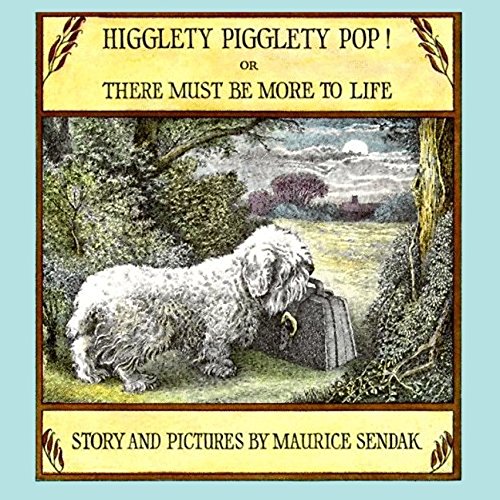
 Funnily enough? This poetic satire later become the central verse of a truly delightful children's book:

Higglety Pigglety Pop! or There Must Be More to Life
written and illustrated by Maurice Sendak, author of Where the Wild Things Are
https://images-na.ssl-images-amazon.com/images/I/61c76Xrp+7L.jpg

This classic features the exploits of Jennie, a small and hairy and intriguingly unsatisfied pooch (based on Sendak's real-life pet). She leaves home with naught but her nose in the air and a basket of snacks under her paw, looking for greener pastures and sweeter pastries elsewhere. And yes, it does involve mishap with a mop.

There's also a short film of the same name that was released in 2010, which I think perfectly captures the peculiarity of the book:

 

Higglety Pigglety Pop! or There Must Be More to Life from NFB/marketing on Vimeo.

With that, I feel we've found a good note to end on. I wasn't able to root out any satisfiably swine-related sources for higgledy-piggledy, and my desk isn't any cleaner, but my curiosity has been sated for now.

Wednesday, October 20, 2021

Wednesday's Random Slang-o-rama: Ragamuffin

I was on the hunt for words with a Halloween connection (besides those I've covered in the past, including heebie-jeebies, bugaboo, in a dither, and ghouls and vampires) when I bumped into ragamuffin, a word with an interesting history!

>
>
>
>
>
>
>
... And, as you probably know, I'm all about words (and phrases!) with interesting histories.

>
>
>
>
>
>
>
>
>
>
>
At Merriam-Webster, I learned that ragamuffin first appeared in relation to Thanksgiving before drifting back a month in the calendar to Halloween:

Ragamuffin has a long-established history of referring to a ragged person, but in the early 19th century the word became associated with the children who would dress up for Thanksgiving as ragamuffins and parade asking for handouts, parodying begging and beggars. Though these "ragamuffin parades" died out, children continue to dress up, but now on Halloween.

M-W adds that the word has several definitions, besides the common one listed above, including "a type of music (also known as raggamuffin or ragga), and a demon in the 14th-century poem Piers Plowman." The origin of the word, according to M-W, is "uncertain," but goes waaaay back.

In Middle English the word functioned both as a surname and generically to denote a ragged and sometimes stupid person.... The muffin part of the word may have its origin in either of two Anglo-Norman words for a devil or scoundrel, but that too is uncertain. As English lexicographer Samuel Johnson put it, "From rag and I know not what else."
Well, if Samuel Johnson "knows not," then I suppose Slang-o-rama can rest easy. But not quite yet, because the Online Etymological Dictionary has the following:

Ragamuffin. mid-14c., "demon;" late 14c., "a ragged lout," also in surnames (Isabella Ragamuffyn, 1344), from Middle English raggi "ragged" ("rag-y"?) + "fanciful ending" [OED], or else perhaps second the element is Middle Dutch muffe "mitten." 

OED also added a little fascinating info on the related word ragged

Ragged was used of the devil from c. 1300 in reference to his "shaggy" appearance. Raggeman (late 13c. as a surname, presumably "one who goes about in tattered clothes") was used by Langland as the name of a demon (late 14c.), and compare Old French Ragamoffyn, name of a demon in a mystery play. Sense of "dirty, disreputable boy" is from 1580s. Also compare ragabash "idle, worthless fellow" (c. 1600). 
Hmmmm. It seems both rag and muffin have connections to "devil." Sure enough, I found the following from a post titled "What the Deuce, Or, Etymological Devilry"on Oxford University Press:
...Sometimes we discover only the root of the name we investigate. Such is rag(g)-, known in Swedish, Lithuanian, English (the first element of ragamuffin; its second element, -muff-in, also means “devil,” from the French word for “ugly”), and possibly Italian, if ragazzo “boy” formerly meant “imp” (this ragg– is not related to rag “a piece of cloth”)

Before you go, let's re-visit Merriam-Webster's tale of ragamuffin parades....

The use of ragamuffin to describe "a child in masquerade costume" started in the late 19th century, in reference to the children who dressed up on Thanksgiving Day for what was called "Thanksgiving masking." This strange custom began as a parody of begging. Children dressed in costumes, often as ragamuffins, and begged for handouts for their Thanksgiving meals; they often received fruit, pennies, and candy. The practice became so widespread that Thanksgiving was nicknamed "Ragamuffin Day," and cities and towns began holding parades in which children could don their costumes and march. By 1930, the parades and tradition began to wane....  By the mid-1900s, the Thanksgiving ragamuffin became a thing of the past. The practice of dressing up and going out to beg, however, lived on in another holiday—Halloween.

So, when those little ragamuffins come knocking on your door on October 31, be kind. Treats only—no tricks or turkeys!

Back in the day. (Ragamuffin parade, circa 1910)
Library of Congress https://www.loc.gov/pictures/item/2014694901/)