Showing posts with label #ScotsSlang. Show all posts

Wednesday, October 19, 2022

Wednesday's Random Slang-o-rama: Tattie-bogle!

 Ohhhh here's a good word to add to your Halloween vocabulary (rubbing hands together in glee):

Tattie-bogle!

Any guesses as to what this Scottish word means?

>
>
>
>
>
>
>
>
>
>
A tattie-bogle is a scarecrow. Since the word Scottish in origin, who/what better to turn to for the etymology than The Scotsman newspaper? This what they have to say about tattie-bogle:

The tattie part is easy enough to decipher. Potato* farming was widespread across Scotland, so much so that it was one of the country’s main sources of sustenance... Bogle refers to a spiritual being or the subject of a folk tale. The scarecrow in the Wizard of Oz is an obvious literary example, but it does not take a great leap of the imagination to see the link between scarecrows and spectral figures. Despite that, it would be hard to think in all seriousness that anything with a name as daft as a tattie-bogle would be frightening.

Merriam-Webster keeps it simple, defining tattie-bogle as "a scarecrow in a potato field." Awwww, I was hoping for something a little more in the spirit of Halloween, given that it's such a great word! Collins Dictionary obliges, with "a person or thing that appears frightening but is not actually harmful."

I looked around a bit more, and found that there's a Scottish dance called the tattie-bogle and any number of poems invoking these beings, such as The Singin' Tattie-Bogle by an anonymous author and The Tattie-Bogle by William Soutar. 

For Halloween, you might keep your decorative tattie-bogles on the friendly side,
so you don't frighten the wee bairns who come trick-or-treating!
Image by HANSUAN FABREGAS from Pixabay

*Tattie means potato, but you probably guessed that from the context. According to Merriam-Webster, first use was in 1788.

Wednesday, March 23, 2022

Wednesday's Random Slang-o-rama: Don't fash yourself

Last week, as I was racing to finish a guest post summarizing my "journey into fiction writing" for author Donis Casey's Tell Me Your Story corner, I crashed with a migraine. Later, when I crawled out and did a little whimpering to Donis, she very kindly replied, "As my grandma used to say, don't fash yourself."

Don't fash yourself... now there's a Slang-o-rama expression if ever I heard one!

>
>
>
>
>
>
>
>
>
>

According to The Scotsman, I probably should write that phrase out as dinna fash yoursel, because, yes, it's a Scottish expression. The article explains that fash generally has two meanings: the first being not to get annoyed by a situation, and the other being not to inconvenience yourself with something or someone. As for origin? Here's what The Scotsman says:

Uses of the word in Scots have been recorded as early as the sixteenth century, and appears to be derived from the medieval French verb ‘fascher.’  

For those who don't know French (I didn't), Wordsense offers up that fascher means to anger; to enrage, and is descended from the French fâcher, which means to annoy, to vex or to get angry, fall out. Wordsense adds that fâcher is "probably from Vulgar Latin *fasticāre, from an alteration of Late Latin fastidiāre < Classical Latin fastīdīre, present active infinitive of fastīdiō."

From (Vulgar) Latin, to (Medieval) French to (early modern) Scots... How'd that happen? Linguablog has thoughts on this, and also delves into dinna as well as fash.

And if this is  all going down the rabbit hole a little too far for you... well, don't fash yourself, because I'm done! :-)

Could this be a "fash-in" show pose?
 Scottish Kilt ShopCC BY-SA 2.0, via Wikimedia Commons


Wednesday, January 19, 2022

Wednesday's Random Slang-o-rama: Groke

 For those of you who are familiar with Robert A. Heinlein's Stranger in a Strange Land, groke is not to be confused with Heinlein's "grok."


>
>
>
>
>
>
>
>
>
>
>

According to The Little Book of Lost Words by Joe Gillard (which is a veritable feast of strange words), groke is a verb dating to the 19th century, meaning "to stare eagerly at someone who is eating, hoping they'll give you food." 

Back in 2014, groke was featured as "the word of the week" in The Scotsman, which noted it was an old Scots word. (While perusing the short article I spotted some other weekly word offerings I shall have to consider for future Slang-o-rama posts. Who could resist delving into carnaptious, for instance? But I digress...) An article in The Guardian (which also includes some amazing words I shall add to my Slang-o-rama to-do list) adds, "The word was originally used to refer to dogs – and any dog owner whose canine friend has salivated beside them while they eat a steak will know why..."

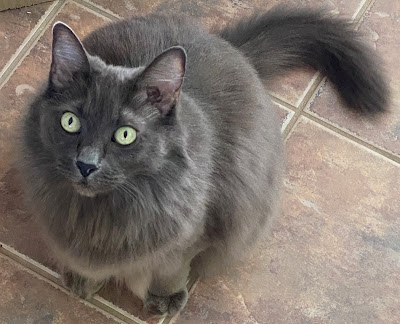
Dogs, eh? What about cats? I vote for cats being groke experts, especially if tuna or salmon is involved.

Is that a tuna sandwich in your hand??