Showing posts with label Devyn McConachie. Show all posts

Wednesday, November 17, 2021

Wednesday's Random Slang-o-rama: Higgledy-piggledy (by DMcC)


Please give three cheers for the return of my assistant Slang-o-rama-ist, Devyn McC! Devyn is a designer-editor-cartoonist, currently lurking near Portland, OR. Examples of Devyn’s work can be found at this here link and in the Slang-o-Rama archive.

-----------------------------------------------------

I'm not sure if it's the change in weather, the continued isolation, the new desk (our apartment now officially has 2.5 desks per resident—what can I say, I suppose we're deskaholics), or simply a shift of mood, but lately my brain has been a mess! 

Social media beckons, with glowing apps tempting my unfocused fingers; the fridge hums, heaving under the burden of untasted snacks; an ever-growing pile of unread books teeters next to the bed; my second-and-a-half desk wobbles fiercely, in need of a new screw… It seems that my home, like my brain, has become higgledy-piggledy mayhem.

This is what my brain/desk feels like.
https://www.pexels.com/photo/pile-of-covered-books-159751/

Now there's a thought (and a welcome distraction from my disaster of a deskspace). Whereabouts did higgledy-piggledy come from? And whence? And wherefore? And how many pigs are involved?

>
>
>
>
>
>
>
>
>
>
Let's start with definitions, as provided by the Collins Dictionary

  1. adverb: in disorder; in jumbled confusion 
  2. adjective: jumbled; confused

 Well, my desk could have told you that much! (If only I could find it under all these papers…) Collins also notes that the term arose around 1590–1600, with origin unknown.

As I rooted for etymological clues, I found one of the earliest recorded uses of higgledy-piggledy in John Florio's 1598 text A Worlde of Wordes, nestled in the definition for alla rappa: "snatchingly, higledi-pigledie, shistingly, rap and run." Entertaining, but alas, not clarifying on the "pig" puzzle.

A (guinea) pig on the desk! That explains the mess…
https://pixabay.com/photos/animal-guinea-pig-pet-cute-rodent-4988403/

The Phrase Finder notes that higgledy-piggledy is a reduplicated phrase, which uses partial repetition for amusing effect. (Regular Slang-o-rama readers might recall seeing reduplication mentioned in shilly-shally, fiddle-faddle, argy-bargy, and pish-posh.) The Online Etymology Dictionary notes that H…-P... reduplications—as in higgledy-piggledy and hanky-panky—are quite common, with many dating to the 16th century, which lines up with John Florio's text. However, Phrase Finder, the Wiktionary, and most other dictionaries I scoured claim that it's uncertain whether or not higgledy-piggledy actually has anything at all to do with pigs. (Hogwash, I say!)

On another linguistic note, the Phrase Finder also mentions higgledy-piggledy is unusual among reduplication words, because it uses a full three syllables per word, as well as being a double-dactyl. (No relation to pterodactyls, alas…) A single dactyl is a word or phrase where the first syllable is stressed, followed by two unstressed syllables (HIGG-le-dy); a double-dactyl combines two dactyls (HIGG-le-dy PIGG-le-dy), and is a popular metre form for poems and nursery rhymes.

Speaking of nursery rhymes… In my digging, I came across one by the writer Samuel Griswold Goodrich (aka Peter Barley), who was known for being "an ardent opponent of nursery rhymes [who] nearly succeeded in having them banned, along with fairy tales, from the more expensive nurseries of both England and America" (quoted from user "Wizard of Oz" at wordwizard.com). In an attempt to besmirch the rhyming craft, Goodrich once declared: "Anybody, even a child, could make one up. Listen! 

 Higglety, pigglety, pop! 

The dog has eaten the mop; 

The pig’s in a hurry, 

The cat’s in a flurry, 

Higglety, pigglety, pop!" 

 Funnily enough? This poetic satire later become the central verse of a truly delightful children's book:

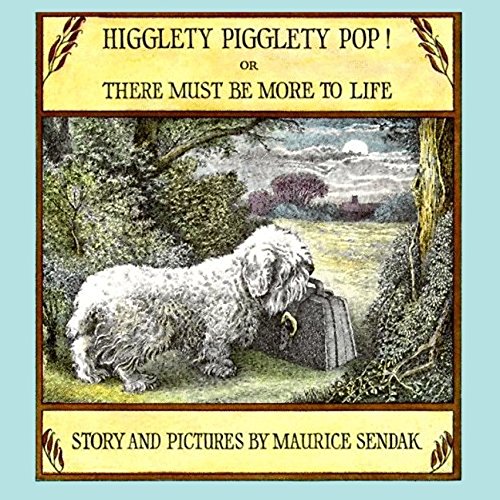
Higglety Pigglety Pop! or There Must Be More to Life
written and illustrated by Maurice Sendak, author of Where the Wild Things Are
https://images-na.ssl-images-amazon.com/images/I/61c76Xrp+7L.jpg

This classic features the exploits of Jennie, a small and hairy and intriguingly unsatisfied pooch (based on Sendak's real-life pet). She leaves home with naught but her nose in the air and a basket of snacks under her paw, looking for greener pastures and sweeter pastries elsewhere. And yes, it does involve mishap with a mop.

There's also a short film of the same name that was released in 2010, which I think perfectly captures the peculiarity of the book:


Higglety Pigglety Pop! or There Must Be More to Life from NFB/marketing on Vimeo.

With that, I feel we've found a good note to end on. I wasn't able to root out any satisfiably swine-related sources for higgledy-piggledy, and my desk isn't any cleaner, but my curiosity has been sated for now.

Wednesday, August 25, 2021

Wednesday's Random Slang-o-rama: Chicken scratch (by DMcC)


Please give three cheers for the return of my assistant Slang-o-rama-ist, Devyn McC! Devyn is a designer-editor-cartoonist, currently lurking near Portland, OR. 

Examples of Devyn’s work can be found at this here link and in the Slang-o-Rama archive.

-------------------------------

Recently I was browsing a certain bird-themed app when I came across what has become one of my favorite accounts yet: @KidsWriteJokes, which publishes “genuine joke attempts by children” … many of which are genuinely strange! These include brand-new, never-before-seen jokes:
 (I can appreciate a comedian who’s emotionally honest. Source: https://twitter.com/kidswritejokes/status/917292905357864960)


As well as new takes on old classics… 
 (The whims of a chicken are a mysterious force indeed. Source: https://twitter.com/kidswritejokes/status/1102701521005879297)

All this fowl humor reminded me of a certain tidbit of slang that’s been wandering around my mind: chicken scratch! As someone with chronically illegible lettering (y’all are lucky this blog is typed and not handwritten), I found myself wondering about the origins of this peck-uliar phrase.

Let’s see what we can dig up. 
   Ψ
Ψ 
   Ψ 
Ψ 
   Ψ 
Ψ 
   Ψ 
Ψ 
   Ψ 
Ψ 
   Ψ
.
     . 
   . 
Starting with the steadfast Merriam Webster, chicken scratch (the noun) is defined as: “an illegible or scarcely legible mark intended as handwriting.” While I didn’t find definitive evidence, most likely the term arose due to the visual similarity between illegible text and the messy footprints of a hungry chicken. (For a fine example, check out this video of chickens scratching / dancing for grubs: https://www.youtube.com/watch?v=AD37ka9NIUg)

In my poking and pecking around for etymology, I did find Green’s Dictionary of Slang noted that chicken scratch—as well as the variations chicken tracks and hen tracks—are of American origin, and have been recorded in use as far back as 1854. Here are a few actual quotes that had me cluckling—I mean, chuckling: 
  • An 1870 issue of the Lawrence Daily Journal (KS): “A stranger, who happened to see some of the aforeseaid prairie chicken tracks upon the unprinted manuscript, innocently inquired if the writer was one of the sufferers in the recent railroad accident.” 
  • An 1882 issue of the Salt Lake Herald (UT): “The horny-fisted old chicken tracks of farmer Jones when placed at the business end of a cheque.” 
  • An 1885 Bulletin from Sydney, Australia: “‘What do you think of my handwriting, and would you advise me to change it?’ […] Think you should employ another hen to scratch for you.”
To be fair, I’m sure a chicken would make a fine employee—I hear they’re great at Egg-cel spreadsheets.

According to Wiktionary, a number of other languages also have feathery phrases for bad handwriting, including: 
  • German Krähenfüße (“crow’s feet”) 
  • Vietnamese chữ như gà bới (“like letters by a chicken”) 
  • Russian как ку́рица лапой (“like a chicken’s foot”) 
  • Polish jak kura pazurem (“like a chicken with a claw”) 
  • Finnish harakanvarvas (“magpie toe”)

While the species and language vary, I think these bits o’ slang point to a universal truth: birds have pretty poor penmanship.

If you’re interested in more chicken humor, @KidsWriteJokes is a great place to start, as well as this post on the origins of the classic “why did the chicken cross the road?” by the punny and insightful newsletter Under the Henfluence. (UtH has many other fascinating chicken-related musings, including stories of chickens traveling to unexpected places.)

One final tidbit: the Oxford Dictionary notes that chicken scratch is also the name of a “type of dance music originating among the Pima and Tohono O'odham peoples of the Sonoran desert region of the United States and Mexico, blending European and Mexican influences and adapted from the polka.” Here’s an example of a chicken scratch tune—also called “Waila”—to delight your ears:
I hope that puts some pep in your step!

Wednesday, June 9, 2021

Wednesday's Random Slang-o-rama: Catnap (by DMcC)

Hello all... My assistant slang-o-rama-ist, the euphonious DMcC (aka Devyn McConachie), returns with another post for your edification. Enjoy! - Ann

Devyn McConachie is a designer-editor-cartoonist, currently lurking about Portland, Oregon. Were it not for her wobbly landlubber legs and love of indoor-living, she would absolutely have taken up a career as a sea-pirate. Landlocked as she is, she instead fills her days with graphic design, animation, illustration, and copy editing.
For more info and to view her visual portfolio, visit this here link
 She also has an Etsy shop (arts, hats, and cards) right here 
-------------------------------
As the days stretch longer and warmer, filled with buzzing of bees and rustling of leaves, I find myself more and more often nodding off in the afternoon, dazedly daydreaming of a sweet siesta... 

And I’m not alone—Ann’s office assistant, the Diva Miss Mia, is well-known for her slumbering prowess. With a snooze after every meal and regular dozes in the office, she’s always sleeping on the job. She is, undoubtedly, a master of the cat-nap.

The skilled snoozer, the Diva Miss Mia, prepares to catch her forty furry winks.

Now there’s a word! Before my eyelids droop too far, let’s see where cat-napping came from... 

>

>

 The Online Etymology Dictionary defines the noun cat-nap (also spelled catnap or cat’s nap) as “a short, light sleep,” which was first recorded in 1823; cat-nap as a verb emerged in 1859.

As I was prowling the web for more snooze clues, I came across an interesting tidbit of research: most animals have polyphasic sleep patterns, meaning that they sleep in more than one chunk each day. And according to research by historian A. Roger Ekirch, until relatively recently, we humans were polyphasic, too.

While studying letters, legal documents, medical records, and other written miscellany from before the Industrial Revolution, Ekrich came across the terms first sleep and second sleep. From context, he concluded that these were distinct periods of nighttime slumber, each lasting three or four hours, and with an hour or so of wakefulness in between. Those wee waking hours could be used for keeping watch, telling stories, interpreting dreams, committing petty crime, and any number of other activities.

How about that—two cat-naps a day, plus time to play!

-- But is she on her first or second sleep?
The Sleeping Beauty - Edward Burn-Jones, 1870-1890

And our snoozing tendencies didn’t stop with the Industrial Revolution. Consider the classic Mediterranean siesta (from the Latin sexta, or “sixth hour”), a post-lunch doze, popular in warm climates. Or how about the Japanese inemuri, the face-planting snooze of the exhausted and overworked?

Perhaps you’ve also heard of the power nap, a 10-30 minute daylight snooze (sometimes supplemented with a strong dose of coffee) for optimized productivity and cognitive performance. Somehow, though, the term power nap doesn’t hold the same appeal to me as the luxuriously lazy-sounding cat-nap.

So although the language has changed, perhaps we’ve always been catnappers at heart. As usual, maybe those cats know something that we don’t…

Two catnapping experts, hard at work.
Sleeping Girl (Girl With a Cat) - Pierre-Auguste Renoir, 1880


Wednesday, March 24, 2021

Wednesday's Random Slang-o-rama: Fish or cut bait (by DMcC)

 Hello all! I've enlisted some occasional help with Slang-o-rama from the euphonious DMcC (aka Devyn McConachie)—so look for entries such as this one to pop up from time to time! Now, a bit about our assistant slang-o-rama-ist:

Devyn McConachie is a designer-editor-cartoonist, currently lurking about Portland, Oregon. Were it not for her wobbly landlubber legs and love of indoor-living, she would absolutely have taken up a career as a sea-pirate. Landlocked as she is, she instead fills her days with graphic design, animation, illustration, and copy editing.

For more info and to view her visual portfolio, visit this here link. She also has an Etsy shop (arts, hats, and cards) right here
-----------------------------------
The idiom fish or cut bait actually has a tale of two meanings, depending on how “cut bait” is interpreted. Wikipedia provides a solid explanation for the more literal interpretation:
(1) The expression explores the merits of two options: "Fish", which refers to the act of fishing; or "cut bait", which refers to cutting up pieces of bait into small, usable portions.
[...] The original version of the expression derives from the fishing industry, in which fishermen must literally decide who is to fish, and who is to cut the bait used for fishing. Both the task of fishing, and that of cutting the bait, were considered equally important to the goal of catching fish.
Failure to contribute is not one of the offered alternatives, although "go ashore" and "go overboard" are sometimes offered as clarifying alternatives.
The Cambridge dictionary describes the second, figurative definition, now more widely used:
(2) Fish or cut bait: used to tell someone to take action or to stop saying that they will.
Fans of American idioms may recall similar phrases, such as “put up or shut up,” or the expletive-laden directive ending in “get off the pot.” For a vivid example, imagine:

A lone fisher sits in his boat, casting for fish. Perhaps his name is Santiago, and he’s had exceptionally poor luck. But for the first time in 85 days, at last, his line goes taught: a massive marlin took the bait—and then took old Santiago and his boat with it. Santiago has two choices, then: he can fish (hold on in hopes of catching the marlin), or he can cut bait (cut the line and lose the fish, but save his energy for another catch).

Or you may not have to imagine at all, since Russian artist Aleksandr Petrov created a beautifully animated rendition of this Ernest Hemingway classic, The Old Man and the Sea 

One of the earliest instances of this  “commit or quit” version of fish or cut bait appears in an 1853 legal setting. After a Wisconsin judge ruled on a land holdings case, defendant Caleb Cushing, highly displeased with the result, threatened to have the judge impeached. The judge reportedly responded: “Cushing has commenced a suit in the United States Court. [...] Cushing must either fish or cut bait.” Fish or cut bait lives on in another legal setting: a “fish or cut bait clause” in some retail rental agreements. If a tenant breaks a co-tenancy rule of the lease, which allowed them to pay lower rent, they must either pay rent in full (fish) or end the lease (cut bait). I found the usage here a little murkier to parse.

The face I make when I have to read legal documents.
By Edgar Ravenswood Waite - Waite, Edgar R. (1921) Illustrated Catalogue of the Fishes of South Australia, Adelaide, Australia: G. Hassell & Son, Public Domain, https://commons.wikimedia.org/w/index.php?curid=42580865

If you're interested in diving deeper, you can find other takes on the history of  the phrase fish or cut bait, at ReadEx Blog, Wordorigins.org, and in this post by Jan Freeman in Boston.com's "The Word" blog. 

Finally, if you’ve enjoyed this semi-literary meanderings, you might want to check out the Twitter account @MobyDickatSea, which quotes random lines from Moby Dick several times a day. I’ve found it adds a delightfully surreal twist to my timeline. And now, it is time for me to cut the line on chasing down this fishy phrase and sail off in search of another Slang-o-Rama tidbit to hang on my hook...


Wednesday, March 3, 2021

Wednesday's Random Slang-o-rama: Argy-bargy (by DMcC)

 Hello all! I've enlisted some occasional help with Slang-o-rama from the euphonious DMcC (aka Devyn McConachie)—so look for entries such as this one to pop up from time to time! Now, a bit about our assistant slang-o-rama-ist:

Devyn McConachie is a designer-editor-cartoonist, currently lurking about Portland, Oregon. Were it not for her wobbly landlubber legs and love of indoor-living, she would absolutely have taken up a career as a sea-pirate. Landlocked as she is, she instead fills her days with graphic design, animation, illustration, and copy editing.

For more info and to view her visual portfolio, visit this here link. She also has an Etsy shop (arts, hats, and cards) right here
-----------------------------------

Returning to an earlier theme, here’s another nearly-nautical-sounding phrase… argy-bargy! Alas, Ann had no luck with the boat-connection with “dory” in hunky-dory, but perhaps “bargy” will prove fruitful in this hunt for a boating idiom. Let’s find out… 

>
>
>
>
>
>
>
According Merriam-Webster Online, an argy-bargy is a “lively discussion,” or “an argument or disagreement.” Like shilly-shally from last year, argy-bargy features rhyming reduplication—a linguistic tweak where a word or word stem is repeated for expressive effect. The stem, argy, is a Scots-English term for “argue,” with first known usage as early 1839.

The Chess Game by 19th-century painter Charles Bargue (no relation to argue-bargue, but these fellows do look ready to start an argie-bargiement)
http://en.wikipedia.org/wiki/File:Bargue_The_Chess_Game.jpg, Public Domain, https://commons.wikimedia.org/w/index.php?curid=9370799

The Scottish National Dictionary, contained in the Dictionaries of the Scots Language (Dictionars o the Scots Leid, or DSL for short), offers a similar definition—according to the DSL, argy-bargy (or argie-bargie) means:

  1. (Noun) A dispute in words, a quarrel, haggling, its use generally implying impatience with the speaker. (for example: “The other [hand] gesticulating in front of Tom Reid in an argy-bargy over the amount of his charge.”)
  2. (Verb) To dispute, to haggle. (for example: “Sittin' on the corner o' the table, he argy-bargied away, but a' to no purpose.”)

 The DSL defines the root word argy (or argie) as:

  1. (Verb) To argue, [generally] in a contentious or noisy fashion.
  2. (Noun) Assertion. 

… with the noun form appearing in text as early as 1808.

 Along with argie/argy, and argy-bargy / -bargie come a whole extended Scottish family of varying spellings and sayings, brimming with rhyming reduplications. To name a few...

  • Argey-reerie: (noun) a wrangle, a scolding 
  • Arg: (verb) to talk ill-temperedly and hot-headedly 
  • Argie-bargiement: (noun) a wrangling, contention 
  • Argifee (or argufee, argufy, arguify): (verb) to argue, to signify
  • Argolling: (noun) argument, reasoning
  • Argle-bargle (or argol-bargol): (noun) Contention, dispute. (verb) to dispute
  • Argle-bargling: (verbal noun) disputation
  • Argle-bargler: (noun) contentious person, disputer, debater
  • Argle-barglous (or argol-barglous, argol-bargolous): (adjective) quarrelsome, disputatious

 The DSL notes in the entry for argle-barglous that the words argue and bargain may have been the basis for these repetitive reduplicates. To plumb the depths as far as we can...

The Online Etymology Dictionary traces the verb argue back to the 1300s, from the French arguer (“maintain an opinion or view; harry, reproach, accuse, blame”), which itself came from the Latin arguere (“make clear, make known, prove, declare, demonstrate”)... An old term indeed, no argolin’ with that!

Uh-oh, looks like someone starting an argie-baaaaahrgie
Image by suju from Pixabay

As for bargain, the same etymology dictionary cites its origin to the 1400s, based on the Old French term bargaignier (“to haggle over the price”), which itself was based on a Germanic term, likely the Proto-Germanic borgan (“to pledge, lend, borrow”). However, 19th-century German philologist Friedrich Diez suggested that the French bargaignier could, in fact, have come from the Late Latin barcaa barge!—although there aren’t many sources to back this theory.

Hmmm, a tenuous conclusion, if there is one. Personally, I’m wiffle-waffling on whether this counts as a sea term… But at this point, I’ve got to either fish or cut bait—so I’ll leave it to you to decide!

What do you think? Argy-bargy, a boat-based byword, or no?