Showing posts with label historical slang. Show all posts

Tuesday, April 11, 2023

Wednesday's Random Slang-o-rama: Whooperup

I was looking at words from "long ago and far away" and bumped into whooperup. At a guess, I thought it might describe a sound one might make while celebrating, and might perhaps be a bit of Old West slang (as in, "The cattle drive is over, let's head into town and whooperup."). Nnnnot quite.

>
>
>
>
>
>
>
>
>

According to Green’s Dictionary of Slang, whooperup is a noun meaning "a second-rate singer who produces noise rather than music." Green's notes it's of British origin and offers up a first-use date of 1909. Dusty Old Thing adds a few more adjectives with the definition of "loud and disorderly people engaged in discordant song."

Turning to Google's Ngram, I did find one reference to whooperup in an 1891 issue of Outing: An Illustrated Weekly Magazine of Sport, Travel, and Recreation (Vol. XVIII) in a chapter titled "Harry's Career at Yale." So perhaps we can nudge this non-musically-inclined word back into the 19th century...

Whooperups, whooping it up.
Image by Clker-Free-Vector-Images from Pixabay


Wednesday, February 2, 2022

Wednesday's Random Slang-o-rama: Monkeyshines

Monkeyshines. Now there's a word with an origin I can't even begin to guess. Time to hit the wondrous world of the internet!

>
>
>
>
>
>
>
>
>
>
>
>
According to the online Merriam-Webster, monkeyshine (which is usually used in the plural) means mischievous or playful activity. The Online Etymology Dictionary gives it an origin date of 1832, adding: 

from monkey (n.) + shine (n.) "a caper, trick" (1835), from an American English slang sense perhaps related to the expression cut a shine "make a fine impression" (1819).... For sense of the whole word, compare Old French singerie "disreputable behavior," from singe "monkey, ape."

 The Word Detective also addresses monkeyshines, in a fascinating (and more lengthy) dive with asides about other monkey-themed phrases:

“Monkeyshine,” a US coinage dating back to the early 19th century meaning a prank, trick or just boisterous behavior, is one of several English words and phrases that draw parallels, usually not very negative, between human and playful simian behavior. “Monkey business,” “monkey around,” “more fun than a barrel of monkeys,” “monkey see, monkey do,” etc., all make being a monkey sound like a lot more fun than it probably is. “Monkeyshines” may land you on probation at college or even cost you your job, but you’re unlikely to land in the slammer by monkeying around (unless “monkeyshines” is used, as it sometimes is, in a sarcastic sense to mean serious ethical or legal violations). 
The “shine” in “monkeyshine” is a colloquial term, also dating back to the early 19th century, with a number of meanings. “Shine” in this sense can mean “a party” (as in “tea-shine”), “a ruckus or commotion,” “a fancy for” (as in “take a shine to”), or simply “a trick or caper” (“‘I’ll boun you pulled ’em out, some o’ your shines,’ said Aunt Chloe,” Harriet Beecher Stowe, Uncle Tom’s Cabin, 1852). The origins of this “shine” are uncertain. It may be simply a specialized use of “shine” in the sense of “radiance.” But it may also be related to the dialectical terms “shindy” and “shinty,” both used to mean “commotion,” and both related to “shinny,” a game similar to field hockey dating back to the 17th century.

Wow... field hockey?? Now there's a connection to monkeyshines that would have never occurred to me. And if you read this little conversation over on The Phrase Finder, there may even be a connection to moonshine, as in illicit liquor. 

Definitely a word with a lot of history and a bit of mystery in its origins...

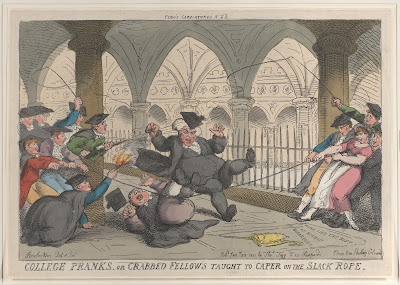
College monkeyshines, before monkeyshines was a word
By Template:Thomas Rowlandson - This file was donated to Wikimedia Commons as part of a project by the Metropolitan Museum of Art. See the Image and Data Resources Open Access Policy, CC0, https://commons.wikimedia.org/w/index.php?curid=92707011

Wednesday, December 15, 2021

Wednesday's Random Slang-o-rama: Spondulicks (or spondulics or spondulix or...)

I'm making a list, checking it twice, and getting ready for a quick shopping spree. This spree requires that I crack open the piggybank and check the spondulicks within. Wait... does anyone even use piggybanks anymore? It's probably almost as ancient a concept as our Slang-o-rama word o' the week, spondulicks....

>
>
>
>
>
>
>
>
>
According to Merriam-Webster, spondulicks is slang for money or funds. Go back far enough, and it was used to mean fractional currency. M-W claims the origin and etymology of the word is unknown. As you probably know, I never take "unknown" at face value, so away we go, delving into the shadowy corners of the internet and the depths of my reference books in search of the whens and wheres of spondulicks.

To my delight, World Wide Words has a lovely piece on the word, opening with:

Though originally a bit of mid-nineteenth-century American slang for money, this has travelled widely, being cast up on the shores of Britain and Australia among other places. It’s a member of a group of words created in a century-long fit of logographical exuberation which also gave us slumgullion, rambunctious, and absquatulate...

(Note to self: must find an occasion in which to use the phrase "logographical exuberation.")  World Wide Words does such a great job, that I'll quote their post some more:

...It would seem from the evidence that spondulicks (either so spelled or as spondulix) was originally American college slang. One of its earliest appearances was in a piece about college life in the New York magazine Vanity Fair in 1860: “My friend the Senior got out of spondulix, and borrowed [my watch] to spout for the purpose of bucking the Tiger” (to interpret, his friend had run out of money and pawned the watch to get some more cash in order to gamble on cards, probably faro).

This reference to the game of faro (aka bucking the tiger) has me thinking I'll have to find a way to weave spondulicks into a bit of dialogue in some future Silver Rush story. 

Plenty of spondulicks exchanged hands while bucking the tiger
The game of faro as depicted by John David Borthwick in California, 1851
http://www.library.yale.edu/beinecke/customs3.htm
Public Domain, https://commons.wikimedia.org/w/index.php?curid=7876330

WWW notes that the word appears in the writings of O. Henry and Bret Harte, which is very nifty indeed, but what about its evolution? That's a story and a bit of a mystery in and of itself, according to the post. WWW lays it all out in such a delightful manner, I have to share the explanation with you:

Where does it come from? “A fanciful coinage”, the Oxford English Dictionary says. It has been described as a “perverted and elaborated” form of greenback (you may feel that to believe spondulicks could come from greenback requires a perverted imagination all its own). Eric Partridge suggests that it might derive from Greek spondulikos, from spondulos, a species of shell once used as money.

 However, Doug Wilson pointed out that that Greek stem is also the source of various English words beginning in spondylo– that refer to the spine or vertebrae. He suggested that a stack of coins may have been likened to the spine, with each coin a vertebra. He found a supporting reference in an 1867 book, A Manual of the Art of Prose Composition: for the Use of Colleges and Schools, by John Mitchell Bonnell. A list of provincialisms included: “Spondulics — coin piled for counting”.

 I found the word (spelled spondulics) on my bookshelf, in my three-volume Green's Dictionary of Slang (which you can also view online), with the earliest print appearance cited being in a 1856 parody of Henry Wadsworth Longfellow's "The Song of Hiawatha," titled "Plu-ri-bus-tah." The parody was written by Q. K. Philander Doesticks, the pseudonym for U.S. journalist/humorist Mortimer Thomson, who was apparently quite a character himself. (Thomson's Wikipedia entry says he was expelled from Michigan University for, perhaps "for "too much enterprise in securing subjects for the dissecting room.")

Well! I have wandered far afield here, but research is soooooo much fun! However, I must now tote up the spondulicks I have on hand and see what Santa can offer up this year...

Dori, Public domain, via Wikimedia Commons

Wednesday, November 17, 2021

Wednesday's Random Slang-o-rama: Higgledy-piggledy (by DMcC)


Please give three cheers for the return of my assistant Slang-o-rama-ist, Devyn McC! Devyn is a designer-editor-cartoonist, currently lurking near Portland, OR. Examples of Devyn’s work can be found at this here link and in the Slang-o-Rama archive.

-----------------------------------------------------

I'm not sure if it's the change in weather, the continued isolation, the new desk (our apartment now officially has 2.5 desks per resident—what can I say, I suppose we're deskaholics), or simply a shift of mood, but lately my brain has been a mess! 

Social media beckons, with glowing apps tempting my unfocused fingers; the fridge hums, heaving under the burden of untasted snacks; an ever-growing pile of unread books teeters next to the bed; my second-and-a-half desk wobbles fiercely, in need of a new screw… It seems that my home, like my brain, has become higgledy-piggledy mayhem.

This is what my brain/desk feels like.
https://www.pexels.com/photo/pile-of-covered-books-159751/

Now there's a thought (and a welcome distraction from my disaster of a deskspace). Whereabouts did higgledy-piggledy come from? And whence? And wherefore? And how many pigs are involved?

>
>
>
>
>
>
>
>
>
>
Let's start with definitions, as provided by the Collins Dictionary: 

  1. adverb: in disorder; in jumbled confusion 
  2. adjective: jumbled; confused

 Well, my desk could have told you that much! (If only I could find it under all these papers…) Collins also notes that the term arose around 1590–1600, with origin unknown.

As I rooted for etymological clues, I found one of the earliest recorded uses of higgledy-piggledy in John Florio's 1598 text A Worlde of Wordes, nestled in the definition for alla rappa: "snatchingly, higledi-pigledie, shistingly, rap and run." Entertaining, but alas, not clarifying on the "pig" puzzle.

A (guinea) pig on the desk! That explains the mess…
https://pixabay.com/photos/animal-guinea-pig-pet-cute-rodent-4988403/

The Phrase Finder notes that higgledy-piggledy is a reduplicated phrase, which uses partial repetition for amusing effect. (Regular Slang-o-rama readers might recall seeing reduplication mentioned in shilly-shally, fiddle-faddle, argy-bargy, and pish-posh.) The Online Etymology Dictionary notes that H…-P... reduplications—as in higgledy-piggledy and hanky-panky—are quite common, with many dating to the 16th century, which lines up with John Florio's text. However, Phrase Finder, the Wiktionary, and most other dictionaries I scoured claim that it's uncertain whether or not higgledy-piggledy actually has anything at all to do with pigs. (Hogwash, I say!)

On another linguistic note, the Phrase Finder also mentions higgledy-piggledy is unusual among reduplication words, because it uses a full three syllables per word, as well as being a double-dactyl. (No relation to pterodactyls, alas…) A single dactyl is a word or phrase where the first syllable is stressed, followed by two unstressed syllables (HIGG-le-dy); a double-dactyl combines two dactyls (HIGG-le-dy PIGG-le-dy), and is a popular metre form for poems and nursery rhymes.

Speaking of nursery rhymes… In my digging, I came across one by the writer Samuel Griswold Goodrich (aka Peter Barley), who was known for being "an ardent opponent of nursery rhymes [who] nearly succeeded in having them banned, along with fairy tales, from the more expensive nurseries of both England and America" (quoted from user "Wizard of Oz" at wordwizard.com). In an attempt to besmirch the rhyming craft, Goodrich once declared: "Anybody, even a child, could make one up. Listen! 

 Higglety, pigglety, pop! 

The dog has eaten the mop; 

The pig’s in a hurry, 

The cat’s in a flurry, 

Higglety, pigglety, pop!" 

 Funnily enough? This poetic satire later become the central verse of a truly delightful children's book:

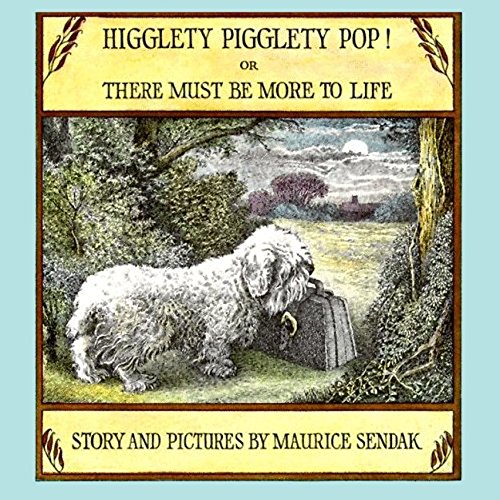
Higglety Pigglety Pop! or There Must Be More to Life
written and illustrated by Maurice Sendak, author of Where the Wild Things Are
https://images-na.ssl-images-amazon.com/images/I/61c76Xrp+7L.jpg

This classic features the exploits of Jennie, a small and hairy and intriguingly unsatisfied pooch (based on Sendak's real-life pet). She leaves home with naught but her nose in the air and a basket of snacks under her paw, looking for greener pastures and sweeter pastries elsewhere. And yes, it does involve mishap with a mop.

There's also a short film of the same name that was released in 2010, which I think perfectly captures the peculiarity of the book:
 

Higglety Pigglety Pop! or There Must Be More to Life from NFB/marketing on Vimeo.

With that, I feel we've found a good note to end on. I wasn't able to root out any satisfiably swine-related sources for higgledy-piggledy, and my desk isn't any cleaner, but my curiosity has been sated for now.

Wednesday, November 10, 2021

Wednesday's Random Slang-o-rama: The cat's pajamas (and a hurrah for MORTAL MUSIC)

I was looking up lists of cat- and dog-related sayings and slang when I bumped into the cat's pajamas. Cats... and pajamas? What a strange pairing. When, how, and why did it come about?
So, off I went, a-searching for more.

>
>
>
>
>
>
>
>
(Randi Platt's Slang-o-Matic would certainly come in handy for this!)

>
>
>
>
>
>
>
>

Merriam-Webster defines this phrase as "a highly admired or exceptionally excellent person or thing," and dates it to 1922. Wiktionary notes that the cat's pajamas became popular at the same time that phrases such as the bee's knees, cat's whiskers, and so on gained prominence. Wiktionary also referenced a New York Time's article from November 6, 1922, titled "Pajama Girl and Cats Out" in which a young woman in silk pajamas was spotted strolling along Fifth Avenue, leading four similarly-clad cats on leashes. I'd love to do a screen capture of that short article and put it here, but unsure about copyright issues, I'll just offer the link to the article and hope you can view it yourself.

The Phrase Finder also has a nice post on the cat's pajamas, adding an earlier sighting of the sentence "Wouldn't that beat the cat's pajamas?" in a February 1918 edition of The Pageland Journal, a South Carolina newspaper. Phase Finder also notes that cat was flapper slang for fashionable young woman, and that the phrase the cat's pajamas was so fashionable in the 1920s, it was attached to "a dance, a stage show, a song, a film, even the name of a style of furry underwear." (Oh my!)

By Paramount Pictures - Motion Picture News
Public Domain, https://commons.wikimedia.org/w/index.php?curid=57788679


____________________________

Extra! Extra! MORTAL MUSIC Wins Silver

I'm excited to announce that MORTAL MUSIC received the "Silver" (second place) Will Rogers Medallion Award in the Maverick category! I was unable to attend the ceremony, but it was recorded. You can view it on YouTube and hear/see what they say about the book at the 36:25 mark. My favorite quote from the one-minute segment: "Inez Stannert is one of the most memorable characters to grace the pages of a western novel." 

Now isn't THAT the cat's pajamas! :-)

____________________________

.... Late-breaking bonus! I found a piano rendition of the 1920s tune "The Cat's Pajamas" on YouTube. So, if your day could use a little toe-tapping music, click below and enjoy!

Wednesday, November 3, 2021

Wednesday's Random Slang-o-rama: Slang-o-Matic Extravaganza by Guest Author Randall Platt

Please welcome honored guest author and serious slang aficionado, Randall Platt (aka "that Platt woman").  So just who is this Randall Platt?
Taking the words right from her mouth: She writes fiction for adults and young adults and people who don’t own up to being either. A three-time winner of the WILLA Literary award for young adult fiction, she has been a finalist for the Washington State Book Award three times, in addition to winning several other state and national awards. Check out her three latest novels, all dripping with slang! 
Her books are available at bookstores everywhere and online outlets galore, but, as Randi points out, it sure is good to support your local indie bookstore. She adds, "I am on Facebook, but only as a real person, not a writer—not that a writer can’t be a real person, too. I guess." www.plattbooks.com

-------------------------------------------------------------------------

Thanks for the guest spot, Ann! 

When folks learn about my passion for slang and the resulting interactive database I created, which I call Slang-O-Matic, the first thing they ask is, ‘How did this monstrosity all come about?’ Honestly? It all came about with a book review. The reviewer had questioned some terms I used in my first novel, The Four Arrows Fe-As-Ko (1992) about four mentally and physically challenged adults running the largest cattle ranch in Eastern Oregon. I did my due diligence and researched the heck out of the language of the day, the situation, and the people. From that point on, I decided I would create a database of the terms I used, especially since that novel was the first book in a three-book series. I was able to keep the language and the slanguage consistent from book to book. Handy, huh?
Gosh, I sure like Slang-O-Matic. I can’t wait to say THAT to Mom!

Well, as with many things in a writer’s life, my database took on much larger proportions and grew with each subsequent novel involving other eras and situations. I finally trademarked my tag line:
Slang-O-Matic—for the color of our speech.
Because we don’t speak,
nor should we write,
in black and white. 

What’s interesting to me as I explore the ‘history’ of a term, is how the internet and social media and of course, television and film, changed how a term can come into being and spread in an instant. Slang from the 19th Century and earlier took about ten years to ‘make the rounds.’ Today, a word can come in and out of favor within days. And of course, we writers need to be aware of that and make sure our readers of tomorrow will understand the slang of today. Conversely, readers of today might not understand the slang of yesterday. Proceed with caution. Everything needs to be in context.
Wow, according to Slang-O-Matic, there are over 174 references to coke
and not one of them referring to what’s in my hand.
Take for instance the common word ‘bug.’ According to Slang-O-Matic, there are 135 slang entries that contain ‘bug.’ It can mean anything from a bribe, to annoy, a crazy person, a cheating device, a jockey’s weight allowance, a tie pin, a bad student, a germ, to a strong desire to cheap tobacco. 

It seems the more taboo a subject is, the more slang surrounds it—take for instance the lower portions of one’s body. I count 221 terms which might be medical slang or street slang or child-speak for such areas and their functions. I will never want for a great slang term for one’s behind or procreation apparatus.

Why call a cab when you can call a ramble, a trip, a coffee grinder, a cracker box, a flapdoodle, a jarvey, or a jar box? Why call a drunk a drunk when you can choose from alki stiff, belch-guts, blossom-nose, boozington, bottle baby, croak, dipso, gin head, glow worm, light-house (big glowing red nose), soak, swillpot, malt-worm, drain pipe, or my personal favorite, a lush merchant? 

Folks usually wonder how I use my database for my own work. Since I have eight fields of information for each of my 43,000 (and counting) entries, I can easily manipulate the database for my needs. For instance, I am current working on book which takes place in the 1930s and my characters are from the fortune telling trades, the banking trades, the radio trades, and the con artistry trades. I have broken terms down to hundreds of categories - so, for this book, I call up slang and cant from the banking, carnival, con artist, and radio industries. Then I sort the terms by the date and my database returns a list of the terms used from 1920 to 1940, to cover the approximate timeline of my novel. So, if my conservative banking character needs to delicately refer to a woman as a whore, I can chose from my list of over 375 terms for ‘whore’: 
  • pro skirt 
  • QT cutie 
  • trick babe 
  • charity girl 
  • soft lady 
  • two-by-four (rhymes with ‘whore’) 
  • soft lady 
  • B-girl 
  • behavior problem 
  • boulevard woman 
  • clever girl 
 Now, my con artist character, being much more worldly and of the streets herself, might refer to that same whore in much less charitable terms, such as 
  • artichoke 
  • blisterine 
  • blowser 
  • brass nail 
  • hat rack 
  • jump 
  • mudkicker 
  • notch girl 
  • round heel 
  • scupper 
See the difference? Fun, huh?
 
So what began as someone questioning some terms I used decades ago as anachronistic, has evolved into those editors, writers, and book reviewers coming to me with their questions. I am certainly not the world’s foremost expert on slang, but I sure as heck know a thing or two by now. I always welcome questions regarding this along with any idea as to how to exploit all this work. 

Help! Before I slang again! 
Oh, dear. Billy’s been reading Slang-O-Matic again!


Wednesday, October 27, 2021

Wednesday's Random Slang-o-rama: Scaredy cat

 Halloween  comes a-creepin' on little cat feet (apologies to Carl Sandberg and his poem Fog), so delving into the phrase scaredy cat seems very appropriate.

>
>
>
>
>
>
>
>
>
>
>
>
>
>
>
>
>
>
>
>
Scaredy cat was a common childhood taunt when I was growing up. However, I suspect this term, which is defined by Merriam-Webster as "an unduly fearful person," is much older than mid-20th century. Sure enough, M-W dates it to 1904. The Online Etymological Dictionary punts it forward a couple of years to 1906. Idiom Origins says this "children's slang" first appeared in 1930. Whaaaat?? Time to consult Google Ngram, methinks. 

From there, the earliest I could find was 1906, in the children's book Billy Bounce, by Dudley A. Bragdon, in the following passage.

WordSense credits Dorothy Parker with coining the phrase in 1933, in her short piece,"The Waltz." However, Billy Bounce in 1906 clearly beats her to it.

In any case, scaredy cat is not as "old" as I'd like it to be (here's hoping I haven't used it in one of my Silver Rush books somewhere!), but still far older than I am.

Wishing you a peaceful Halloween, and keep your pets safe! No scaredy cats or scaredy dogs, please. 

Image by YuliaSlept from Pixabay


Image by YuliaSlept from Pixabay

Wednesday, October 20, 2021

Wednesday's Random Slang-o-rama: Ragamuffin

I was on the hunt for words with a Halloween connection (besides those I've covered in the past, including heebie-jeebies, bugaboo, in a dither, and ghouls and vampires) when I bumped into ragamuffin, a word with an interesting history!

>
>
>
>
>
>
>
... And, as you probably know, I'm all about words (and phrases!) with interesting histories.

>
>
>
>
>
>
>
>
>
>
>
At Merriam-Webster, I learned that ragamuffin first appeared in relation to Thanksgiving before drifting back a month in the calendar to Halloween:

Ragamuffin has a long-established history of referring to a ragged person, but in the early 19th century the word became associated with the children who would dress up for Thanksgiving as ragamuffins and parade asking for handouts, parodying begging and beggars. Though these "ragamuffin parades" died out, children continue to dress up, but now on Halloween.

M-W adds that the word has several definitions, besides the common one listed above, including "a type of music (also known as raggamuffin or ragga), and a demon in the 14th-century poem Piers Plowman." The origin of the word, according to M-W, is "uncertain," but goes waaaay back.

In Middle English the word functioned both as a surname and generically to denote a ragged and sometimes stupid person.... The muffin part of the word may have its origin in either of two Anglo-Norman words for a devil or scoundrel, but that too is uncertain. As English lexicographer Samuel Johnson put it, "From rag and I know not what else."
Well, if Samuel Johnson "knows not," then I suppose Slang-o-rama can rest easy. But not quite yet, because the Online Etymological Dictionary has the following:

Ragamuffin. mid-14c., "demon;" late 14c., "a ragged lout," also in surnames (Isabella Ragamuffyn, 1344), from Middle English raggi "ragged" ("rag-y"?) + "fanciful ending" [OED], or else perhaps second the element is Middle Dutch muffe "mitten." 

OED also added a little fascinating info on the related word ragged: 

Ragged was used of the devil from c. 1300 in reference to his "shaggy" appearance. Raggeman (late 13c. as a surname, presumably "one who goes about in tattered clothes") was used by Langland as the name of a demon (late 14c.), and compare Old French Ragamoffyn, name of a demon in a mystery play. Sense of "dirty, disreputable boy" is from 1580s. Also compare ragabash "idle, worthless fellow" (c. 1600). 
Hmmmm. It seems both rag and muffin have connections to "devil." Sure enough, I found the following from a post titled "What the Deuce, Or, Etymological Devilry"on Oxford University Press:
...Sometimes we discover only the root of the name we investigate. Such is rag(g)-, known in Swedish, Lithuanian, English (the first element of ragamuffin; its second element, -muff-in, also means “devil,” from the French word for “ugly”), and possibly Italian, if ragazzo “boy” formerly meant “imp” (this ragg– is not related to rag “a piece of cloth”)

Before you go, let's re-visit Merriam-Webster's tale of ragamuffin parades....

The use of ragamuffin to describe "a child in masquerade costume" started in the late 19th century, in reference to the children who dressed up on Thanksgiving Day for what was called "Thanksgiving masking." This strange custom began as a parody of begging. Children dressed in costumes, often as ragamuffins, and begged for handouts for their Thanksgiving meals; they often received fruit, pennies, and candy. The practice became so widespread that Thanksgiving was nicknamed "Ragamuffin Day," and cities and towns began holding parades in which children could don their costumes and march. By 1930, the parades and tradition began to wane....  By the mid-1900s, the Thanksgiving ragamuffin became a thing of the past. The practice of dressing up and going out to beg, however, lived on in another holiday—Halloween.

So, when those little ragamuffins come knocking on your door on October 31, be kind. Treats only—no tricks or turkeys!

Back in the day. (Ragamuffin parade, circa 1910)
Library of Congress https://www.loc.gov/pictures/item/2014694901/)


Wednesday, October 13, 2021

Wednesday's Random Slang-o-rama: Whistle britches

 I bumped up against the phrase whistle britches, and thought whaaaaaaat??

So do any of you know what whistle britches means? Or where it came from?

>
>
>
>
>
>
>
>
>
>
>
>
>
>
>
>
>
>
>

Well, this is what I found....

A Way with Words defines whistle britches as "a Southern term for fellows who draw a lot of attention to themselves, comes from the sound corduroy trousers make when you walk and the wales rub against each other" and has a short (5-minute) audio session about whistle britches. (A Way with Words is a fascinating site, btw... heartily recommended for word nerds. I can personally attest that there is great danger of falling in and not emerging for some hours. But back to britches...)

A Google group conversation dove into whistle britches back in 1995 (egads, they had Google groups that far back??). You can read the thread here. The previous definition comes up in the discussion, but one poster said that's wrong, adding "it's a southern term of endearment meaning someone who is very physically attractive, especially in jeans, slacks, etc that because of such could garner whistles from men because of her figure." Another poster said this is a Southern term dating to the Depression era for someone who suffers from (ahem) flatulence. A third comments "My father called me 'whistle britches' affectionately. He grew up during the depression (but on the North Shore of Massachusetts). I thought it referred to one whose pants had so many holes the wind whistled through them."

Words and Phrases of the Past defines it as the trousers themselves, aka "corduroy pants," and provides a date of 1900. My hardcopy of Green's Dictionary of Slang agrees with that definition (although opting for whistling-BREECHES). For reference, Green's points to (taking a deeep breath here) Slang and its analogues past and present. A dictionary, historical and comparative of the heterodox speech of all classes of society for more than three hundred years. With synonyms in English, French, German, Italian, etc (Vol. VII) by John Stephen Farmer and William Ernest Henley, publication date 1904. I checked it out, and sure enough, there it is!

To add to the etymological variety of this phrase, The Online Slang Dictionary defines whistle britches as "a term for anybody whose name you don't know."

Choices, choices. I guess that if I ever use the term whistle-britches/breeches in a story, I'd better define it.

Whistle while you walk in a pair of these.
Image by tookapic from Pixabay

Wednesday, September 1, 2021

Wednesday's Random Slang-o-rama: Cold shoulder

 The protagonist of my Silver Rush series, Inez Stannert, has been known to give the cold shoulder to those who deserve it (and even to a few who do not!). So, was she acting in her timeframe (1880s) when exhibiting this display of contempt?

>
>
>
>
>
>
>
>
>
>
>>
>
>
>
>
>
>
>
Well, of course she was! According to American Slang, 2nd Edition by Robert L. Chapman and Barbara Ann Kipfer, cold shoulder as a noun phrase was in use by 1816, well before Inez was born. Defined as "a deliberate snub; display of chilly contempt," cold shoulder also became a verb form by 1845. 

The Phrase Finder has a few words to say about this phrase:

The origin of this expression which is often repeated is that visitors to a house who were welcome were given a hot meal but those who weren't were offered only "cold shoulder of mutton." This is repeated in several etymological texts, including Hendrickson's usually reliable Encyclopedia of Word and Phrase Origins. There's no evidence to support this view though and it appears to be an example of folk etymology. 
The post goes on to note that the first printed reference appears in Sir Walter Scott's 1816 The Antiquary, a "novel of manners," as follows: 
The Countess’s dislike didna gang farther at first than just showing o’ the cauld shouther.

What else can I say besides... (here it comes).... Great Scott! 
(Thanks goes to Susan Knilans for suggesting cold shoulder as a Slang-o-rama topic.)

An elegant "cold shoulder." (I love this portrait!)
 Madame X (Madame Pierre Gautreau) By John Singer Sargent
This file was donated to Wikimedia Commons as part of a project by the Metropolitan Museum of Art. See the Image and Data Resources Open Access Policy, CC0, https://commons.wikimedia.org/w/index.php?curid=56723870


Wednesday, August 25, 2021

Wednesday's Random Slang-o-rama: Chicken scratch (by DMcC)


Please give three cheers for the return of my assistant Slang-o-rama-ist, Devyn McC! Devyn is a designer-editor-cartoonist, currently lurking near Portland, OR. 

Examples of Devyn’s work can be found at this here link and in the Slang-o-Rama archive.

-------------------------------

Recently I was browsing a certain bird-themed app when I came across what has become one of my favorite accounts yet: @KidsWriteJokes, which publishes “genuine joke attempts by children” … many of which are genuinely strange! These include brand-new, never-before-seen jokes:
 (I can appreciate a comedian who’s emotionally honest. Source: https://twitter.com/kidswritejokes/status/917292905357864960)


As well as new takes on old classics… 
 (The whims of a chicken are a mysterious force indeed. Source: https://twitter.com/kidswritejokes/status/1102701521005879297)

All this fowl humor reminded me of a certain tidbit of slang that’s been wandering around my mind: chicken scratch! As someone with chronically illegible lettering (y’all are lucky this blog is typed and not handwritten), I found myself wondering about the origins of this peck-uliar phrase.

Let’s see what we can dig up. 
   Ψ
Ψ 
   Ψ 
Ψ 
   Ψ 
Ψ 
   Ψ 
Ψ 
   Ψ 
Ψ 
   Ψ
.
     . 
   . 
Starting with the steadfast Merriam Webster, chicken scratch (the noun) is defined as: “an illegible or scarcely legible mark intended as handwriting.” While I didn’t find definitive evidence, most likely the term arose due to the visual similarity between illegible text and the messy footprints of a hungry chicken. (For a fine example, check out this video of chickens scratching / dancing for grubs: https://www.youtube.com/watch?v=AD37ka9NIUg)

In my poking and pecking around for etymology, I did find Green’s Dictionary of Slang noted that chicken scratch—as well as the variations chicken tracks and hen tracks—are of American origin, and have been recorded in use as far back as 1854. Here are a few actual quotes that had me cluckling—I mean, chuckling: 
  • An 1870 issue of the Lawrence Daily Journal (KS): “A stranger, who happened to see some of the aforeseaid prairie chicken tracks upon the unprinted manuscript, innocently inquired if the writer was one of the sufferers in the recent railroad accident.” 
  • An 1882 issue of the Salt Lake Herald (UT): “The horny-fisted old chicken tracks of farmer Jones when placed at the business end of a cheque.” 
  • An 1885 Bulletin from Sydney, Australia: “‘What do you think of my handwriting, and would you advise me to change it?’ […] Think you should employ another hen to scratch for you.”
To be fair, I’m sure a chicken would make a fine employee—I hear they’re great at Egg-cel spreadsheets.

According to Wiktionary, a number of other languages also have feathery phrases for bad handwriting, including: 
  • German Krähenfüße (“crow’s feet”) 
  • Vietnamese chữ như gà bới (“like letters by a chicken”) 
  • Russian как ку́рица лапой (“like a chicken’s foot”) 
  • Polish jak kura pazurem (“like a chicken with a claw”) 
  • Finnish harakanvarvas (“magpie toe”)

While the species and language vary, I think these bits o’ slang point to a universal truth: birds have pretty poor penmanship.

If you’re interested in more chicken humor, @KidsWriteJokes is a great place to start, as well as this post on the origins of the classic “why did the chicken cross the road?” by the punny and insightful newsletter Under the Henfluence. (UtH has many other fascinating chicken-related musings, including stories of chickens traveling to unexpected places.)

One final tidbit: the Oxford Dictionary notes that chicken scratch is also the name of a “type of dance music originating among the Pima and Tohono O'odham peoples of the Sonoran desert region of the United States and Mexico, blending European and Mexican influences and adapted from the polka.” Here’s an example of a chicken scratch tune—also called “Waila”—to delight your ears:
I hope that puts some pep in your step!

Wednesday, July 21, 2021

Wednesday's Random Slang-o-rama: Asleep at the switch

I suddenly realized that, yes, Wednesday is nearly over and I have not posted Slang-o-rama! I am definitely asleep at the switch this week. That is, unprepared; lacking alertness; inattentive...

>
>
>
>
>
>
>
>
>
>
>
>
>
>
... at least, that is how Heavens to Betsy and Other Curious Sayings, by Charles Earle Funk, defines it.

According to Funk, this "American expression" relates to the railroads and is almost literal in meaning:

It dates from the time when railroad switches or turnouts were thrown or turned by levers operated by hand, either by switch-tenders or brakemen. In a freight yard especially, where it was the duty of the switch-tender to shunt cars to the proper tracks, alertness was an essential. Lack of attention gave rise to the charge that he was asleep at the switch.

Curious to see if I could find out more (first appearance of this idiom, perhaps?) I turned to the internet. In Idioms in the News - 1,000 Phrases, Real Examples by Peter Bengelsdorf, I found the following passage:


Well, now I had to chase down the poem itself. I found "Asleep at the Switch" here, on the site Poetry Nook (which unfortunately is littered with annoying ads).

I also found a reference to an 1897 ballad by that title, which again references Hoey's poem.

I even found a video of a reading of the poem on YouTube, with some great old-time piano music in the background... 

I hope this sudden flurry of activity and research will absolve me from being late with this week's post!

It's already Wednesday??
Image by Hands off my tags! Michael Gaida from Pixabay


Wednesday, July 14, 2021

Wednesday's Random Slang-o-rama: Ultracrepidarian

 Ultracrepidarian is a "lost word" that I'd be tempted to fling about on occasion. The Little Book of Lost Words by Joe Gillard defines it as "a person with opinions on subjects beyond their knowledge" and dates it from the 19th century.

Let's see if we can narrow down the first appearance of this seven-syllable obscurity.

>
>
>
>
>
>
>
>
>
>
>
>
>
According to Word Histories, ultracrepidarian can also be an adjective, in which case it's defined as "expressing opinions on matters outside the scope of one’s knowledge or expertise" (which certainly makes sense). The Word Histories post gives a detailed rundown on the word's origins and first appearance:

...This word was specifically invented to qualify the English poet and critic William Gifford (1756-1826)... The son of a glazier, Gifford served an apprenticeship to a shoemaker before... attending Exeter College, Oxford; he was, from 1809 to 1824, the first editor of The Quarterly Review. 
With reference to the fact that William Gifford had been a shoemaker’s apprentice, ultracrepidarian alludes to the remark "ne supra crepidam sutor iudicaret", "the cobbler should not judge beyond his shoe"**, attributed to the painter Apelles in response to criticism from a shoemaker, in Naturalis Historia (The Natural History – 77), a vast encyclopaedia of the natural and human worlds by the Roman statesman and scholar Pliny the Elder (23-79). This anecdote is the origin of the proverb let the cobbler stick to his last. (The word ultracrepidarian is from Latin ultra, meaning beyond, and crĕpĭda (from Greek κρηπίς [= krēpís]), denoting the sole which served the Greeks, and the Romans who adopted Grecian habits, as a shoe, a sandal.) 
The word ultracrepidarian was first used as an adjective qualifying the noun "critic" by the English writer and painter William Hazlitt (1778-1830) in A Letter to William Gifford, Esq. (London, 1819):  
...Your overweening self-complacency is never easy but in the expression of your contempt for others; like a conceited mechanic in a village ale-house, you would set down every one who differs from you as an ignorant blockhead; and very fairly infer that any one who is beneath yourself must be nothing. You have been well called an Ultra-Crepidarian critic. 
In 1823, James Henry Leigh Hunt (1784-1859), English poet, journalist and critic, published Ultra-Crepidarius, a satirical poem on William Gifford.

Whoa! Sounds like William Gifford pissed off some highly literate people in his day. According to his bio in Wikipedia, that indeed appears to be the case. 

So, go ahead, and fling that word around. There are plenty of ultracrepidarians in today's world as well. (If the shoe fits...)

"A pair of shoes" by Vincent van Gogh (1887)
The Baltimore Museum of Art, Public Domain, https://commons.wikimedia.org/w/index.php?curid=27368228

------------------

** If you want to know more about this phrase, click here (Wikipedia is your friend). 


Wednesday, June 2, 2021

Wednesday's Random Slang-o-rama Redux and News Flash: Knock me down with a feather


I have news to share, and an idiom to go with it...

MORTAL MUSIC, the seventh book in my Silver Rush series, has been nominated for the 2021 Macavity / Sue Feder Memorial Award for Best Historical Mystery! 

When I heard about this, well, you could have knocked me down with a feather. Given that MORTAL MUSIC was released just before the pandemic hit, I felt sure people were focused on things other than reading (things like stocking up on toilet paper and researching where to buy hand sanitizer and jigsaw puzzles). So yes, I am surprised, but happily so, and honored to be included with such a fine group of Macavity nominees!

>
>
>
>
>
>
>
>
>
>
>
>
>
>

As for knock me down (or over) with a feather, yep, I already looked at this idiom at the end of 2018. But I kinda forgot about all that in my excitement, and researched it all again, so pardon the (partial) repetition below.

In this discussion in Quora, one responder noted its written appearance in Porcupine's Works; Containing Various Writings and Selections, Exhibiting a Faithful Picture of the United States of America, Volume 4 by William Cobbett, in 1801. Another pointed to a StackExchange exchange, which mentions the same Cobbett reference (with a slightly earlier date of 1796), and an even earlier variant—beat me down with a feather—in Samuel Richardson's Pamela; or, Virtue Rewarded (1740). And of course, as someone else pointed out, once you see a phrase like this in print, you know it has probably been circulating for a while in the spoken word.

Defined as "extremely astonished, surprised" by Merriam-Webster Online, I'd say knocked down with a feather sums up exactly how I feel right now.

And if you are wondering, "Who is Sue Feder?" this 2006 post from The Rap Sheet provides a little background on her, and why there is an award in her honor.

Knocked down with a feather, perhaps? (It's a mystery!)
Still Life with a Skull and a Writing Quill by Pieter Claesz (Dutch, Berchem? 1596/97–1660 Haarlem), 1628.  Medium: Oil on wood. The Metropolitan Museum of Art

Wednesday, April 14, 2021

Wednesday's Random Slang-o-rama: Blackball

 Well now, here's one I thought I knew: blackball. Per Online Etymology Dictionary: 

"to exclude from a club by adverse votes," 1770, from black (adj.) + ball (n.1). The image is of the black balls of wood or ivory that were dropped into an urn as adverse votes during secret ballots.  

Ah, but there is also a nautical twist...

>
>
>
>
>

...and it has to do with the "Black Ball Line" shipping company of old.

The Black Ball Line Packet Ship 'New York' off Ailsa Craig by William Clark (1836)
https://www.google.com/culturalinstitute/asset-viewer/1QGRQs0DDURfww

>
>
>
>
>
>
>
>
I bumped into this entry in the 1889 Americanisms, Old and New by John Stephen Farmer:

Blackballing.—Stealing or pilfering. A sailor's word. it originated amongst the employees of the old Black Ball line of steamers between New York and Liverpool. The cruelty and scandalous conduct of officers to men—and sailors to each other—became so proverbial, that the line of vessels in question became known all over the world for the cruelty of its officers, and the thieving propensities of its sailors.

I read this, and thought, "Really, now! Time to dig a little deeper."

In a long discussion of the origin of the word blackball on Wordwizard, one of the posters mentioned this tie to the Black Ball Line, referencing Facts on File Encyclopedia of Word and Phrase Origins by Robert Hendrickson. (Hmmm. That's a book I should add to my shelves...) I couldn't find much more about this slangish use of the word, but did find this little history of the Black Ball Line that mentions the viciousness of its officers on Contemplator.com in the notes for the sea shanty "The Black Ball Line":

...The Black Ball Line was founded by a group of Quakers in 1818. It was the first line to take passengers on a regular basis, sailing from New York, Boston and Philadelphia on the first and sixteenth of each month. The Blackball flag was a crimson swallow-tail flag with a black ball. The ships were famous for their fast passage and excellent seamanship. However, they were also famed for their fighting mates and the brutal treatment of seamen.

The Contemplator.com page even has a musical file and lyrics, so you can play this sea shanty and sing along! (Note that the lyrics offer a more upbeat picture of the Black Ball Line, in which the "good and gallant crew" bests a pirate ship.) Or, if you prefer, you can play the YouTube rendition below. 


Wednesday, March 31, 2021

Wednesday's Random Slang-o-rama: Tuckered out

 Not sure what happened to the month of March. It seems that it just arrived and now it's gone and, wow, I am all tuckered out.

Tuckered out is defined in John Stephen Farmer's Americanisms, Old and New (c. 1887) as "Wearied, tired out, fatigued."

The phrase has a definite Western ring to it, don't you think?

>
>
>
>
>
>
>
>
>
>
>
>

However, it dates way before cattle-drives, wagon trains, and so on, and isn't even "of the West." 

According to The Phrase Finder, "Tucker is a colloquial New England word, coined in the early 19th century, meaning 'become weary' and which ultimately derives from the Old English verb tuck, meaning 'punish; torment'." From more than a century-and-a-quarter earlier, Farmer in his Americanisms concurs, noting that the colloquialism "is most common in New England."

The Phrase Finder tracked the first appearance of tuckered out to this intriguing quote from the April 1839 Wisconsin Enquirer:

"I reckoned to have got to the tavern by sundown, but I haven't - as I'm prodigiously tuckered out." 

The Historically Speaking website has a nice collection of quotes featuring tuckered out, starting in 1962 and going back to 1845. This post also suggests that the phrase might have been in use by 1820. I'd pursue that further, but, well, I'm tuckered out, so I'll leave it as an exercise to those with more energy than I have at the moment...

The #DivaMissMia demonstrates what it means to be tuckered out.
Photo by Ann Parker