Showing posts with label gambling. Show all posts

Wednesday, April 27, 2022

Wednesday's Random Slang-o-rama: All in

 I'm baaaack from the Malice Domestic mystery convention and, whew, I have to say I am all in, as in "tired, exhausted" (Merriam-Webster, Entry 2 of 2, Definition 1). All in also means "fully committed or involved in something," which I get. But how/when did it come to mean just. plain. beat...?

>
>
>
>
>
>
>
>
>
>
>
>


I'm not the only one wondering, and The Grammarist addresses this very question, saying:

According to [Eric] Partridge’s Dictionary of Slang and Unconventional English, the term “all in” is a colloquial expression that originated on the floors of stock exchanges in the mid-19th century. If the market was “all in,” it was down or depressed; if it was “all out,” it was rising or inflated. By extension, the term “all in” was borrowed in the early 20th century to mean “exhausted” or “used up” in reference to people or animals who were verging on collapse.

Okay, that origin story makes sense to me. However, The Grammarist then says (essentially) "not so fast": 

... The Random House Historical Dictionary of American Slang has a somewhat different explanation: “all in” originated at the card table. If you were “all in,” you were broke (that is, out of money), because you had already put all of your money in the pot. So you couldn’t play anymore.

The American Heritage Dictionary of Idioms by Christine Ammer says this expression for exhaustion appeared in the last half of the 19th century, with the gambling reference first recorded in  1907.

The New Yorker did a deep dive into all in and its relation to politics in the 2015 article Going All In on "All In," noting:

In American usage, the phrase “all in” began as a colloquial expression meaning to be in a bad spot—exhausted, worn out, and spent. In the game of poker, it refers to the moment when a player—whether out of bravado, recklessness, or desperation—bets all of his or her chips on a single hand... Whereas “all in” once referred to a scenario in which someone either wins a hand or loses everything in a flash, now it means that a person is simply generally enthusiastic or fully committed. It’s everywhere these days—business jargon, marketing catch phrases, sports mantras, and the idioms of religion and self-help. The all-in moment in poker is a thrilling win-or-lose-everything crisis of dramatic clarity: you’ve wagered all you’ve got, giving your fate over to the cards, and you can’t go back out again. Going all in is often a spectacularly bad idea. But in life, it seems, it is all good—the only way to live boldly is to be all in on many different things at once. ... 

Whereas “all in” once referred to a scenario in which someone either wins a hand or loses everything in a flash, now it means that a person is simply generally enthusiastic or fully committed. It’s everywhere these days—business jargon, marketing catch phrases, sports mantras, and the idioms of religion and self-help.

The all-in moment in poker is a thrilling win-or-lose-everything crisis of dramatic clarity: you’ve wagered all you’ve got, giving your fate over to the cards, and you can’t go back out again. Going all in is often a spectacularly bad idea. But in life, it seems, it is all good—the only way to live boldly is to be all in on many different things at once.

And with that... I'm definitely all in. 

Naptime!
Repose by John White Alexander, 1895


Wednesday, December 15, 2021

Wednesday's Random Slang-o-rama: Spondulicks (or spondulics or spondulix or...)

I'm making a list, checking it twice, and getting ready for a quick shopping spree. This spree requires that I crack open the piggybank and check the spondulicks within. Wait... does anyone even use piggybanks anymore? It's probably almost as ancient a concept as our Slang-o-rama word o' the week, spondulicks....

>
>
>
>
>
>
>
>
>
According to Merriam-Webster, spondulicks is slang for money or funds. Go back far enough, and it was used to mean fractional currency. M-W claims the origin and etymology of the word is unknown. As you probably know, I never take "unknown" at face value, so away we go, delving into the shadowy corners of the internet and the depths of my reference books in search of the whens and wheres of spondulicks.

To my delight, World Wide Words has a lovely piece on the word, opening with:

Though originally a bit of mid-nineteenth-century American slang for money, this has travelled widely, being cast up on the shores of Britain and Australia among other places. It’s a member of a group of words created in a century-long fit of logographical exuberation which also gave us slumgullion, rambunctious, and absquatulate...

(Note to self: must find an occasion in which to use the phrase "logographical exuberation.")  World Wide Words does such a great job, that I'll quote their post some more:

...It would seem from the evidence that spondulicks (either so spelled or as spondulix) was originally American college slang. One of its earliest appearances was in a piece about college life in the New York magazine Vanity Fair in 1860: “My friend the Senior got out of spondulix, and borrowed [my watch] to spout for the purpose of bucking the Tiger” (to interpret, his friend had run out of money and pawned the watch to get some more cash in order to gamble on cards, probably faro).

This reference to the game of faro (aka bucking the tiger) has me thinking I'll have to find a way to weave spondulicks into a bit of dialogue in some future Silver Rush story. 

Plenty of spondulicks exchanged hands while bucking the tiger
The game of faro as depicted by John David Borthwick in California, 1851
http://www.library.yale.edu/beinecke/customs3.htm
Public Domain, https://commons.wikimedia.org/w/index.php?curid=7876330

WWW notes that the word appears in the writings of O. Henry and Bret Harte, which is very nifty indeed, but what about its evolution? That's a story and a bit of a mystery in and of itself, according to the post. WWW lays it all out in such a delightful manner, I have to share the explanation with you:

Where does it come from? “A fanciful coinage”, the Oxford English Dictionary says. It has been described as a “perverted and elaborated” form of greenback (you may feel that to believe spondulicks could come from greenback requires a perverted imagination all its own). Eric Partridge suggests that it might derive from Greek spondulikos, from spondulos, a species of shell once used as money.
 However, Doug Wilson pointed out that that Greek stem is also the source of various English words beginning in spondylo– that refer to the spine or vertebrae. He suggested that a stack of coins may have been likened to the spine, with each coin a vertebra. He found a supporting reference in an 1867 book, A Manual of the Art of Prose Composition: for the Use of Colleges and Schools, by John Mitchell Bonnell. A list of provincialisms included: “Spondulics — coin piled for counting”.

 I found the word (spelled spondulics) on my bookshelf, in my three-volume Green's Dictionary of Slang (which you can also view online), with the earliest print appearance cited being in a 1856 parody of Henry Wadsworth Longfellow's "The Song of Hiawatha," titled "Plu-ri-bus-tah." The parody was written by Q. K. Philander Doesticks, the pseudonym for U.S. journalist/humorist Mortimer Thomson, who was apparently quite a character himself. (Thomson's Wikipedia entry says he was expelled from Michigan University for, perhaps "for "too much enterprise in securing subjects for the dissecting room.")

Well! I have wandered far afield here, but research is soooooo much fun! However, I must now tote up the spondulicks I have on hand and see what Santa can offer up this year...

Dori, Public domain, via Wikimedia Commons

Wednesday, September 8, 2021

Wednesday's Random Slang-o-rama: Piker

Just recently, I was bemoaning what a piker I was, and then I paused. Did piker mean what I thought it meant?

>
>
>
>
>
>
>
>
>
>
>
>
>
>
In a word, nope.

Merriam Webster has two definitions for this noun: 

  1. One who gambles or speculates with small amounts of money
  2. One who does things in a small way.

M-W lists first use (in the sense of the first definition) in 1859 and notes that the root word pike means to play cautiously and is of unknown origin.

Well, if you know anything about me and Slang-o-rama, you know that "unknown origin" words and phrases kick me into a research frenzy. So let's see what I can find...

World Wide Words is always a good place for etymological discussions, and in this case they have a nice post on piker, which I quote at length below, because it's so fascinating:

...If somebody piked himself in late medieval times he had furnished himself with a pilgrim’s staff — yet another sort of pike. Figuratively to pike oneself meant to travel on foot, go away or run away.

 It may be, though the evidence is sparse, that through the idea of running away the verb came to suggest withdrawing from a situation through excessive caution. In the US in the 1850s it began to be attached to small-time gambling and a piker was a man who made very small bets, often hedging them. This is the first example on record: "Piker is a man who plays very small amounts. Plays a quarter, wins, pockets the winnings, and keeps at quarters; and never, if he can help it, bets on his winnings. Vocabulum; or, The Rogue’s Lexicon, by George W Matsell, 1859."

Are those quarters on the table? (From the 1921 western, "The Beautiful Gambler")
By Universal Film Manufacturing Company - Exhibitors Herald (Jul. - Sep. 1921) on the Internet Archive, Public Domain, https://commons.wikimedia.org/w/index.php?curid=60007022 

World Wide Words (WWW) continues, offering another possible origin story:

 Some reference books suggest a completely different source. A piker in the US was also a poor white migrant from the southern states. The first pikers were migrants to California, around the time of the 1849 Gold Rush, from Pike County, Missouri. (The county was named after Zebulon Pike, the soldier and explorer who also gave his name to Pikes Peak in Colorado.) This version of the term came to mean a worthless, lazy, good-for-nothing person.

 The subsequent history of piker in the US has interwoven these two strands so they are now hard to separate. Piker became a disparaging term with several senses, describing a person as a shirker, stingy, cowardly, a cheat or insignificant.... For the sake of completeness, perhaps I ought to mention that in Australia and New Zealand piker has yet another sense, of a person who agrees with enthusiasm to take part in some social event, but who later pulls out, often at the last minute and at some inconvenience to others. It is probable that it evolved independently from the old sense of a person who runs away.

Wow... California, Colorado, Missouri, Australia. This word has done a lot of traveling in its time!

Americanisms, Old and New, by John Stephen Farmer (1889) pretty much says the same thing as WWW, adding some moral outrage along the way. (Opinions and moral judgments abound in this 19th century dictionary, just as in the newspapers of the day.) The Online Etymological Dictionary agrees with the suggestion that U.S. usage arose from folks migrating West from Missouri (Pike County), but also adds piker might originally hail from the notion of a vagrant who wanders the pike or highway (i.e., turnpike) from 1838.  

Goodness, I've wandered far afield on this one, which seems appropriate, somehow. To bring it back around to the first definition, and as a reward for your patience in reading through my musings,  here's an iconic "gambling" song for your listening pleasure. 

Enjoy!


Wednesday, June 24, 2020

Wednesday's Random Slang-o-rama: The game is not worth the candle


I bumped up against the phrase the game is not worth the candle, and although I more or less understood it to mean "the game" (whatever it may be) isn't worth pursuing for whatever reason, I wasn't at all sure about the origin or timeframe.

So, off we go, on a little idiomatic journey....
>
>
>
>
>
>
>
>
>
>
>
My well-used copy of The American Heritage Dictionary of Idioms by Christine Ammer has this to say:
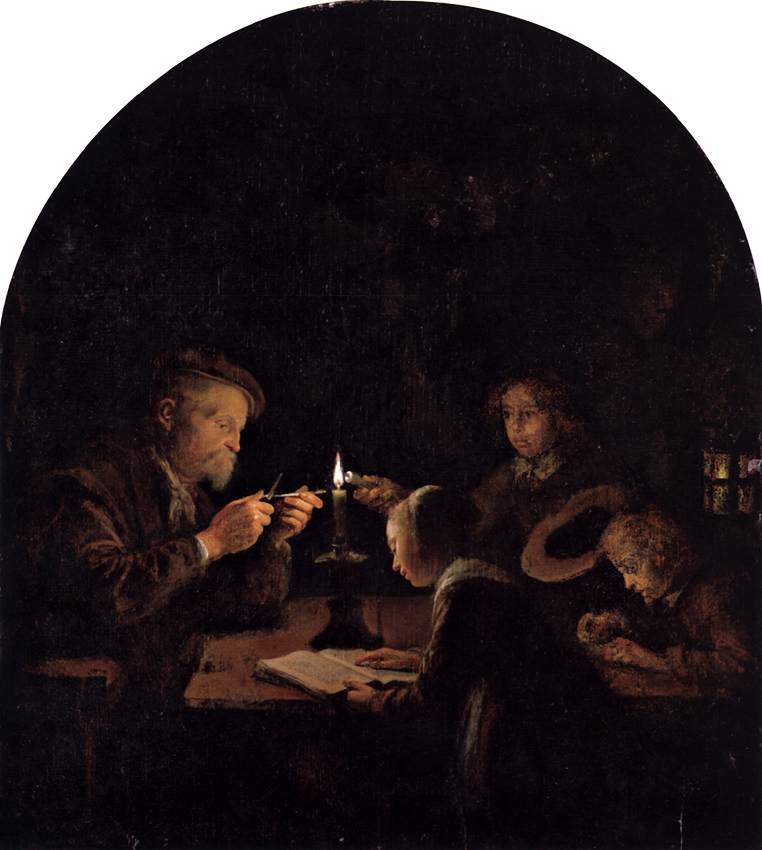
The game is not worth the candle. The returns from an activity or enterprise do not warrant the time, money, or effort required. This expression, which began as a translation of a term used by the French essayist Michel de Montaigne in 1580, alludes to gambling by candlelight, which involved the expense of illumination. If the winnings were not sufficient, they did not warrant the expense. Used figuratively, it was a proverb within a century.
The Phrase Finder also has a nice post about not worth the candle. The first known printed record of that phrase in English appeared in Sir William Temple's Works, circa 1690: "Perhaps the Play is not worth the Candle."

So, let me know: Was this little etymological diversion to your day sufficiently... illuminating? ;-)

If the hand you're dealt isn't worth the candle, just hold those cards a little closer to the flame.
By Gerrit Dou - Web Gallery of Art:   Image  Info about artwork, Public Domain, Link


Wednesday, June 26, 2019

Wednesday's Random Slang-o-rama: Wheel and deal


I was typing out the phrase wheeling and dealing and, as so often happens to me these days, stopped mid-keystroke, to wonder: How old is this phrase? And where did it come from?

You probably have your own theories, as I did mine. I figured it must come from the gambling world, and I was thinking it might be pretty old. Maybe even mid-19th century? (When was roulette invented? Whoops, mustn't get sidetracked. **)
>
>
>
>
>
>
>
>
>
>
>
>
>
>
The Grammarist offers up the following:
Wheel and deal is an American phrase that means to pursue one’s interests zealously, usually in a scheming or unscrupulous manner. Wheel and deal usually applies to pursuits in the business or political world. The origin of the phrase wheel and deal is up for debate, but there are several interesting theories. The first theory attributes the origin to American gambling, the term wheel and deal supposedly describing someone’s ability to run a roulette wheel game or a card game. Another theory attributes the phrase wheel and deal to the automobile industry in the 1930s, when many car dealers proclaimed they were giving wheel deals, or competitive pricing on their inventories. After World War II, the phrase wheel and deal became common. Related terms are wheels and deals, wheeling and dealing, and the noun wheeler-dealer.

Ah-ha. There's the roulette wheel reference, but no date attached to it. The American Heritage Dictionary of Idioms also mentions roulette, but doesn't support my 19th century suppositions:
wheel and deal. Operate or manipulate for one's own interest, especially in an aggressive or unscrupulous way. ... This term comes from gambling in the American West, where a wheeler-dealer was a heavy bettor on the roulette wheel and at cards. [Colloquial; c. 1940]
My Merriam-Webster's Collegiate Dictionary, Tenth Edition, pushes the term even closer to the here and now, saying wheeler-dealer dates from 1954.

Well. I'm glad I haven't used it in my fiction. I'll just have to be sure to keep any wheeling and dealing confined to the mid- to late-20th century.


Wheeling and dealing in abundance.
La Roulette in the Casino, from Monte-Carlo, 2nd Serie (circa 1910) by Georges Goursat (1863–1934), known as Sem
--------------------------------

** But of course I had to look it up! According to Wikipedia, roulette has been around since the 1700s, and may have been invented by mathematician Blaise Pascal:

The first form of roulette was devised in 18th century France. Many historians believe Blaise Pascal introduced a primitive form of roulette in the 17th century in his search for a perpetual motion machine. The roulette mechanism is a hybrid of a gaming wheel invented in 1720 and the Italian game Biribi. The game has been played in its present form since as early as 1796 in Paris. An early description of the roulette game in its current form is found in a French novel La Roulette, ou le Jour by Jaques Lablee, which describes a roulette wheel in the Palais Royal in Paris in 1796.

Monday, February 4, 2013

Around the track in Leadville, 1880

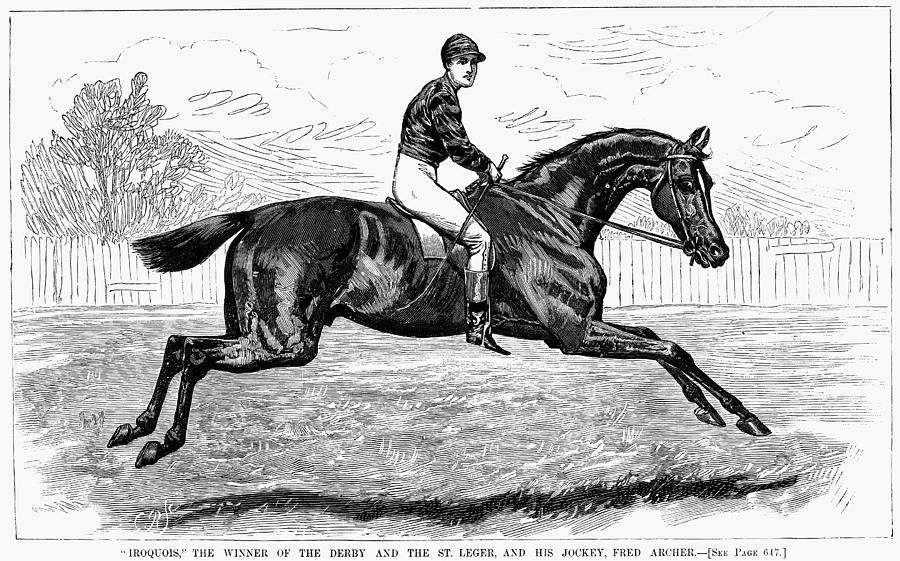
--> All is quiet on the hometown streets today (Sunday), with most folks (I’m assuming) hunkered down in front of their big screens, watching the Superbowl. Well, there sure wasn’t any football in Leadville during the Silver Rush, so what kind of spectator sports did folks enjoy?

I turned to my copy of Eugene Floyd Irey’s dissertation, A Social History of Leadville, Colorado, During the Boom Days, 1877–1881, for some insight. There was horseracing, apparently, for in the dissertation, he quotes the Leadville Democrat (July 27, 1880)  “… on the race course sporting is rife …”). Yes, I’ll bet it was.

Irey has a section talking about sports, in which he says the most popular varieties were closely allied with contests that offered the opportunity for gambling. Thus, “sporting activity tended rather heavily toward such spectator sports as wrestling, boxing, billiards, shuffle board, walking and horse racing.”

Horse racing seems to have been a big favorite. In 1879, Leadville had constructed a race trace on the edge of town. By the beginning of 1880, the Leadville Trotting and Running Club was holding regular meets, with typical purses for a three-day meet running as high as $6,000.

Now, according to the website MeasuringWorth.com, $6,000 in 1880 equates to about $136,000 today. Wowee!! I can see why there would be so much interest in racing...


 ... One wonders how much money is changing hands this evening, at the conclusion of the Superbowl ...