
Showing posts with label Old West. Show all posts

Wednesday, January 5, 2022

Wednesday's Random Slang-o-rama: Pull oneself up by the bootstraps

Ohhhh  the holidays are over, and boy do I feel it. January stretches before me, dark and cold. Well, no time for muddling about. It's time to pull myself up by the bootstraps and march forward into 2022.

Speaking of pulling and bootstraps, how old would you guess the phrase pulling oneself up by the bootstraps is? And where it first appeared? It sure has an "Old West" feel to it, don'tcha think?

>
>
>
>
>
>
>
>
>
>
Well, the The Phrase Finder claims this phrase, meaning to improve one's situation (or to succeed) by one's own efforts, was in use by the early 20th century. James Joyce alludes to it in his 1922 tome, Ulysses, in the sentence "There were others who had forced their way to the top from the lowest rung by the aid of their bootstraps." 

This isn't early enough for me, and has me wondering if I should search my Silver Rush books to see if I ever mention bootstraps in this idiomatic manner. However, not all is lost, because Wiktionary puts first use much earlier, claiming 1834:

In original use, often used to refer to pulling oneself over a fence, and implying that someone is attempting or has claimed some ludicrously far-fetched or impossible task. Presumably a variant on a traditional tall tale...

World Wide Words has a long piece on boot and bootstrapping, which talks some about this phrase. (The post also notes that "[a] bootstrap is not a bootlace, by the way, but a pair of loops inside the top of a heavy riding boot, something to pull on to get the foot past that awkward bend at the ankle.") WWW adds details re: the "tall tale" origin as well:

The idea of lifting oneself off the ground by pulling on [bootstraps] is sometimes said to date back to a tall story included by the German writer Rudolph Raspe in his book of 1785, Baron Munchausen’s Narrative of his Marvellous Travels and Campaigns in Russia, in which the famous Baron saved himself by this incredible feat. Some versions of Rudolph Raspe’s book include an incident in which he hauls himself (and his horse) out of the mud by lifting himself by his own hair. This is so similar an idea that it is highly likely that it is indeed the source. But somewhere along the way the story became modified to refer to bootstraps — this seems to have originated in the USA early in the nineteenth century; at least, the phrase was well known in that country by the 1860s.

1860s? That's more like it! And no less a publication than the New York Times provides a link, which names this 1834 reference and provides the quote, as follows (plus many other mid-19th century quotes):

1834 _Workingman's Advocate_ 4 Oct. 1/1 "It is conjectured that Mr. Murphee will now be enabled to hand himself over the Cumberland river or a barn yard fence by the straps of his boots." [APS]  
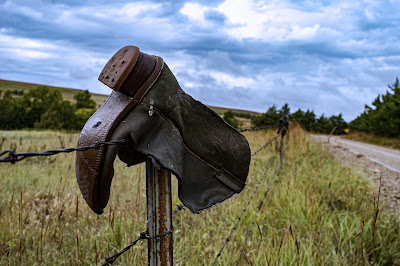
An unsuccessful attempt to make it over a fence using bootstraps.

So, there we go! I think a 19th-century yank on those bootstraps to attempt the impossible and absurd (although maybe not the merely difficult) has been vindicated. Which means we, in the 21st century, can pull ourselves up by our bootstraps and maybe, by current definitions, succeed! (Whereas my 1880s fictional characters, alas, would probably not.)


Wednesday, June 27, 2018

Wednesday's Random Slang-o-rama: Mammoxed


Are you flumoxed by mammoxed? I love the sound of it, but had nooooooo idea what it meant. Americanisms, Old and New by John Stephen Farmer, to the rescue!
>
>
>
>
>
>
>
>
>
>
>
>
>
>
>
>
>
Mammoxed—A doubtful word, current in the South and West. It seems to bear a meaning of serious personal injury, and may, perhaps, be  compared with "flummuxed" in the sense of great mental perturbation.

A doubtful word??
Hmmm.
Time to dig a little more (lest I lead you all astray!). I found the term again in Volume 9 of The American Educational Monthly (which certainly sounds like a credible journal) from 1872. This is what I found (and here's the link):


Sounds like a useful word for a crime fiction novel set in the American West of the 19th century, don't you think? :-)

Looks like someone is in danger of being mammoxed! (from Wikimedia - https://commons.wikimedia.org/wiki/File:Wild_West_Show_p%C3%A5_High_Chaparral.jpg)


Wednesday, May 2, 2018

Wednesday's Random Slang-o-rama: Hassayamper


I was perusing the Dictionary of the American West by Win Blevins when I stumbled upon the unfamiliar (to me) term Hassayamper.

This is an old-time term out of Arizona, which seems very appropriate and serendipitous, since I will be heading to the Poisoned Pen in Scottsdale, Arizona, to participate in their Cozy-Con this coming Saturday, 1 p.m.!

So, any guesses as to what Hassayamper might mean?
>
>
>
>
>
>
>
>
>
>
>
>
>
>

A little background: This comes from Arizona's Hassayampa River, which was the location of a gold rush back in 1863-ish. It was said, "If ya wash yer face in the Hassayampa River ya can pan four ounces of gold dust from yer whiskers."
>
>
>
>
>
>
>
>
Give up? Here's what Blevins' dictionary has to say:
The gold rush on the river gave rise to the myth that whoever drank its waters, especially when drunk, would become a liar. The old-time Arizonans, when bragging or yarning, were called Hassayampers.
If you want to read a 19th century poem that lays it all out, check out this post titled "He Is Full of Hassayamp!" No Hassayamping, I promise, going on at Cozy-Con. Hope to see some of you there...

Think there might be a Hassayamper in this picture, hoping to spin his tall tales into gold??


Monday, February 25, 2013

Leadville enthusiasts, rejoice!


On Saturday, I got a book in the mail that made me say YAY!!

Leadville historian Gretchen Scanlon's A HISTORY OF LEADVILLE THEATER arrived from Leadville's The Book Mine bookstore, and I couldn't be happier.

I know Gretchen has been working on this a long time, and I, for one, have been chomping at the bit for its arrival.

Here's the blurb from the back:

When the West was wild, the glitziest streets in Colorado ran through Leadville, where opera, variety and burlesque lit up Magic City theaters. Theatrical legends Buffalo Bill and Oscar Wilde graced the Tabor Opera House, while revolutionary Susan B. Anthony reached a rough mining audience from a stage atop a bar. Thomas Kemp spared no expense on the risqué Black Crook at the Grand Central Theater, complete with a grand waterfall, a trapdoor and dragons. Follow Leadville historian Gretchen Scanlon through these theatrical glory days, from the glamorous productions and stump speeches to the offstage theft and debauchery that kept the drama going even when the curtain fell.
You can find the book at all the usual places on-line, but I'm going to make a special plea that you  strongly consider ordering from The Book Mine in Leadville (phone: 1-719-486-2866) or your favorite indie bookstore. Show them you care! :-)

It's Christmas in February for me!

Thursday, July 2, 2009

Of law and lawlessness in Leadville

Leadville got off to a rough start in the law and order department: In "History of Lake County," R.G. Dill described the situation in 1878 (from the lofty viewpoint of 1881):
The streets and alleys which had come into being with the growth of the town, were the hiding places of desperadoes who waited paitently for the coming of their victims, whom a blow from the bludgeon would put in a condition to be quietly robbed.

One year later in 1879, things are even worse:
Following in the wakes of the wealth which daily poured into the camp, were men whose trades were theft and robbery. To drug a victim, coolly rifle his pockets of every article of value, and throw him into the streets to be arrested for drunkennes, was among the most common ethhods of the thugs who infested the saloons and variety theatres... Men were robbed within the shadows of their own doors; stripped of their valuables in their own bedchambers... and no part of the city was so well guarded as to be safe...
Leadville's first town marshal lasted only a few days. The second lasted three and a half weeks before being shot. The third, Mart Duggan, was a man who, by some accounts, was no better than those he set out to bring to heel. Edward Blair, in his very readable Leadville: Colorado's Magic City, sums Duggan up nicely: "He was not overly concerned with the letter of the law or the rights of the accused. His methods were those of the 'roughs,' and his success was born out of his superior strength, determination, and absolute fearlessness."

The town (or city) marshal was not the only enforcer of law. Leadville also had a police force. in mid-1879, the Leadville Daily Chronicle sums up the typical officer in this manner:
... numbered and branded with a star and turned loose. He has no instructions as to what he is to do, or how he is to do it. He is amendable to nobody nor nothing. Makes arrests when he feels like it, and sometimes tries and discharges his own prisoners. If there is one place in the city where he can find more comforts than another, that place will be well watched.
In early 1880, Leadville appointed a "city collector" from the police force to collect all revenues (saloon licenses and fines of prostitutes and gamblers were the biggest sources of revenue for the city—around $3,500 a month). Some fees were collected by the city clerk and various police officers as well. Interestingly enough, however, it wasn't until October 1880 that the city council finally passed a resolution requiring that all officers collecting funds to account for them.

Hmmm, says I. Sounds like plenty of opportunity for corruption and for said funds to go astray... These mental musings were the genesis of one of the story lines in Leaden Skies.

Next up (because it's that time of year): Fourth of July in long-ago Leadville.