Showing posts with label obscure words. Show all posts

Wednesday, November 30, 2022

Wednesday's Random Slang-o-rama: Deliciate

 Deliciate is a lovely word for the season. It's too bad that it has fallen into disuse...

>
>
>
>
>
>
>
>
>
>
>
>
According to Webster's 1913 dictionary, deliciate means "to delight one's self; to indulge in feasting; to revel." Reveling and feasting sure sound good to me! Bring on the pumpkin pie! (Or the fudge. I'll accept either or both.) If you are wondering how this word is pronounced, I've included a YouTube pronunciation link right here.

And if you celebrate Christmas and are looking for a little Christmas-y music to listen to as you deliciate, click this link for "Top 200 Christmas Songs of All Time"... 10 hours worth of tunes accompanied by a cozy Christmas scene. You're welcome!


Wednesday, January 19, 2022

Wednesday's Random Slang-o-rama: Groke

 For those of you who are familiar with Robert A. Heinlein's Stranger in a Strange Land, groke is not to be confused with Heinlein's "grok."


>
>
>
>
>
>
>
>
>
>
>

According to The Little Book of Lost Words by Joe Gillard (which is a veritable feast of strange words), groke is a verb dating to the 19th century, meaning "to stare eagerly at someone who is eating, hoping they'll give you food." 

Back in 2014, groke was featured as "the word of the week" in The Scotsman, which noted it was an old Scots word. (While perusing the short article I spotted some other weekly word offerings I shall have to consider for future Slang-o-rama posts. Who could resist delving into carnaptious, for instance? But I digress...) An article in The Guardian (which also includes some amazing words I shall add to my Slang-o-rama to-do list) adds, "The word was originally used to refer to dogs – and any dog owner whose canine friend has salivated beside them while they eat a steak will know why..."

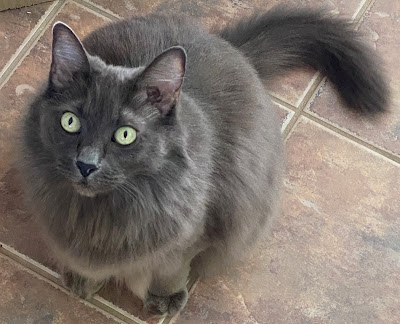
Dogs, eh? What about cats? I vote for cats being groke experts, especially if tuna or salmon is involved.

Is that a tuna sandwich in your hand??


Thursday, January 13, 2022

Wednesday's Random Slang-o-rama: Quanked

 Ah, I'm late with this Slang-o-rama post, although I can hardly blame it on being quanked... more like being unorganized and losing track of what day it is.

"And quanked means... what?" you ask.

Allow me to elucidate (actually, I'll let the references at hand do that).

>
>
>
>
>
>
>
>
>
>
According to The Little Book of Lost Words by Joe Gillard, quanked is a 19th-century adjective meaning "exhausted or fatigued from hard work." I don't know if one could count sitting hunched over a keyboard as "hard work." It's not as if I'm digging ditches here! (Well, maybe metaphorical ditches, but that's a different subject.) This word proved pretty elusive on the internet. I did find quanked in Wiktionary, which noted the word was "UK, dialect, obsolete." Wiktionary also provided the reference "Dartnell and Goddard (1893)."

Where there is a reference, there is a path forward, so forward I go...

And sure enough, Google Books promptly offered up quanked in A Glossary of Words Used in the County of Wiltshire, Issues 1-2, by George Edward Dartnell and Edward Hungerford Goddard (1893). Words specific to the county of Wiltshire? I'd say that's pretty specific! And even though I'm deviating from strictly Slang-o-rama here (or maybe not), I just have to share this from the Preface:

The following pages must not be considered as comprising an exhaustive Glossary of our Wiltshire Folk-speech. The field is a wide one, and though much has been accomplished much more still remains to be done. None but those who have themselves attempted such a task know how difficult it is to get together anything remotely approaching a complete list of the dialect words used in a single small parish, to say nothing of a large county, such as ours. Even when the words themselves have been collected, the work is little more than begun. Their range in time and place, their history and etymology, the side-lights thrown on them by allusions in local or general literature, their relation to other English dialects, and a hundred such matters, more or less interesting, have still to be dealt with. However, in spite of many difficulties and hindrances, the results of our five years or more of labour have proved very satisfactory, and we feel fully justified in claiming for this Glossary that it contains the most complete list of Wiltshire words and phrases which has as yet been compiled. More than one-half of the words here noted have never before appeared in any Wiltshire Vocabulary, many of them being now recorded for the first time for any county, while in the case of the remainder much additional information will be found given, as well as numerous examples of actual folk-talk.

Note that the authors spent FIVE YEARS on collecting "folk-speech" from a single county. My mind boggles, and I get quanked just thinking about it...



Wednesday, September 15, 2021

Wednesday's Random Slang-o-rama: Latibulate

For this week's Slang-o-rama offering, I yearned to highlight a really obscure word. The Little Book of Lost Words by Joe Gillard did not let me down.

Latibulate

Any guesses as to what it means? (No peeking! No Googling!)

>
>
>
>
>
>
>
>
>
>
>
>
>
Allow me to enlighten you (or rather, we'll let Gillard do that): Latibulate is a 17th century English word that means "to hide in a corner." What a cool word, right?? 

I spot a little latibulation goin' on...
The Eavesdropper by Jean Carolus (1880) - Sotheby's New York, Public Domain, https://commons.wikimedia.org/w/index.php?curid=29501650

I dug around online... and, wow, obscure I wanted, and obscure I got. Slang Define notes this is "among a group of words with the root latib, all used to describe the action or place of hiding." A group of words? I can't even think of one. So, I explored a little more. A Way with Words provides some insight with a post on latibulum that says:

The Latin word latibulum means a "refuge or hiding place of animals." It derives from the same root that gives us the English word latent, meaning "hidden." A 17th-century dictionary defines the now-rare English word latibulate as "privily to hide oneself in a corner."

A little more was revealed in this pandemic-lockdown era post from Writing Redux. This was about all I could find, EXCEPT there is a very short (and rather catchy) song by Scotland singer/songwriter Adam Donaldson titled "Latibulate" (!!) which you can hear (and watch) below. Maybe this word is getting ready to step out of obscurity, eh?

(Privily, I shall latibulate now.)


Wednesday, June 30, 2021

Wednesday's Random Slang-o-rama (July 4th edition): Homerkin

Heeeere comes the Fourth of July! Time to raise a homerkin, perhaps?

>
>
>
>
>
>
>
>
>
>
>
>
>

According to Joe Gillard's The Little Book of Lost Words, homerkin is a 17th century English noun meaning "a measure of beer." A measure of beer sounds like a good way to toast a holiday in the middle of a (blazing) hot summer.

But not so fast...

In a Gigglewater411.com post titled "A homerkin, anyone?" one commenter offers the following elucidation:

A homer is an old Hebrew word for a unit of measurement for liquids, equal to 10 “baths,” or approximately 55 gallons. The suffix kin is an old English addition to denote diminutive. So a homerkin is likely a unit of liquid measure equal to half of a homer; or, approximately 27 gallons.

Twenty-seven gallons of beer?? That is a lot of beer.

Let's dive a little deeper and see what else we can find.

A homerkin's worth, perhaps?
Image by Digital Photo and Design DigiPD.com from Pixabay

Homerkin shows up again in The Creature's Cookbook's "Cool Beer Glasses Perfect for Wordsmiths,Book Polygamist's "Save the Words Saturday," and The Guardian's "Move to rescue obscure words." However, it doesn't even register on the Google Ngram viewer or appear in the usual online dictionaries.

My seven-pound Webster's New Universal Unabridged Dictionary (Fully revised and updated) did list homer as "a Hebrew unit of capacity equal to ten baths in liquid measure," with a first use date 1525–35. (I also found that definition of homer in Wikipedia, here.)

-kin is defined in my Webster's as "a diminutive suffice of nouns." Well, I knew that. I'm still not certain how we get -kin equating to half, but so be it. In any case, I gather a homerkin is a lot of beer, probably more than fits your average glass or stein.

Okay, I'm thirsty now. Time for some iced tea.

Wishing you all a safe and pleasant Fourth of July!

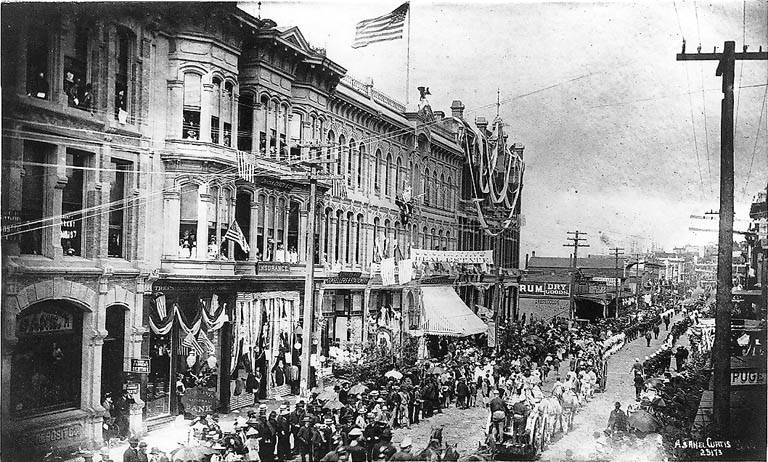
Fourth of July, Seattle WA, 1888
By Theodore E. Peiser - Asahel Curtis Photo Company Photographs, Public Domain, https://commons.wikimedia.org/w/index.php?curid=72641975