Showing posts with label Victorian slang. Show all posts

Wednesday, May 31, 2023

Wednesday's Random Slang-o-rama: Scamander

June is upon us—the perfect month to scamander along trails and streets...

>
>
>
>
>
>
>
>
>
>
>
... And if you lived in Victorian times (or happen to have access to a copy of A Dictionary of Slang, Cant, and Vulgar Words, by A London Antiquary, from 1860) you would know that, back then, to scamander meant "to wander about without a settled purpose." Horologicon by Mark Forsyth adds that scamander is the sister word to meander, with both words having their origin in waterways: 

The river Maeander winds, by a preposterously curly-whirly route, through Izmir in Turkey. The ancient Greeks were very taken with the twisting of the Maeander... If you feel that the Maeander isn't the river for you, you may pick the Scamander, another Turkish watercourse now known as the Karamenderes.

Wikipedia notes that Scamander was a river god in Greek mythology and that the Scamander River, named after this god, was the river surrounding Troy. The river deity fought on the side of the Trojans during the Trojan War, and tried to drown Achilles three times. I have long forgotten the details of The Iliad by Homer, so tracked down the section where Achilles squares off with the river god. I must admit that after reading about how Scamander remarks to the warrior that the river is choked with corpses and couldn't Achilles please just do all his hewing and hacking on land, and Achilles pretty much responds, "No way, I'm a killing machine and there's no stopping me!" that I side with Scamander on all this.

Having done a fair job of scamander-ing through this post, I'll stop here.

Have fun as you scamander around this summer, whether in wilderness or city.
Wilderness image by JayMantri from Pixabay ; City image by RD Law from Pixabay


Tuesday, April 11, 2023

Wednesday's Random Slang-o-rama: Whooperup

I was looking at words from "long ago and far away" and bumped into whooperup. At a guess, I thought it might describe a sound one might make while celebrating, and might perhaps be a bit of Old West slang (as in, "The cattle drive is over, let's head into town and whooperup."). Nnnnot quite.

>
>
>
>
>
>
>
>
>

According to Green’s Dictionary of Slang, whooperup is a noun meaning "a second-rate singer who produces noise rather than music." Green's notes it's of British origin and offers up a first-use date of 1909. Dusty Old Thing adds a few more adjectives with the definition of "loud and disorderly people engaged in discordant song."

Turning to Google's Ngram, I did find one reference to whooperup in an 1891 issue of Outing: An Illustrated Weekly Magazine of Sport, Travel, and Recreation (Vol. XVIII) in a chapter titled "Harry's Career at Yale." So perhaps we can nudge this non-musically-inclined word back into the 19th century...

Whooperups, whooping it up.
Image by Clker-Free-Vector-Images from Pixabay


Wednesday, April 21, 2021

Wednesday's Random Slang-o-rama: Podsnappery

Now isn't podsnappery just the most delightful-sounding word you've seen in a while?

But what does it mean? Care to guess?

>
>
>
>
>
>
>
>
>
>
>
>
>
>
>
>
>

According to this Mental Floss post, podsnappery is a bit o' Victorian slang describing a person who has a "willful determination to ignore the objectionable or inconvenient, at the same time assuming airs of superior virtue and noble resignation." 

Talk about specific!

Merriam-Webster Online defines it as "an attitude toward life marked by complacency and a refusal to recognize unpleasant facts." Podsnappery shows up on an Ngram plot with a peak around 1870 and appears 12 times in Charles Dickens' Our Mutual Friend (which also features a character named Podsnap).  In fact, according to Wiktionary, Dickens coined the word.

I guess I should make time to brush up on Dickens. Probably lots of Slang-o-rama possibilities lurking in those books...

The podsnapper-ish milieu of Our Mutual Friend by Charles Dickens
 https://www.flickr.com/photos/internetarchivebookimages/14594577827/Source book page: https://archive.org/stream/ourmutualfriend00dick/ourmutualfriend00dick#page/n146/mode/1up, No restrictions, https://commons.wikimedia.org/w/index.php?curid=43086366


Wednesday, September 30, 2020

Wednesday's Random Slang-o-rama: Collie shangles

I fled to the past, searching for comfort and a bit of linguistic fun, and bumped into the intriguing phrase collie shangles. Have any of you heard of this bit of Victorian slang before?

>
>
>
>
>
>
>
>
>
>
>
>
>

Because it is definitely Victorian. According to a post titled A Dictionary Full of Victorian Slang, Queen Victoria herself brought this term into the light. The phrase and the definition appear in Passing English of the Victorian era: a dictionary of heterodox English, slang and phrase by James Redding Ware. Collie shangles appears in the Queen's journal More Leaves, published in 1884, as follows:

At five minutes to eleven rode off with Beatrice, good Sharp going with us, and having occasional collie shangles (a Scottish word for quarrels or rows, but taken from fights between dogs) with collies when we came near cottages. 

The perfect term to fling about the next time an exchange turns heated, don't you think? 

No collie shangles when in the presence of the Queen!
Photo of Queen Victoria with her dog "Sharp," the Border Collie, taken at Balmoral Castle
Unknown author - http://the-lothians.blogspot.com/2012/06/, Public Domain, Link

Wednesday, May 13, 2020

Wednesday's Random Slang-o-rama: Zounderkite


Here is an vintage word that is perfect for our times: zounderkite.

Any ideas as to what it means?

Go ahead, guess! (No fair peeking on Google.) And then, keep reading to see if you are right...

>
>
>
>
>
>
>
>
>
>
>
>
>
>
>
>
>
>
>
>
According to the Dictionary.com article Insults We Should Bring Back, zounderkite is a Victorian word meaning "idiot." It shows up in many lists of vintage curse words, including 22 Incredible Forgotten Curse Words from Way Back in the Day (which expands on the simple one-word definition with: "a complete idiot who constantly makes clumsy and awkward mistakes"), and BBC America's 10 Victorian Swears from the Real "Ripper Street" (which goes whole hog: "the kind of bumbling idiot that will end up making a disastrous mistake of the sort that beggars belief").

BBC America provided a source, which was a good thing, because this word did not appear in any of my hard copy dictionaries, including Webster's New Universal Unabridged Dictionary. However, their source—1811 Dictionary of the Vulgar Tongue—does not contain zounderkite.

What do they take me for, an idiot? That I would not check the source?

I turned to N-gram, thinking surely it would show up there. Nope. Nothing.

Determined, I delved a little further into Google Books, hoping to find a 19th century mention. I finally found it, I'm proud to say, in the 1876 A Glossary of Surrey Words (A Supplement to No. 12.) by Granville William Gresham Leveson Gower, in the Mid-Yorkshire section, where it appears between zookerins! and zounds! 
There it is! Proof, at last!

I think the scarcity of zounderkite in books in general might mean it was a word more spoken than written, at least in the past.

My thrashing about also turned up a Zounderkite family of fonts.
One just never knows what will turn up during Slang-o-rama research.


Wednesday, March 11, 2020

Wednesday's Random Slang-o-rama: Snookered!


Yes, I know I promised an arm and a leg for this week, but I've been snookered by a virus (not THIS virus, thank goodness. Just some run-of-the-mill seasonal virus). As a result, I had to bow out of attending one of my favorite mystery conventions, Left Coast Crime. And I am saaaaaad. 😢

So, while the ibuprofen is at maximum strength, let's take a look at the word snookered. Could my 19th century protagonist Inez cry out in anger that she'd been snookered and stomp around in a fury? I'd like to think so—at least, I can certainly envision it—but I've been wrong before... 
>
>
>
>
>
>
>
>
>
>
>
>
>
>
>
>

My copy of Merriam-Webster's Collegiate Dictionary, Tenth Edition,  notes that the noun snooker (dating from 1889 and of unknown origin) is a variation of pool played with 15 red balls and 6 variously colored balls. It took until 1925, apparently, for it to gain traction as a verb meaning to make a dupe of or hoodwink.

Huh!

I'm not seeing how the noun and verb are even related. But then, I've never played snooker! Let's dig a little deeper.

The Online Etymological Dictionary offers a possible explanation of how the game came to be called such, and then gets right down to it, defining snooker as "to cheat" and providing this connection, straight from the rules of the game:

One of the great amusements of this game is, by accuracy in strength, to place the white ball so close behind a pool ball that the next player cannot hit a pyramid ball, he being "snookered" from all of them. If he fail to strike a pyramid ball, this failure counts one to the adversary. If, however, in attempting to strike a pyramid ball off a cushion, he strike a pool ball, his adversary is credited with as many points as the pool ball that is struck would count if pocketed by rule. [Maj.-Gen. A.W. Drayson, The Art of Practical Billiards for Amateurs, 1889]
Still, this sneaky setup isn't "cheating," per se. It just sounds like very skilled playing. So, I'm still not seeing the connection. Luckily, there's a very nice discussion on Stack Exchange about this very thing, and I invite you to check it out... you'll learn a lot more about snooker—the game and the possible connection to "cheating," than I can tell you here. 

My takeaway: I can be snookered, but Inez can't (at least, not in 1882!).
And just when you least expect it, snookered! (I could definitely see Inez doing this...)
From The Galaxy, An Illustrated Magazine of Entertaining Reading, Vol. VI), July 1868
Wood engraving, Winslow Homer
Addendum: In her comment below, Liz V mentioned the movie "The Hustler" starring Paul Newman and Jackie Gleason. I found a clip and just have to share. Thank you, Liz!

Wednesday, January 1, 2020

Wednesday's Random Slang-o-rama: Mafficking


How was your New Year's Eve? Did you go mafficking about when the clock struck midnight? I'll wager that many folks did (although I am long past that point and was more intent on sleeping the night through).

Now, let us dive into the mysterious word: mafficking...
>
>
>
>
>
>
>
>
>
>
>
>
>
>
>
>
Mafficking is a most excellent bit of Victorian slang that, according to the Mental Floss blog post "56 Delightful Victorian Slang Terms You Should Be Using," means getting rowdy in the streets.

The origin of this word is fascinating as well. According to Merriam Webster:
 Maffick is an alteration of Mafeking Night, the British celebration of the lifting of the siege of a British military outpost during the South African War at the town of Mafikeng (also spelled Mafeking) on May 17, 1900. The South African War was fought between the British and the Afrikaners, who were Dutch and Huguenot settlers originally called Boers, over the right to govern frontier territories. Though the war did not end until 1902, the lifting of the siege of Mafikeng was a significant victory for the British because they held out against a larger Afrikaner force for 217 days until reinforcements could arrive. The rejoicing in British cities on news of the rescue produced maffick, a word that was popular for a while, especially in journalistic writing, but is now relatively uncommon.
I think it's a word that should be revived, don't you? 

Here's to a new year, a new decade, and a renewal of mafficking!
Here's to more mafficking in 2020!
Image by ktphotography from Pixabay

Wednesday, April 3, 2019

Wednesday's Random Slang-o-rama: Kit and caboodle


The whole kit and caboodle is a term that I recall from my childhood, as in "If you kids bring the whole kit and caboodle for vacation, you will be riding on the rooftop." (The phrase seems to go hand in hand with everything but the kitchen sink.) So what is caboodle anyway, and how did it get hooked up with kit?

Let's dive in and find out.
>
>
>
>
>
>
>
>
>
>
>
>
>
>
>
Caboodle shows up in Americanisms, New and Old as the whole caboodle, as follows:
A pleonastic expression for "the whole." Thought to be an enlarged form of boodle, which is sometimes used in the same sense, and which is derived from the old English "bottel," a bundle....  Caboodle is general throughout the States, and has now almost completely supplanted boodle, which is more usually applied in a totally different sense.
The Online Etymological Dictionary says for kit and caboodle:
also kaboodle, 1870, earlier kit and boodle (1855), kit and cargo (1848), according to OED from kit (n.1) in dismissive sense "number of things viewed as a whole" (1785) + boodle "lot, collection," perhaps from Dutch boedel "property." Century Dictionary compares the whole kit, of persons, "every one" (1785).

Since I was thinking of the kitchen-sink business, I checked the Online Etymological Dictionary and found the following:
... everything but (or and) the kitchen sink is attested from 1944, from World War II armed forces slang, in reference to intense bombardment.
 So, in my Silver Rush series, my characters can pack the whole kit and caboodle, but they better not try to bring everything but the kitchen sink.

Traveling in style in the mid-19th century meant packing the whole kit and caboodle.
The Arrival in Lisbon, From "Journal of a Visit to Madeira and Portugal (1853-1854)," 1854, by Isabella de França (1794-1880) [Public domain]


Wednesday, March 13, 2019

Wednesday's Random Slang-o-rama: Bang up to the elephant (AND News Flash!)


~~ NEWS FLASH! This just in: A DYING NOTE is a finalist (along with piles of other wonderful books) for the Foreword INDIE Award for Mystery. Winners in all categories will be announced on June 14. Click here to see categories and to view finalists. 
END NEWS FLASH! ~~
------------------------------------------------------
 I know I promised to explore chicanery this week, but the news flash above, which I just had to share, has me exclaiming with great glee, "Well, isn't this just bang up to the elephant!"

And wouldn't you just looooove to know where what that phrase means, how old it is, and where it comes from? If so, just keep reading...
>
>
>
>
>
>
>
>
>
>
>
>
>
>
Passing English of the Victorian Era: A Dictionary of Heterodox English, Slang, and Phrase by J. Redding Ware (1909) gives us this very complete entry:

Bang up to the Elephant (London, 1882): Perfect, complete, unapproachable. The 'Elephant' ( 'Elephant and Castle Tavern,' South London), had for years been the centre of South London tavern-life when (1882) Jumbo, an exceptionally large elephant at the Zoological Gardens, became popular through certain articles in the D. T.* The public were pleased to think Jumbo refused to leave England and the gardens for America. He, however, did ultimately, with no emotion, leave behind him this bit of passing English.
'The fly flat** thinks himself so blooming sharp, so right bang up to the elephant, that he's got an idea that no sharper*** would ever try to take him on.'

Jumbo at the opera, courtesy of an 1883 advertisement for cotton thread.
Buek and Lindner [Public domain]


*D. T. = Daily Telegraph 
** Fly flat (from 1864) = A foolish or gullible person who considers him- or herself clever. Found in Oxford Dictionary of Modern Slang by John Ayto, John Simpson.
*** Sharper (from 17th century) = a thief who uses trickery to part an owner from his or her money possessions. Found in Wikipedia.

Wednesday, February 13, 2019

Wednesday's Random Slang-o-rama: Honeyfuggle


Doesn't the word honeyfuggle sound like it's just made for Valentine's Day activities?

Well, not so fast! You may not want to honeyfuggle, once you read more about its origins...

>
>
>
>
>
>
>
>
>
>
>
>
>
>
Green's Dictionary of Slang has the low-down on this interesting slang word.

My favorite definition, from 1856 is to "sweet talk," to flatter, to entice. (Such a perfect word cannot be ignored... I think someone in my next book is going to have to be accused of honeyfuggling.)

When it originally popped up in about 1829, honeyfuggle (or honeyfogle, or honeyfugle) meant to swindle, to trick, to fool.

A couple of really lovely alternative dialects include:
  • connyfogle: entice by flatter, to hoodwink
  • gallyfuggle: to deceive or trick
So, is there nothing nice to say about honeyfuggle? Well, another definition (first spotted 1969-70) is to "cuddle up to." And much, much earlier (1872), Susan B. Anthony used honey-fugling for "kissing" in her lectures on Women's Rights.

So if there's any honeyfuggling going on for you on Valentine's Day, here's hoping it all had to do with kissing and cuddling and none of it with cozening.*

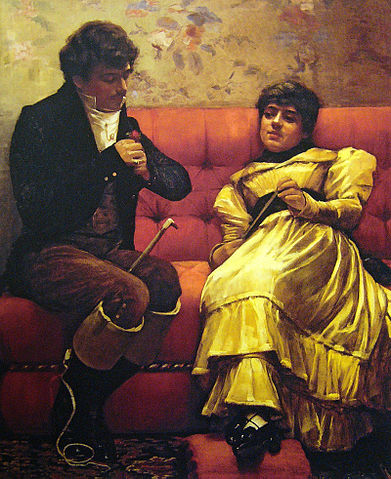
I sense honeyfuggling is afoot!
[1882: The Conquest, by John Lavery - Glasgow Boys, Roger Bilcliffe, Public Domain, https://commons.wikimedia.org/w/index.php?curid=17870167]

*cozening being another word for deceiving, winning over, or inducing to do something by artful coaxing and wheedling or shrewd trickery.