Camille Minichino, my dear friend of nearly 46 years, died Monday, May 6, 2024. She was companion, colleague, mentor, teacher, ally, and more to me and many many others. By any measure, she was an amazing person, one in a million, and will be sorely missed. It's hard to put thoughts into words at this point, so instead, I'll share a letter that was sent to those on her snail-mail "Christmas list." Below the letter, I'll add links to tributes, obituaries, etc., as I find them. If you come across any postings/articles, feel free to contact me and I will add them.
To receive updates about services in honor of Camille, please click on this link and provide your email address. Your email will only be used to provide information about such events.
https://form.jotform.com/241314790968162
-------------------
 |
Camille Minichino, Ph.D.
June 3, 1937 – May 6, 2024 |
Dear Family, Friends, and Colleagues of Camille Minichino,
It is with sorrow we are informing you that Camille passed away on Monday, May 6, 2024, after a brief illness. What follows is an overview of her life, which in no way captures the amazing totality of a life "well and truly lived."
Born in Revere, Massachusetts, in June 1937, to Joseph and Helen Avallone Minichino, Camille was the first of two daughters; sister Arlene Minichino Polinene predeceased her. Camille often related how her father, a laborer, introduced her first to the joys of mathematics by showing her how to measure, multiply, and divide. After graduating from Revere High School, her love of mathematics and physics grew at Emmanuel College where several sisters took her under their wings and nurtured and encouraged her intellect and scientific curiosity. At the urging of these role models, Camille graduated with a B.A. in Mathematics in 1958. She then joined the Sisters of Notre Dame, where she remained for 18 years, and attended Fordham University, New York City, where she carried out experimental physics research in spectroscopy and obtained a Ph.D. in Physics in 1968, one of three women in a department of nearly 80 students. After leaving the order, she moved to California, and during her 30-year career at Lawrence Livermore National Laboratory worked in high-temperature, high-pressure physics, provided technical support to the Nuclear Regulatory Commission in pre- and post-Three Mile Island, and consulted at commercial reactors throughout the country. She also worked on problems of nuclear waste management and co-authored a book on the subject in 1982 (
Nuclear Waste Management Abstracts, with Richard Heckman).
As an educator and professor, Camille developed and taught physics, mathematics, philosophy, critical thinking, and interdisciplinary courses at all levels. She served on numerous academic faculties: Golden Gate University, San Francisco; Emmanuel College, Boston; St. John’s College, Boston; Dominican University, San Rafael, California; and John F. Kennedy University, Orinda, California. She also developed and taught writing classes and workshops at community colleges and through various writers’ organizations, including Emeritus College (Diablo Valley College), California Writers Club, and Sisters in Crime (an organization for mystery readers and writers). Which brings us to the third part of her professional journey…
She loved See's Candies, a well-crafted, bone dry, whole milk decaf cappuccino, Amici's margherita pizza (hold the sauce!), designing and creating "miniature" scenes and dollhouses, watching movies (especially
The Godfather), throwing parties (including gatherings to celebrate the Academy Awards, Fourth of July, New Year's Eve, and birthdays), reading across the spectrum of fiction and nonfiction, and supporting her artistic friends by buying their jewelry, knit items, and crafts. She also was there to raise a hand when the call went out for volunteers for all the myriad organizations she belonged to, or when a friend, family member, or student needed a hand or a listening ear or just wanted to grab an ice cream cone and a chat at the nearby Loard's Ice Cream Parlor. Although she lived in the San Francisco Bay Area for 50 years, she still considered herself a "New Yorker," and regular trips to the Big Apple, with its museums and bookstores, helped feed her city-soul.
On her blog site,
The Real Me, Camille described herself as follows: "I've been a factory worker, a translator, a teacher, an experimental physicist, a nuclear safeguards engineer, a writer, a waitress, a miniaturist, a paralegal, a nun, a minister, a short order cook, a ticket taker, an editor, a crafter, and a cotton candy twirler... plus a wife."
No overview of Camille's life is complete without acknowledging the deep devotion she shared with her husband, Richard (Dick) Rufer. Camille and Dick met at "The Lab" and married in 1977. Dick was, without question, the great love of her life. They watched movies together, conspired on solving crossword, acrostic, and jigsaw puzzles and creating cryptoquotes. Camille often fondly referred to Dick as her "24/7 tech support" and/or "The Cable Guy." He was the inspiration for her book
How to Live with an Engineer. Over their nearly half-century of marriage, they exchanged nightly love-notes. Dick was always there for her, and she for him. Dick predeceased Camille by two months, shattering her world. Although her death certificate states a medical cause of death, all who knew Camille and supported her for those months after Dick's death know that she really died of a broken heart.
Camille is survived by a number of cousins and second cousins, and by legions of friends, colleagues, and students.
Yours in shared joy at having had Camille in our lives,
A small committee of Camille's friends
-------------------------
LINKS AND OTHER TRIBUTES
Thank you, mystery author
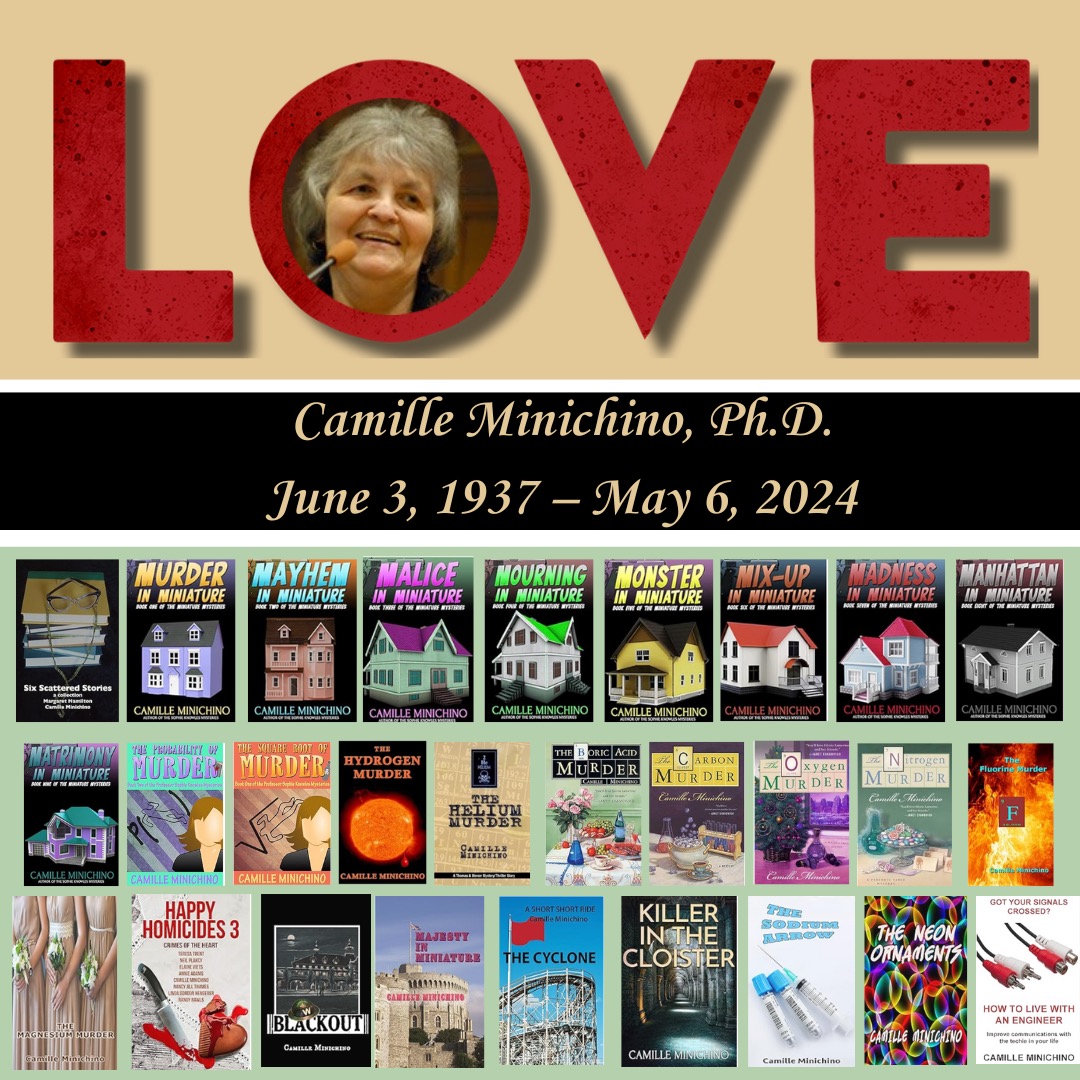
Gabriel Valjan, for creating the lovely visual tribute below that captures all of Camille's mystery titles...
 |
| Credit: Gabriel Valjan |





 Posts
Posts


