Showing posts with label Mortal Music. Show all posts

Wednesday, July 7, 2021

Wednesday's Random Slang-o-rama: Caught flat-footed (and NEWS FLASH!)

With the 4th of July holiday on Sunday and a "day off" from the virtual cubicle farm on Monday, I am caught flat-footed with the sudden appearance of Wednesday and (yikes!) the need to drum up something for Slang-o-rama! 

So first, caught flat-footed, and then, a bookish news flash!

>
>
>
>

>
>
>
>>
>
>
>>
>
>

Even my little visual "pause" of right-facing angle brackets are a little unprepared, which is very appropriate, for caught flat-footed means caught unprepared or taken by surprise, according to Dictionary.com. The entry goes on to say:

This usage comes from one or another sport in which a player should be on his or her toes, ready to act. [c. 1900]

The same explanation appears in The American Heritage Dictionary of Idioms by Christine Ammer. The site Idiom Origins adds that the expression is originally American, adding, "All the evidence points to its origin from being caught flat-footed or unprepared in baseball." A Wikipedia entry "List of police-related slang" has an intriguing entry on flatfoot, which expands on this possible origin:

FLATFOOT: A term with uncertain origins. Possibly related to the large amount of walking that a police officer would do; at a time when the condition flat feet became common knowledge, it was assumed that excessive walking was a major cause. Another possible origin is the army's rejection of men with flat feet, who would often take jobs in law enforcement as a backup, particularly during war when established police officers would often join up (or be forced). What is known is that by 1912, flat-footed was an insult among U.S. baseball players, used against players not "on their toes." This may have been applied to police officers sometime later, for similar reasons.
Caught flat-footed indeed!
Image by David Mark from Pixabay


---------------------------------NEWS FLASH NEWS FLASH NEWS FLASH--------------------

On July 4th I was thrilled and honored to learn that MORTAL MUSIC is a finalist for the Will Rogers Medallion Award (WRMA) in the Maverick category.!Those of you who sport the spirit of the West, please join me as I hoot and holler and throw my hat in the air! You can see the complete list of finalists for all the categories here. Winners will be announced on October 23 at the WRMA ceremony and banquet in Ft. Worth, Texas. 

Congratulations to all the other finalists, and many thanks to the judges for all their hard work—they were apparently inundated with entries this year, which no doubt added to the complexity and time involved in reading and evaluating all the submittals.

Now, I'm off to scour the freezer for ice cream and to do a little celebrating...

More WRMA details and links on this page.


Wednesday, June 2, 2021

Wednesday's Random Slang-o-rama Redux and News Flash: Knock me down with a feather


I have news to share, and an idiom to go with it...

MORTAL MUSIC, the seventh book in my Silver Rush series, has been nominated for the 2021 Macavity / Sue Feder Memorial Award for Best Historical Mystery

When I heard about this, well, you could have knocked me down with a feather. Given that MORTAL MUSIC was released just before the pandemic hit, I felt sure people were focused on things other than reading (things like stocking up on toilet paper and researching where to buy hand sanitizer and jigsaw puzzles). So yes, I am surprised, but happily so, and honored to be included with such a fine group of Macavity nominees!

>
>
>
>
>
>
>
>
>
>
>
>
>
>

As for knock me down (or over) with a feather, yep, I already looked at this idiom at the end of 2018. But I kinda forgot about all that in my excitement, and researched it all again, so pardon the (partial) repetition below.

In this discussion in Quora, one responder noted its written appearance in Porcupine's Works; Containing Various Writings and Selections, Exhibiting a Faithful Picture of the United States of America, Volume 4 by William Cobbett, in 1801. Another pointed to a StackExchange exchange, which mentions the same Cobbett reference (with a slightly earlier date of 1796), and an even earlier variant—beat me down with a feather—in Samuel Richardson's Pamela; or, Virtue Rewarded (1740). And of course, as someone else pointed out, once you see a phrase like this in print, you know it has probably been circulating for a while in the spoken word.

Defined as "extremely astonished, surprised" by Merriam-Webster Online, I'd say knocked down with a feather sums up exactly how I feel right now.

And if you are wondering, "Who is Sue Feder?" this 2006 post from The Rap Sheet provides a little background on her, and why there is an award in her honor.

Knocked down with a feather, perhaps? (It's a mystery!)
Still Life with a Skull and a Writing Quill by Pieter Claesz (Dutch, Berchem? 1596/97–1660 Haarlem), 1628.  Medium: Oil on wood. The Metropolitan Museum of Art

Wednesday, January 20, 2021

Well, carry me out with the tongs! Slang-o-rama and an Award nomination

I received a pleasant surprise early this week: The seventh Silver Rush mystery Mortal Music is a finalist for the Left Coast Crime's 2021 Lefty Award for Best Historical Mystery Novel!

I'm pleased, thrilled, honored, and yes, a mite astonished! I'm also tickled pink that I get to rub elbows (virtually only!) with the other Lefty Historical finalists—all wonderful people and writers:

You can view a list of all the Lefty Award finalists for all the categories here. Awards will be presented on April 10.

And yes, this is a combo Slang-o-rama post because Carry me out with the tongs! is...

>
>
>
>
>
>

... an exclamation of surprise dating from 1927, according to Words and Phrases from the Past. Since it appears in The Facts on File Dictionary of American Regionalisms (Facts on File Library of American Literature) by Robert Hendrickson, I think we can safely assume it is a regional expression. More than that, I cannot say... 


Do salad tongs count?


Wednesday, August 12, 2020

Tootle of the Horn for MORTAL MUSIC

Stepping away from the usual slang-o-rama entry this week to let you all know that the latest book in my Silver Rush series, MORTAL MUSIC, is a finalist for a Colorado Independent Publishers Association (CIPA) award! I am thrilled, honored, excited, and dancing in the streets (with a mask on). You can find the complete list of finalists for the nearly 50 categories right here.

This year's CIPA EVVY Awards ceremony will broadcast virtually on September 10th.

Please join me as I break out the extra-special coffee to celebrate! Slang-o-rama will return next Wednesday, I promise.


Thursday, January 30, 2020

The curtain rises and the music begins

Interrupting my usual every-Wednesday schedule to say...

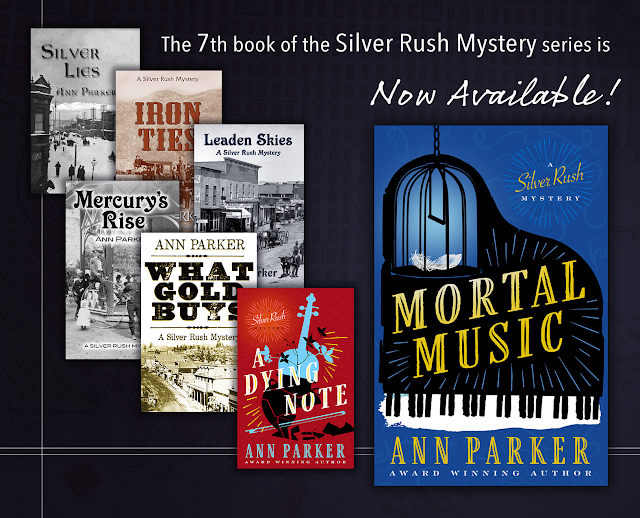
Silver Rush series covers with newest, Mortal Music, prominent

I have buy links for all the usual venues here.

Wishing you all a good weekend!

Wednesday, January 29, 2020

Wednesday's Random Slang-o-rama: For a song


When you can obtain something for a song, you expect to get it inexpensively, right? In fact, The American Heritage Dictionary of Idioms by Christine Ammer defines the phrase as meaning "very cheaply, for little money, especially for less than something is worth" and gives an example straight out of Shakespeare's All's Well That Ends Well:
I know a man... sold a goodly manor for a song.
So how long has this idiom been around, and why would it refer to buying on the cheap?

Any guesses?
>
>
>
>
>
>
>
>
>
>
>
>
Ammer places its first appearance in the late 1500s (well, Shakespeare, after all) and notes:
"This idiom alludes to the pennies given to street singers or to the small cost of sheet music." The Free Dictionary says pretty much the same: "The ultimate origin of this phrase is probably the practice, in former times, of selling written copies of ballads very cheaply at fairs." According to this entry, the expression was in common use by the mid-17th century.

TheIdioms.com goes with a first appearance in the 1500s and agrees that the phrase probably refers to street singers, adding, "They would stand on the side of the street and people would give them pennies. Singing was not seen as a large accomplishment as it could be done by everyone. Therefore, you would not be paid much for it."


Singing... not a large accomplishment???
The idiom is probably related to street singers. They would stand on the side of the street and people would give them pennies. Singing was not seen as a large accomplishment as it could be done by everyone. Therefor, you would not be paid much for it. You would also have to pay for sheet music (1500s.) (Theidioms.com)

Theia Carrington Drake, my fictional prima donna who takes center stage in my newest Silver Rush historical mystery, MORTAL MUSIC, would vehemently disagree.


You won't get this kind of singing for a song.
By Thomas Rowlandson - JwFP_imNhhV_iw at Google Cultural Institute maximum zoom level, Public Domain, Link


Wednesday, January 22, 2020

Wednesday's Random Slang-o-rama: Face the music


In my newest Silver Rush novel MORTAL MUSIC, several characters—including prima donna Theia Carrington Drake—must face the music as the story unfolds.

Since I'm exploring music-related slang this month, this seems like the perfect time to dig into the origins of this idiom. On the surface, to face the music sounds enjoyable—what's not to like about experiencing a musical interlude? (Unless it's really loud or not to your liking, of course.) But the definition of this phrase is anything but pleasant: to meet, take, or accept the consequences of one's mistakes, actions. 

So, what's the origin, and why isn't facing the music a more welcome prospect?
>
>
>
>
>
>
>
>
>
>
>
>
PhraseFinder's thorough entry reflects my musing before giving a shrug:
The phrase 'face the music' has an agreeable imagery. We feel that we can picture who was facing what and what music was playing at the time. Regrettably, the documentary records don't point to any clear source for the phrase and we are, as so often, at the mercy of plausible speculation...
 Two possibilities offered up are:
  1. It reflects the tradition of disgraced officers being "drummed out" of their regiment
  2. It originated in the theater world: Actors "face the music" when they go onstage and face the orchestra pit.
The PhraseFinder notes the phrase first popped up in U.S., with one of its earliest appearances in The New Hampshire Statesman & State Journal in August 1834:
Will the editor of the Courier explain this black affair. We want no equivocation - 'face the music' this time.
My copy of American Slang: Second Edition, edited by Robert L. Chapman, has the phrase in use by 1850 and offers two possible sources:
  1. It might have come about from the necessity of forcing a cavalry horse to steadily face the regimental band.
  2. It refers to the plight of a performer on stage.
I'm going to go with the second suggestions in both cases. For me and MORTAL MUSIC, it hits the right note!

Unlike some of my characters, this singer is prepared to face the music.
By Ivan Kramskoi - The Russian Museum, St. Petersburg, Russia., Public Domain, https://commons.wikimedia.org/w/index.php?curid=6359697
POSTSCRIPT: In the comments to this post, Liz V notes she found another "origin story" for face the music on the World Wide Words blog site. Theory: That it comes from contra dancing (which I also had to look up... :-) ). Thank you, Liz!

Wednesday, January 15, 2020

Wednesday's Random Slang-o-rama: Chin music


As promised, here's another musical idiom to herald the upcoming release of the seventh book in my Silver Rush series, MORTAL MUSIC:

 Chin music.

I'll confess, this is a new one to me. Not that it's "new." In fact, it apparently first appeared almost two centuries ago...

>
>
>
>
>
>
>
>
>
>
>
>
>
>
>
According to American Slang, Second Edition, edited by Robert L. Chapman Ph.D., chin music has several definitions, depending on the context. It can mean:
  1. talk, especially inconsequential chatter or chitchat (first appeared in 1830s)
  2. various kinds of raucous shouting at a baseball game, from the crowd, from the players to each other, from the players or manager to the umpires, etc. (by 1880s)
  3. a pitched ball that passes close to the batter's face; a beanball (by the 1980s)
I checked this one on Google's ngram, and sure enough, there it is, going waaaay back.


I dug a little deeper and found several 19th-century examples, including the one below from Potter's American Monthly: An Illustrated Magazine of History, Literature, Science and Art, Volumes 10–11 (1878).

Chin music would fit right in with my Silver Rush series. So is this idiom new to you as well? Or is it just me?
A chin-music ensemble? (Cue the accompanist, entering the room.)
By Eugene de Blaas - Art Renewal Center, Public Domain, https://commons.wikimedia.org/w/index.php?curid=7753932


Wednesday, January 8, 2020

Wednesday's Random Slang-o-rama: Blow one's own horn


With the newest of my Silver Rush historical mysteries, MORTAL MUSIC, officially releasing on January 27, I thought I'd spend this month exploring some not-so-random musical idioms and bits of slang. After all, as an author, I should blow my own horn or alternatively (or more specifically) blow my trumpet.
>
>
>
>
>
>
>
>
>
>
>
>
>
>
>
According to The American Heritage Dictionary of Idioms by Christine Ammer, these phrases, which mean to "brag about oneself," have been out and about since the late 1500s.

I was having a hard time finding out much else about this phrase until I stumbled on an archived Writer's Block post by S. D. Liddiard (from the year 2000!) titled "Instruments of Expression: Bells, Drums, and a Horn," which notes:
To blow your own horn is to be a braggart or "blowhard." This expression, arising in the American West about the middle of the 19th century, derives from an earlier expression, blow your own trumpet, dating back to at least 1576 and probably originating in medieval times, when heralds blew trumpets to announce the arrival of the king. Of course, any merchant or other commoner who wanted to announce his arrival had to blow his own horn.
And if that strikes a chord with you, feel free to check out this Slang-o-rama post from July 2019 that delves into that particular expression.

Now here is a man who knows how to blow his own horn! Might he be an author with an upcoming book release??
The actual title of this 1818 cartoon by G. Cruikshank is "A German mountebank blowing his own trumpet at a Dutch concert of 500 piano fortes!!" (From the Library of Congress)

Wednesday, December 25, 2019

Christmas came early (Slang-o-rama takes a break)


My author copies of MORTAL MUSIC arrived earlier this month... yet another reason for me to celebrate the season.


And here, as a little gift to you, is a piece of music that features prominently in this most recent Silver Rush historical mystery. Sit back and enjoy!


Wishing you all a restful break this week. Slang-o-rama will return next Wednesday: the first day of a new year and a new decade.

Wednesday, September 11, 2019

Wednesday's Random Slang-o-rama: Brouhaha


Ohhhhh did I really try to use brouhaha in the upcoming book in my Silver Rush series? *

Yes, yes I did. But I was gently corrected, because....
>
>
>
>
>
>
>
>
>
>
>
>
>
>
>
>
>
>
>
>
...according to Merriam-Webster's Collegiate Dictionary (I have the 10th edition, which I'm looking at right now), brouhaha, which means hubbub or uproar, was first used in 1890.

Well, dang. 

I'm nine years ahead of timeframe with that one.

You must admit, it is a fun word to say and spell. And it sure sounds "period." I wonder how it evolved... hmmm.... It turns out World Wide Words has the skinny on brouhaha:


... It’s a negative word for some unpleasant confusion; a more neutral alternative might be the equally odd-looking hubbub. We know the word came from the French word spelled the same way; it’s found in French from the sixteenth century on, but it only arrived in English at the end of the nineteenth century. It seems to have been used in French drama as a noise made by the devil, who cried brou, ha, ha!.
Many etymologists will say that the word was just a noisy nonsense exclamation that imitated the thing it referred to. But there is a theory, put forward by Walther von Wartburg, that it actually comes from the Hebrew barukh habba, meaning “welcome” — literally “blessed be the one who comes”...
The post goes on to say that there may be a different derivation. A WWW subscriber, who did some work on the origins of brou in French, suggested a more likely origin may be bull baiting and that the word may be linked to the Italian or Spanish bravo. He pointed to the French rabrouer, to taunt, as a linked term.

Fascinating, eh? Alas, I shall have to nudge my series forward almost a decade before I can use this word.
Is it a brouhaha or a revolution or a welcoming committee?
Image by Clker-Free-Vector-Images from Pixabay


* And here comes the BSP (blatant book promotion): The next book in my Silver Rush series is Mortal Music. MM is scheduled for release in late January. If this makes your "buy now" senses come alive, you can pre-order it at indiebound, amazon, B&N, and so on and so forth....

Wednesday, July 31, 2019

Wednesday's Random Slang-o-rama: Strike a chord (and NEWS!)


I am happy to see that A DYING NOTE strikes a chord with so many readers. To see what I'm talking about, check out the news at the end of this post.

But first:

Strike a chord.

Obviously a musical term, but when did it first come into use as an idiom? Hmmmm.
>
>
>
>
>
>
>
>
>
>
>
>
>
>
According to The American Heritage Dictionary of Idioms by Christine Ammer, strike a chord (definition: trigger a feeling or memory) alludes to striking the strings of keys of a musical instrument. If I want to strike an "emotional" chord in my 1880s fictional world, I'm good to go! The expression came into use in the first half of the 1800s.

What a lovely image! It also just happens to "strike a chord"  with regards to the next book in my Silver Rush series: MORTAL MUSIC (coming February 2020).
The Mondona Singer (1884) by Giovanni Boldini - http://www.wikiart.org/en/giovanni-boldini/the-mondona-singer-1884, Public Domain, https://commons.wikimedia.org/w/index.php?curid=38385417

Now... for my news:
I'm thrilled to tell you that A DYING NOTE has racked up a couple more mystery award nominations:
Finalist for the Macavity/Sue Feder Memorial Award for Best Historical Mystery, presented by Mystery Readers International. Macavity winners will be announced at Bouchercon in Dallas, TX, on Oct. 31.
 
Finalist for the Killer Nashville Silver Falchion Award for Mystery. Winners and runners-up will be announced at Killer Nashville in Franklin, TN, Tennessee, on Aug. 24


And there's more!
I am honored to be an inductee to the Colorado Authors' Hall of Fame. A red carpet awards ceremony will be held Sept. 14, in Denver, CO. The ceremony is open to the public. The complete list of inductees and tickets are available here.

Wednesday, July 3, 2019

Interrupting Slang-o-rama for Silver Rush Book #7 - we have a cover!


Silver Rush Book #7 is around the corner, scheduled for release in February 2020 by the Poisoned Pen Press imprint of Sourcebooks.

Mortal Music is the title, and here is the short description that is currently floating around the internet:
In this new adventure in the award-winning Silver Rush mystery series, Inez Stannert must track down a murderer before he silences a famous vocalist--forever.
Mortal Music is set in San Francisco, same as A Dying Note.
And now, if you would like to see the cover, just scroll on down...
>
>
>
>
>
>
>
>
>
>
>
>Keep scrolling! (Gotta build the tension, ya know...)

>
>
>
>
>
>
>
>
>
>
>
>

Almost there!
>
>
>
>
>
>
>

And... (curtains, up) here it is!
The vocalist in question is nicknamed "The Golden Songbird."
See that feather in the cage? Yep, it's a mystery!

 You can pre-order at all the usual places: Indiebound, amazon, Barnes and Noble and so on.

Slang-o-rama will return next week.

Wishing all U.S. readers a pleasant 4th of July! And keep on singing!