Showing posts with label #TooTired. Show all posts

Wednesday, March 22, 2023

Wednesday's Random Slang-o-rama: Done in

 Just came back from Left Coast Crime "Trouble in Tucson" conference, where I had a wonderful time. Kudos to the conference organizers and volunteers and a special whoop and holler to all the "Lefty" winners and finalists!  👏 👍  It was great to catch up with people I know from the mystery world, and to meet and chat with new readers and writers. (My TBR pile underwent a major expansion due to this trip!) I'm back home now and whew! I'm all done in.

Which leads to the Slang-o-rama post of the week...

>
>
>
>
>
>
>
>
>
>
>

Done in, meaning "exhausted, very tired," dates from early 1900s, according to my hardcover copy of The American Heritage Dictionary of Idioms by Christine Ammer (copyright 1997... yeah, I've had this a while!). Turning to the internet, I found an entry on Green's Dictionary of Slang (which is quite an awesome reference for all things slang, btw), which included the following definitions for done in, and different dates for their first appearance.

  • very tired, exhausted (also done out): 1900
  • beyond further effort: 1912
  • dead: 1916
  • intoxicated by a drug: 2013
Well, I'm definitely not dead yet and not intoxicated by a drug (unless caffeine counts?)... but the other two definitions apply. I think I'll cut this entry short, rest a bit, and contemplate what to do with the rest of the day.

Feeling done in: Shall I do the laundry or make a bowl of popcorn and binge on Netflix?
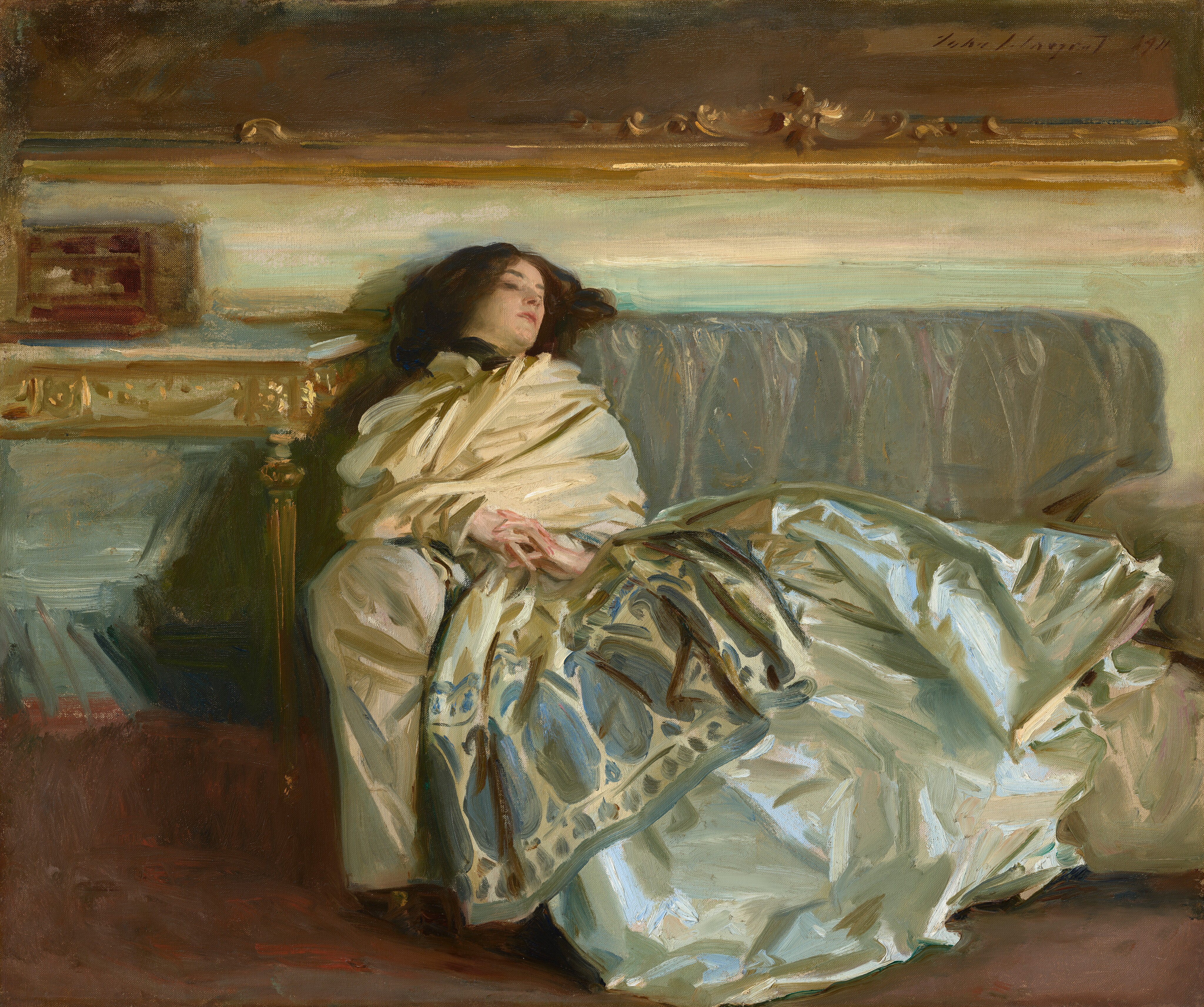
John Singer Sargent, Nonchaloir (Repose), 1911, National Gallery of Art


Wednesday, March 31, 2021

Wednesday's Random Slang-o-rama: Tuckered out

 Not sure what happened to the month of March. It seems that it just arrived and now it's gone and, wow, I am all tuckered out.

Tuckered out is defined in John Stephen Farmer's Americanisms, Old and New (c. 1887) as "Wearied, tired out, fatigued."

The phrase has a definite Western ring to it, don't you think?

>
>
>
>
>
>
>
>
>
>
>
>

However, it dates way before cattle-drives, wagon trains, and so on, and isn't even "of the West." 

According to The Phrase Finder, "Tucker is a colloquial New England word, coined in the early 19th century, meaning 'become weary' and which ultimately derives from the Old English verb tuck, meaning 'punish; torment'." From more than a century-and-a-quarter earlier, Farmer in his Americanisms concurs, noting that the colloquialism "is most common in New England."

The Phrase Finder tracked the first appearance of tuckered out to this intriguing quote from the April 1839 Wisconsin Enquirer:

"I reckoned to have got to the tavern by sundown, but I haven't - as I'm prodigiously tuckered out." 

The Historically Speaking website has a nice collection of quotes featuring tuckered out, starting in 1962 and going back to 1845. This post also suggests that the phrase might have been in use by 1820. I'd pursue that further, but, well, I'm tuckered out, so I'll leave it as an exercise to those with more energy than I have at the moment...

The #DivaMissMia demonstrates what it means to be tuckered out.
Photo by Ann Parker