Showing posts with label idioms. Show all posts

Wednesday, June 22, 2022

Wednesday's Random Slang-o-rama: Make hay while the sun shines

With the solstice, summer has officially arrived! Let's all make hay while the sun shines!

Hey/hay, guess when we started using that expression, which according to the Cambridge Dictionary means "to make good use of an opportunity while it lasts" (but you all knew that, right?).

>
>
>
>
>
>
>
>
>
>
>
>
The American Heritage Dictionary of Idioms by Christine Ammer pegs it to early 1500s, noting that it "alludes to the optimum dry weather for cutting grass." The ever-educational site The Phrase Finder gives us the first recorded appearance in John Heywood's "A Dialogue conteinyng the nomber in effect of all the Prouerbes in the Englishe tongue" in 1546:

 Whan the sunne shinth make hay. Whiche is to say.

Take time whan time cometh, lest time steale away. 

It's still daylight hours as I type this, so I'm going to call it good for today and go make some hay while the sun shines. May you do the same, and seize the moment however you wish!

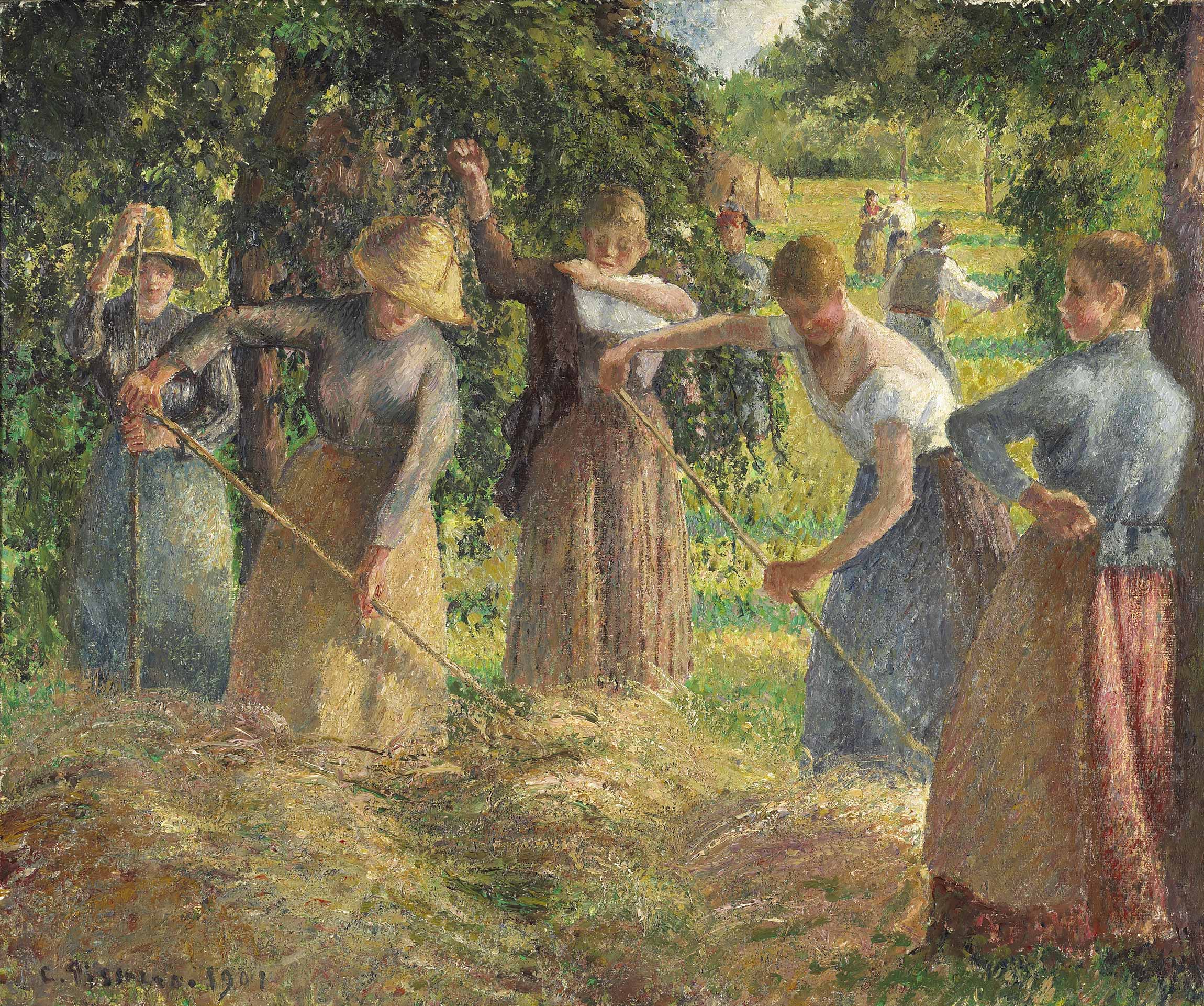
In real life, making hay is hot, dusty work.
Hay Harvest at Éragny, 1901, Camille Pissarro - National Gallery of Canada, Public Domain
https://commons.wikimedia.org/w/index.php?curid=35391190

Wednesday, April 27, 2022

Wednesday's Random Slang-o-rama: All in

 I'm baaaack from the Malice Domestic mystery convention and, whew, I have to say I am all in, as in "tired, exhausted" (Merriam-Webster, Entry 2 of 2, Definition 1). All in also means "fully committed or involved in something," which I get. But how/when did it come to mean just. plain. beat...?

>
>
>
>
>
>
>
>
>
>
>
>


I'm not the only one wondering, and The Grammarist addresses this very question, saying:

According to [Eric] Partridge’s Dictionary of Slang and Unconventional English, the term “all in” is a colloquial expression that originated on the floors of stock exchanges in the mid-19th century. If the market was “all in,” it was down or depressed; if it was “all out,” it was rising or inflated. By extension, the term “all in” was borrowed in the early 20th century to mean “exhausted” or “used up” in reference to people or animals who were verging on collapse.

Okay, that origin story makes sense to me. However, The Grammarist then says (essentially) "not so fast": 

... The Random House Historical Dictionary of American Slang has a somewhat different explanation: “all in” originated at the card table. If you were “all in,” you were broke (that is, out of money), because you had already put all of your money in the pot. So you couldn’t play anymore.

The American Heritage Dictionary of Idioms by Christine Ammer says this expression for exhaustion appeared in the last half of the 19th century, with the gambling reference first recorded in  1907.

The New Yorker did a deep dive into all in and its relation to politics in the 2015 article Going All In on "All In," noting:

In American usage, the phrase “all in” began as a colloquial expression meaning to be in a bad spot—exhausted, worn out, and spent. In the game of poker, it refers to the moment when a player—whether out of bravado, recklessness, or desperation—bets all of his or her chips on a single hand... Whereas “all in” once referred to a scenario in which someone either wins a hand or loses everything in a flash, now it means that a person is simply generally enthusiastic or fully committed. It’s everywhere these days—business jargon, marketing catch phrases, sports mantras, and the idioms of religion and self-help. The all-in moment in poker is a thrilling win-or-lose-everything crisis of dramatic clarity: you’ve wagered all you’ve got, giving your fate over to the cards, and you can’t go back out again. Going all in is often a spectacularly bad idea. But in life, it seems, it is all good—the only way to live boldly is to be all in on many different things at once. ... 

Whereas “all in” once referred to a scenario in which someone either wins a hand or loses everything in a flash, now it means that a person is simply generally enthusiastic or fully committed. It’s everywhere these days—business jargon, marketing catch phrases, sports mantras, and the idioms of religion and self-help.

The all-in moment in poker is a thrilling win-or-lose-everything crisis of dramatic clarity: you’ve wagered all you’ve got, giving your fate over to the cards, and you can’t go back out again. Going all in is often a spectacularly bad idea. But in life, it seems, it is all good—the only way to live boldly is to be all in on many different things at once.

And with that... I'm definitely all in. 

Naptime!
Repose by John White Alexander, 1895


Wednesday, April 13, 2022

Wednesday's Random Slang-o-rama: Hat trick

When I hear the phrase hat trick I think of the "Rocky and Bullwinkle" cartoon series and what happens when Bullwinkle tries the old magic "pull a rabbit out of my hat" trick. Summary: He attempts many times, without success. (See video below for that particular bit from the early 1960s series.)

So, what about hat trick? Old? New(ish)?

>
>
>
>
>
>
>
>
>
>
>

According to Mental Floss and a few other places, hat trick is closely tied to the sport of cricket, from 1858, where it was used when a team won three consecutive wickets. From there, the term meandered over to other sports, particularly ice hockey, to mean scoring three goals in one game. 

Well, shoot, what about the "pull a rabbit from a hat" hat trick? When did that definition come into being? The Online Etymology Dictionary has a pretty thorough entry, part of which I will cheerfully copy/paste here:

hat trick: ...the term probably has been influenced by the image of a conjurer pulling objects from his hat (an act attested by 1876). The term was used earlier for a different sort of magic trick:

Place a glass of liquor on the table, put a hat over it, and say, "I will engage to drink every drop of that liquor, and yet I'll not touch the hat." You then get under the table; and after giving three knocks, you make a noise with your mouth, as if you were swallowing the liquor. Then, getting from under the table, say "Now, gentlemen, be pleased to look." Some one, eager to see if you have drunk the liquor, will raise the hat; when you instantly take the glass and swallow the contents, saying, "Gentlemen I have fulfilled my promise: you are all witnesses that I did not touch the hat." ["Wit and Wisdom," London, 1860]

So this drinking hat trick dates to 1860, eh? I'll have to find somewhere I can use this in a book! 

Wednesday, March 9, 2022

Wednesday's Random Slang-o-rama: Wing it

Last week I was dancing the hokey pokey, and this week I'm winging it, because, well, I'm wondering when wing it came to mean improvise. (I sure hope it was before 1880, but I have an awful feeling that maybe it has to do with airplanes or some such...)

>
>
>
>
>
>
>
>
>
>
>
>
>
According to the Online Etymology Dictionary, the characters from my Silver Rush series should probably not wing it, although if they have some theater background, I might be able to squeak by. Here's the OED entry:

Verbal phrase wing it (1885) is said to be from a theatrical slang sense of an actor learning his lines in the wings before going onstage, or else not learning them at all and being fed by a prompter in the wings; but perhaps it is simply an image of a baby bird taking flight from the nest for the first time (the phrase is attested in this sense from 1875).

Hmmmm, 1885. Since my series has now inched up into 1882 San Francisco (which had many many theaters, dance halls, etc., in this timeframe), I'm thinking that the phrase might have been in verbal use by then.

Maybe.

Looking around a bit more, I came across this in The Phrase Finder:

'Winging it' is a theatrical expression which refers to impromptu performances that given by actors who had hurriedly learned their lines while waiting in the wings and then received prompts from there. This phrase dates from the late 19th century and the verb 'to wing' was defined in an 1885 edition of Stage magazine: "'To wing'... indicates the capacity to play a rôle without knowing the text, and the word itself came into use from the fact that the artiste frequently received the assistance of a special prompter, who... stood... screened by a piece of the scenery or a wing."

Well, that's good to know. At least the origin of the phrase doesn't have anything to do with mechanical flight...

No winging it when you're on stage in 1874.
The Rehearsal of the Ballet Onstage by Edgar Degas, ca. 1874 https://www.metmuseum.org/art/collection/search/436155


Wednesday, September 29, 2021

Wednesday's Random Slang-o-rama: By the seat of the pants

Are you someone who plunges in and does things by the seat of your pants? And, if you are a writer, do your characters act by the seat of their pants?

If the latter, and you write historical fiction, I hope your characters are mid-20th century, because...

>
>
>
>
>
>
>
>
>
>
>
>
>
>

...This idiom, which is defined in The American Heritage Dictionary of Idioms by Christine Ammer as meaning "using intuition and improvisation rather than method or experience," is relatively new. According to Ammer: 

This expression was invented by World War II fliers, who used it to describe flying when instruments were not working or weather interfered with visibility. It was transferred to broader use soon after the war.

The Phrase Finder pretty much agrees, noting that it is parlance from the early days of aviation:

Aircraft initially had few navigation aids and flying was accomplished by means of the pilot's judgment. The term emerged in the 1930s and was first widely used in reports of Douglas Corrigan's flight from the USA to Ireland in 1938. That flight was reported in many US newspapers of the day, including this piece, titled 'Corrigan Flies By The Seat Of His Pants', in The Edwardsville Intelligencer, 19th July 1938.

But... why pants? Seems like there's more to this. A Way with Words offers a little more background:

Back in the 1930s, airplane pilots didn’t have sophisticated instruments to tell them which way was up. When flying through clouds, they literally relied on changes in the vibrations in their seat to help them stay on course, flying by the seat of their pants.

NOW I'm satisfied. Back to my seat of the pants writing.

I'd say this pilot might've been flying by the seat of his pants, but it's about 20 years too early for that...
 By Deseronto Archives - https://www.flickr.com/photos/deserontoarchives/8512946263/, No restrictions, https://commons.wikimedia.org/w/index.php?curid=53061107


Wednesday, September 22, 2021

Wednesday's Random Slang-o-rama: I'll eat my hat

 I'll eat my hat.

No, no, sorry to disappoint you, dear readers, but I won't. However, I do wonder about the origin of this expression. Did it arise when hats were small (and perhaps, boilable)? Or during some era when big, fancy hats with enthusiastic plumage was popular (yuck!)?

Time to put on my thinking cap/hat and do a little digging...

>
>
>
>
>
>
>
>
>
>
>
>
>
According to The American Heritage Dictionary of Idioms by Christine Ammer, the phrase eat one's hat, meaning to "declare one's certainty that something will not happen or is untrue," appeared in the first half of 1800s. Ammer offers up an 1837 quote from Charles Dickens' Pickwick Papers: "If I knew as little of life as that, I'd eat my hat and swallow the buckle whole."

The Today I Found Out website has a nice post exploring the expression, including this bit:

According to the venerable Oxford English Dictionary, the earliest known example of the phrase comes from the 1762 book Homer Travestie, by Thomas Bridges. The book is a parody of the more famous Iliad and contains a line that reads: "For though we tumble down the wall, And fire their rotten boats and all, I’ll eat my hat, if Jove don’t drop us, Or play some queer rogue’s trick to stop us." 

The poster goes on to say that Bridges probably didn't coin the phrase so much as switched it up from an older expression: I'll eat Old Rowley's hat.

Whaaat (or whooo) is Old Rowley?? And what was special about this this hat? Luckily for me, the post continues:

As for who “Old Rowley” was, this may be referring to King Charles II who was called such owing to his reputation with women combined with the fact that “Old Rowley” was the nickname of one of the King’s prized stallions. This is referenced, among other places, about a century after Charles II’s death in The Biographical History of England (1775)...As for why the saying specifically mentioned the king’s hat instead of, say, his shoes or his underwear, this is speculated to be due to the king’s fondness for fabulously flamboyant hats which would be exceptionally difficult, if not impossible, for a person to eat.  

The Phrase Finder says essentially the same thing, mentioning a dubious alternative origin based on the possibility that "hatte" was a medieval word for a veal pie. However Phrase Finder  has its doubts, adding:

...Pies can be eaten, certainly, but these 'hatte' pies were a 15th century creation and the word was never in sufficient circulation for it to have been recorded in the OED, which claims, with good reason, to be 'the definitive record of the English language'. Nor does 'eat my hat' appear in print until 200 years after the last person ate a hatte. Also, 'eat my hat' has always meant 'submit myself to something unpleasant if I prove to be wrong'. Eating veal pies is far from unpleasant, and so the supposed derivation doesn't match the meaning.   

I looked at the hats from the time of Charles II, and must say that eating one of those looks VASTLY more unappetizing than devouring a meat pie...
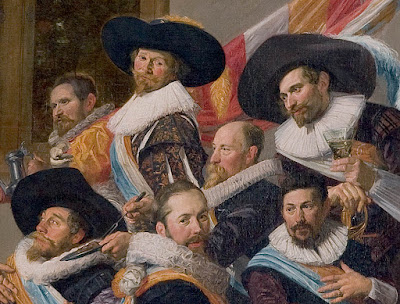
Don't even think about eating THESE hats!
By Frans Hals - Frans_Hals_015.jpg, Public Domain, https://commons.wikimedia.org/w/index.php?curid=17607317


Wednesday, September 16, 2020

Wednesday's Random Slang-o-rama: Needs must when the devil drives


I was zipping along writing a scene when the phrase needs must when the devil drives floated into my mind. It sounded like it would fit right in with what I was fashioning on the page, but I needed to be sure that (1) I understood the meaning and (2) it was "period" enough.
>
>
>
>
>
>
>
>
>
>
>
>
>
>
>
According to World Wide Words, this phrase—or rather, an early permutation—appears in 1420 in John Lydgate's Assembly of Gods, as follows: "He must nedys go that the deuell dryves." Something similar shows up in Shakespeare's All’s Well that Ends Well: "My poor body, madam, requires it: I am driven on by the flesh; and he must needs go that the devil drives."

World Wide Words adds that the semi-archaic needs must is an idiom in and of itself, meaning "necessity compels," and provided a nice definition of the entire phrase:
[I]f the devil drives you, you have no choice but to go, or in other words, sometimes events compel you to do something you would much rather not.
If you are curious about needs must, you can read more about it here, on The Grammarphobia Blog.

My takeaway: My fictional 1882 character could definitely think needs must when the devil drives, take a deep breath, and do what must be done.

Who's driving now?
By Roberts [artist] This file comes from the Bodleian Libraries, a group of research libraries in Oxford University. Public Domain, https://commons.wikimedia.org/w/index.php?curid=47060855

Wednesday, August 26, 2020

Wednesday's Random Slang-o-rama: Spur of the moment


With California's largest wildfire just over the hill about 10 miles south, we've made our list, checked it twice, and have our go bags and bins ready to load up, if we find we need to leave on the spur of the moment.

Taking a pause from compulsively refreshing Cal Fire's page on the SCU Lightning Complex (20% contained) to wonder about on the spur of the moment. Does this have to do with cavalry and spurring horses to gallop faster or what?

>
>
>
>
>
>
>
>
>
>
>

>

>

Word Histories has a nice entry about on the spur of the moment and a variant, on the spur of the occasion. The earliest appearance of the first is July 24, 1784, in Jackson’s Oxford Journal and has to do with a proposal to tax... (wait for it)... watches. As in, timepieces. And the origin does harken to "the use of spurs to urge a horse forward."

The American Heritage Dictionary of Idioms by Christine Ammer concurs. 

The Online Etymology Dictionary adds that the expression, which they nudge forward to 1801 for first use, "preserves [the] archaic phrase on the spur 'in great haste'" from the1520s. 

And that's all I've got for now!

Don't wait until the spur of the moment to pack your go bag!
By Anonymous - Official Guide and Catalogue of the International Fire Exhibition, Earl’s Court, 1903 (https://archive.org/details/internationalfir00earl/page/n37), Public Domain, Link


Wednesday, July 15, 2020

Wednesday's Random Slang-o-rama: Hat in hand


I wrote the phrase hat in hand in my Silver Rush WIP, then had to stop and look it up. (Of course!)
>
>
>
>
>
>
>
>
>
>
>
>
>
>
>
According to Merriam-Webster, hat in hand, a phrase that indicates something is done "in an attitude of respectful humility," dates from 1821, putting it comfortably in the earlier part of the 19th century. The American Heritage Dictionary of Idioms by Christine Ammer includes cap in hand with a definition of "in a humble manner." Ammer places first use of the phrase circa 1700 and adds:
This expression alludes to removing one's headgear as a sign of respect and has survived the era of doffing one's hat.
[ASIDE: Doffing... love that word! Will have to find a place for it...]

In any case, doing something hat in hand is perfectly reasonable for my 1882-era characters, whether they proceed literally or figuratively.

This guy does not look like the "hat in hand" type.
General Étienne-Maurice Gérard (1816) by Jacques Louis David
The Metropolitan Museum

Wednesday, June 17, 2020

Wednesday's Random Slang-o-rama: By the skin of one's teeth


When a character of mine managed to escape detection by the skin of her teeth, I stopped and thought about that a bit. Since when do teeth have skin? Maybe if they haven't been brushed in a long time? (eeeuw!) And where did that little phrase come from anyway?

Sooooo many distractions from focusing on plowing through Book #8!

But I don't want to use an anachronistic phrase if I can avoid it, so time to sink my teeth into by the skin of one's teeth.
>
>
>
>
>
>
>
>
>
>
>
>
>
>
To my vast relief, this appears to be a very old phrase. In fact, thousands of years old, according to The Grammarist:
By the skin of one’s teeth means just barely, by a narrow margin, just in time. The phrase by the skin of one’s teeth is found in the book of Job in the Old Testament of the Bible. Job is a character in the Bible who undergoes an abundance of suffering due to a challenge that Satan has made to God. Satan tries to break Job’s righteousness by bringing suffering upon him. Job laments his status through much of the book, including the phrase, “My bone cleaveth to my skin and to my flesh, and I am escaped with the skin of my teeth.” What exactly the phrase “escaped with the skin of my teeth” meant in Ancient Hebrew is unknown. It is assumed that the skin referred to in the term skin of my teeth is the enamel, though this is only a guess.
World Wide Words notes the idiom appeared first in the Geneva Bible of 1560 and is a direct translation of the original Hebrew:
Since teeth don’t have skin, the phrase is hard to make sense of; Bible translators and commentators have struggled with it down the centuries. The Douay-Rheims Bible has instead “My bone hath cleaved to my skin, and nothing but lips are left about my teeth.” Other writers have suggested that the reference is to the gums.... 
One modern writer has concluded: "The explanations for the last metaphor are multiple and unconvincing. Its meaning eludes us."
I guess all we can conclude is: 'tis a mystery!
Meeting deadlines by the skin of my teeth (i.e., barely)
Image by Dmitry Abramov from Pixabay


Wednesday, June 10, 2020

Wednesday's Random Slang-o-rama: Tin ear


A character in my work-in-progress claims to have a tin ear. I dutifully recorded it... and stopped.

And how did "tin" get all wrapped up with ears? And how old is that idiom, anyway? My books are set in the 1880s, long before author L. Frank Baum introduced the Tin Man in his 1900 book, The Wonderful Wizard of Oz.

So, I proceeded down my virtual version of the Yellow Brick Road to figure out the when, where, and why of the phrase tin ear.
>
>
>
>
>
>
>
>
>
>
>
>
>
According to the Online Etymological Dictionary, tin ear, meaning "lack of musical discernment," has been around since 1909.

The Stack Exchange has a lively discussion on this phrase and throws out several theories on its origin, including:
  • Ear trumpets made of tin 
  • Tin (plate) as cheap and nasty
  • Tin instruments or dropped items made of tin sounding horrible
  • A tale of using a piece of tin on a morse buzzer to amplify the sound
  • Tinnitus
One intrepid Stack Exchange responder noted:
The earliest record I can track of the use in print is in the novel Titan:A Romance, by Jean Paul Richter, published in translation from the German in 1863 and in the original language between 1800 and 1803. 
In that early 19th century novel, tin ear is synonymous with an ear trumpet. Alas, not the meaning I had in mind at all for my character who is in San Francisco in 1882.

Changes were required.

Now, the poor fellow no longer has a tin ear but is tone deaf (which I found in an 1876 tome and an 1880 magazine... good enough for my purposes!).


Not the tin ear I was hoping for, but pretty cool, nonetheless.
A collapsible Victorian ear trumpet made of tin made by Atkinson, Union Court, Holborn, London
See page for author / CC BY

Wednesday, May 6, 2020

Wednesday's Random Slang-o-rama: Sail close to the wind


Those of you who are nautically inclined will no doubt know the origins and meaning of the phrase sail close to the wind, and why it has an air of danger about its definition. However, I do not, and since I'm mucking around with bits of maritime history as I trudge along drafting book #8 of the Silver Rush series, it seemed time to look this one up...
>
>
>
>
>
>
>
>
>
>
>
>
>
>
>
>
>
>
The American Heritage Dictionary of Idioms by Christine Ammer summarizes as follows:
sail close to the wind: Be on the verge of doing something illegal or improper, as in "She was sailing pretty close to the wind when she called him a liar." This term alludes to the danger incurred when literally sailing too close to (that is, in the direction of) the wind. Its figurative use dates from the first half of the 1800s.
Well, that's pretty cool! And I rather like the sample sentence. There are all kinds of folks my protagonist Inez could accuse of sailing close to the wind in my current work-in-progess. In fact, she could be probably be accused of the same.

There is a little more back'n forth about the phrase over at The Phrase Finder, to wit:
This is a true sailing expression. Sail boats have different characteristics, but all need wind. Some can harvest the wind better than others. If you sail close to the edge of direction that the wind is coming from you may well lose the wind altogether, but you may be able to make better progress than a boat that can't sail as well in such a difficult situation. Thus, if you can 'sail close to the wind' then you can benefit, but you enter a risky area and may lose all!
I looked around a bit more, but that was about all I could find that shed light on this particular phrase. At least, the timing gives me license to let my characters sail close to the wind—in some cases, with disastrous results.

Sailed too close to the wind? Or a reef?...
Shipwreck by Ivan Aivazovsky, 1854

Wednesday, March 18, 2020

Wednesday's Random Slang-o-rama: An arm and a leg


Hello all! I hope you are all staying healthy in these uncertain times. And what kind of a crazy place is this where toilet paper (of all things) has become a commodity as scarce as hen's teeth, and when one does find a pack of the precious paper, it costs an arm and a leg??

And when did things that fetch a pretty penny come to demand various appendages in payment in addition to the coin of the realm?
>
>
>
>
>
>
>
>
>
>
>
>
>
The American Heritage Dictionary of Idioms by Christine Ammer says that the idiom arm and a leg became widely known from the 1930s on, and probably had its origins in the 19th-century American criminal slang phrase if it takes a leg (that is, even at the cost of a leg), to express desperate determination.

Phrase Finder offers a more detailed theory:
'It cost and arm and a leg' is one of those phrases that rank high in the 'I know where that comes from' stories told at the local pub.... It is in fact an American phrase, coined sometime after WWII. The earliest citation I can find is from The Long Beach Independent, December 1949:
Food Editor Beulah Karney has more than 10 ideas for the homemaker who wants to say "Merry Christmas" and not have it cost her an arm and a leg.
'Arm' and 'leg' are used as examples of items that no one would consider selling other than at an enormous price. It is a grim reality that, around that time, there were many US newspaper reports of servicemen who had lost an arm and a leg in the recent war. It is possible that the phrase originated in reference to the high cost paid by those who suffered such amputations. A more likely explanation is that the expression derived from two earlier phrases: 'I would give my right arm for...' and '[Even] if it takes a leg', which were both coined in the 19th century. The earliest example that I can find of the former in print is from an 1849 edition of Sharpe's London Journal:
He felt as if he could gladly give his right arm to be cut off if it would make him, at once, old enough to go and earn money instead of Lizzy.
The second phrase is American and an early example of it is given in this heartfelt story from the Iowa newspaper the Burlington Daily Hawk-Eye, July 1875:
A man who owes five years subscription to the Gazette is trying to stop his paper without paying up, and the editor is going to grab that back pay if it takes a leg.

Interesting!

In any case, I hope that, if you are on the search for toilet paper, buying such does not involve losing limbs or handing over great amounts of capital.

Stay healthy, stay sane, and share with others less fortunate and/or more desperate, if you can.

It does seem a bit like this lately...
Image by bbasilico0 from Pixabay

Wednesday, January 29, 2020

Wednesday's Random Slang-o-rama: For a song


When you can obtain something for a song, you expect to get it inexpensively, right? In fact, The American Heritage Dictionary of Idioms by Christine Ammer defines the phrase as meaning "very cheaply, for little money, especially for less than something is worth" and gives an example straight out of Shakespeare's All's Well That Ends Well:
I know a man... sold a goodly manor for a song.
So how long has this idiom been around, and why would it refer to buying on the cheap?

Any guesses?
>
>
>
>
>
>
>
>
>
>
>
>
Ammer places its first appearance in the late 1500s (well, Shakespeare, after all) and notes:
"This idiom alludes to the pennies given to street singers or to the small cost of sheet music." The Free Dictionary says pretty much the same: "The ultimate origin of this phrase is probably the practice, in former times, of selling written copies of ballads very cheaply at fairs." According to this entry, the expression was in common use by the mid-17th century.

TheIdioms.com goes with a first appearance in the 1500s and agrees that the phrase probably refers to street singers, adding, "They would stand on the side of the street and people would give them pennies. Singing was not seen as a large accomplishment as it could be done by everyone. Therefore, you would not be paid much for it."


Singing... not a large accomplishment???
The idiom is probably related to street singers. They would stand on the side of the street and people would give them pennies. Singing was not seen as a large accomplishment as it could be done by everyone. Therefor, you would not be paid much for it. You would also have to pay for sheet music (1500s.) (Theidioms.com)

Theia Carrington Drake, my fictional prima donna who takes center stage in my newest Silver Rush historical mystery, MORTAL MUSIC, would vehemently disagree.


You won't get this kind of singing for a song.
By Thomas Rowlandson - JwFP_imNhhV_iw at Google Cultural Institute maximum zoom level, Public Domain, Link


Wednesday, January 22, 2020

Wednesday's Random Slang-o-rama: Face the music


In my newest Silver Rush novel MORTAL MUSIC, several characters—including prima donna Theia Carrington Drake—must face the music as the story unfolds.

Since I'm exploring music-related slang this month, this seems like the perfect time to dig into the origins of this idiom. On the surface, to face the music sounds enjoyable—what's not to like about experiencing a musical interlude? (Unless it's really loud or not to your liking, of course.) But the definition of this phrase is anything but pleasant: to meet, take, or accept the consequences of one's mistakes, actions. 

So, what's the origin, and why isn't facing the music a more welcome prospect?
>
>
>
>
>
>
>
>
>
>
>
>
PhraseFinder's thorough entry reflects my musing before giving a shrug:
The phrase 'face the music' has an agreeable imagery. We feel that we can picture who was facing what and what music was playing at the time. Regrettably, the documentary records don't point to any clear source for the phrase and we are, as so often, at the mercy of plausible speculation...
 Two possibilities offered up are:
  1. It reflects the tradition of disgraced officers being "drummed out" of their regiment
  2. It originated in the theater world: Actors "face the music" when they go onstage and face the orchestra pit.
The PhraseFinder notes the phrase first popped up in U.S., with one of its earliest appearances in The New Hampshire Statesman & State Journal in August 1834:
Will the editor of the Courier explain this black affair. We want no equivocation - 'face the music' this time.
My copy of American Slang: Second Edition, edited by Robert L. Chapman, has the phrase in use by 1850 and offers two possible sources:
  1. It might have come about from the necessity of forcing a cavalry horse to steadily face the regimental band.
  2. It refers to the plight of a performer on stage.
I'm going to go with the second suggestions in both cases. For me and MORTAL MUSIC, it hits the right note!

Unlike some of my characters, this singer is prepared to face the music.
By Ivan Kramskoi - The Russian Museum, St. Petersburg, Russia., Public Domain, https://commons.wikimedia.org/w/index.php?curid=6359697
POSTSCRIPT: In the comments to this post, Liz V notes she found another "origin story" for face the music on the World Wide Words blog site. Theory: That it comes from contra dancing (which I also had to look up... :-) ). Thank you, Liz!

Wednesday, January 15, 2020

Wednesday's Random Slang-o-rama: Chin music


As promised, here's another musical idiom to herald the upcoming release of the seventh book in my Silver Rush series, MORTAL MUSIC:

 Chin music.

I'll confess, this is a new one to me. Not that it's "new." In fact, it apparently first appeared almost two centuries ago...

>
>
>
>
>
>
>
>
>
>
>
>
>
>
>
According to American Slang, Second Edition, edited by Robert L. Chapman Ph.D., chin music has several definitions, depending on the context. It can mean:
  1. talk, especially inconsequential chatter or chitchat (first appeared in 1830s)
  2. various kinds of raucous shouting at a baseball game, from the crowd, from the players to each other, from the players or manager to the umpires, etc. (by 1880s)
  3. a pitched ball that passes close to the batter's face; a beanball (by the 1980s)
I checked this one on Google's ngram, and sure enough, there it is, going waaaay back.


I dug a little deeper and found several 19th-century examples, including the one below from Potter's American Monthly: An Illustrated Magazine of History, Literature, Science and Art, Volumes 10–11 (1878).

Chin music would fit right in with my Silver Rush series. So is this idiom new to you as well? Or is it just me?
A chin-music ensemble? (Cue the accompanist, entering the room.)
By Eugene de Blaas - Art Renewal Center, Public Domain, https://commons.wikimedia.org/w/index.php?curid=7753932


Wednesday, December 4, 2019

Wednesday's Random Slang-o-rama: As scarce as hen's teeth


Continuing on a bird-themed exploration of idioms and expressions (see last week's post for cold turkey), I had occasion to write as scarce as hen's teeth, and then (as is my wont), I wondered.

Who on earth came up with that phrase (which, by the way, means "exceptionally rare")? And how far back does it go? I'm guessing mid-19th century, for no reason other than it seems there would've been a lot of chickens running around on farms and homesteads then.

Let's find out!
>
>
>
>
>
>
>
>
>
>
>
>
>
>
>
According to the entry for this saying in Heavens to Betsy and Other Curious Sayings by Charles Earle Funk:
Just when this hyperbole first appeared has not yet been determined. The Dictionary of Americanisms reports its use by "Edmund Kirke," pen name of Fames R. Gilmore, in My Southern Friends (1862). But because this metaphor is thoroughly familiar in all parts of the country, there's good reason to believe that it may actually have had word-of-mouth use from colonial days.
The American Heritage Dictionary of Idioms by Christine Ammer pretty much concurs, citing mid-1800s for this expression.

However, not so fast.... there's more!

 I was googling about and, lo and behold, I found a 2006 article in Science Daily titled "Hens' Teeth Not So Rare After All." The abstract reads:
Scientists have discovered that rarest of things: a chicken with teeth -- crocodile teeth to be precise. Contrary to the well-known phrase, "As rare as hens' teeth," the researchers say they have found a naturally occurring mutant chicken called Talpid that has a complete set of ivories.
  I'm speechless. Metaphorically speaking.
Show us those teeth!
Image by Capri23auto from Pixabay

Wednesday, November 20, 2019

Wednesday's Random Slang-o-rama: In cahoots


The phrase in cahoots has a slightly "Old West" ring to me, although that might simply be due to an overabundance of old-time black-and-white TV Western-watching from the early 1960s. That aside, I have no idea what a single cahoot is. Do you?
>
>
>
>
>
>
>
>
>
>
>
>
>
>
>
>
>
>
>
According to Merriam-Webster, the definition of cahoot is "partnership, league." However I could probably be forgiven for wondering if the singular form even exists:
Cahoot is used almost exclusively in the phrase "in cahoots," which means "in an alliance or partnership." In most contexts, it describes the conspiring activity of people up to no good. (There's also the rare idiom go cahoots, meaning "to enter into a partnership," as in "they went cahoots on a new restaurant.") "Cahoot" may derive from French cahute, meaning "cabin" or "hut," suggesting the notion of two or more people hidden away working together in secret. "Cahute" is believed to have been formed through the combination of two other words for cabins and huts, "cabane" and "hutte."
M-W claims the term first appeared in 1827. The Online Etymological Dictionary begs to differ in time frame, putting first use at 1829 (well, let's not quibble over a couple of years) and also suggests a different origin, to wit:
... U.S. sources [Bartlett] credit it to French cohorte (see cohort), which is said to have had a sense of "companions, confederates."
If you wish to dig a little deeper into the mysterious origin of cahoot(s), with early examples of use, I recommend checking out this post of The Grammarphobia Blog.

In any case, the phrase in cahoots certainly smacks of skulduggery to me and... hmmmm... I do believe I just stumbled upon next week's slang-o-rama topic...

Is this mob of meerkats in cahoots? Maybe.
Image by Rhulk G. from Pixabay


Wednesday, November 6, 2019

Wednesday's Random Slang-o-rama: Playing hooky


Well, I took last week away from almost everything to go to Iceland and chase around after the Northern Lights. I had a marvelous time, yet still felt a little guilty, as if I was playing hooky from my endless lists of to-dos and responsibilities. But abandon Slang-o-rama? Never!

So, let's take a closer look at playing hooky...
>
>
>
>
>
>
>
>
>
>
>
... However, first, a few photos from my trip...
>
>
>

>
>
>
>
>
>
Now that I've shared some of the lovely scenery from this fascinating land of ice and snow, let's return to play hooky, which, according to Dictionary.com, means "be absent from school or some other obligation without permission."

The American Heritage Dictionary of Idioms by Christine Ammer notes that the term play hooky dates from the mid-1800s and adds
In this term, the noun hooky may have come from the phrase hook it, meaning "escape."
I shall close with a little Led Zepplin, because.... (see link re: land of ice and snow, above).

Wednesday, May 22, 2019

Wednesday's Random Slang-o-rama: Swan song


No, I am not going away, nor is my protagonist Inez. But swan song does pop up in passing in Inez's musings as I gallop to the final line of Silver Rush book #7. The phrase sounds very Shakespearean to me, but what do I know? I've been fooled before by idioms that sound "old" but are "new" (and vice versa).

So, swan song. Pre- or post-1880s? Want to hazard a guess?
>
>
>
>
>
>
>
>
>
>
>
>
>
Of course, I'm not going to guess. I'm going to research!

First stop (because the book is right at hand) is my trusty American Heritage Dictionary of Idioms by Christine Ammer:
swan song: A final accomplishment or performance, one's last work. ... The term alludes to the old belief that swans normally are mute but burst into beautiful song moments before they die.
Hey! This is perfect for my scene! I must use it! But then the entry continues:
...Although the idea is much older, the term was first recorded in English only in 1890.

What?? 1890??

I want a second opinion. And maybe a third.

Next stop, The Phrase Finder, which includes a quote from the Swan of Avon, William Shakespeare (yes!!) from 1596. The following appears in The Merchant of Venice, straight from Portia: "Let music sound while he doth make his choice; then, if he lose, he makes a swan-like end, fading in music." 

The Online Etymological Dictionary obliges me by noting, "swan-song (1831) is a translation of German Schwanengesang." 

I check several more references on my bookshelf. Nothing for swan song. How can that be? I finally turned to an old dependable: Merriam-Webster's Collegiate Dictionary, 10th Edition. It does not let me down.
swan song (1831) 1: a song of great sweetness said to be sung by a dying swan 2: a farewell appearance or final act or pronouncement.
 Good enough for me! I close the book, and allow Inez to ponder on a diva's swan song.
And here you have it! Ossian Singing His Swan Song, painted circa 1780, by Nicolai Abildgaard.
Not quite the singer I have in mind, but still...
[Public domain]