Showing posts with label Camille Minichino. Show all posts

Sunday, July 28, 2024

A Dear Friend Completes Life's Journey: Rest in Peace, Camille Minichino

Camille Minichino, my dear friend of nearly 46 years, died Monday, May 6, 2024. She was companion, colleague, mentor, teacher, ally, and more to me and many many others. By any measure, she was an amazing person, one in a million, and will be sorely missed. It's hard to put thoughts into words at this point, so instead, I'll share a letter that was sent to those on her snail-mail "Christmas list." Below the letter, I'll add links to tributes, obituaries, etc., as I find them. If you come across any postings/articles, feel free to contact me and I will add them.

To receive updates about services in honor of Camille, please click on this link and provide your email address. Your email will only be used to provide information about such events.

 https://form.jotform.com/241314790968162


-------------------

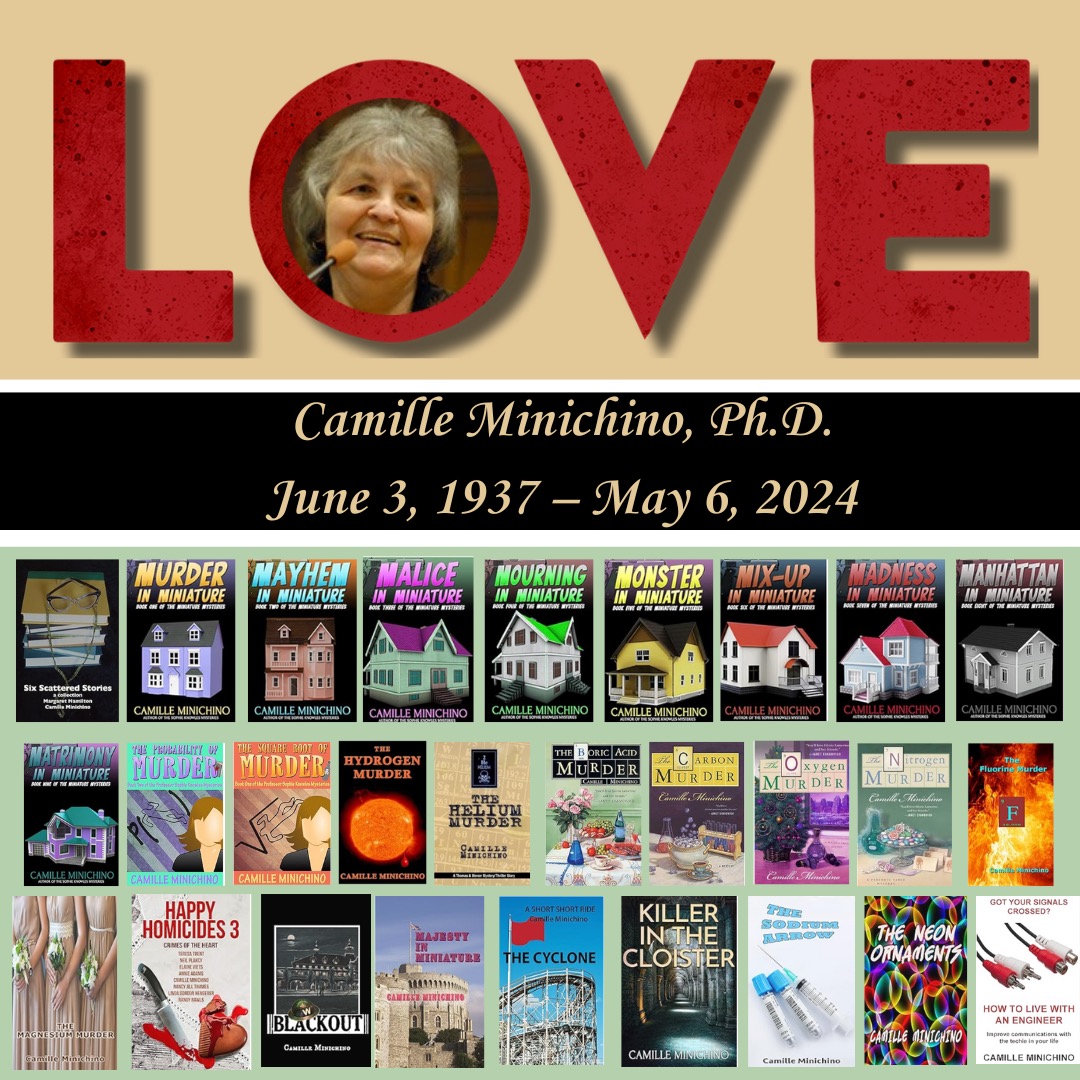
Camille Minichino, Ph.D.
June 3, 1937 – May 6, 2024

Dear Family, Friends, and Colleagues of Camille Minichino

It is with sorrow we are informing you that Camille passed away on Monday, May 6, 2024, after a brief illness. What follows is an overview of her life, which in no way captures the amazing totality of a life "well and truly lived."

Born in Revere, Massachusetts, in June 1937, to Joseph and Helen Avallone Minichino, Camille was the first of two daughters; sister Arlene Minichino Polinene predeceased her. Camille often related how her father, a laborer, introduced her first to the joys of mathematics by showing her how to measure, multiply, and divide. After graduating from Revere High School, her love of mathematics and physics grew at Emmanuel College where several sisters took her under their wings and nurtured and encouraged her intellect and scientific curiosity. At the urging of these role models, Camille graduated with a B.A. in Mathematics in 1958. She then joined the Sisters of Notre Dame, where she remained for 18 years, and attended Fordham University, New York City, where she carried out experimental physics research in spectroscopy and obtained a Ph.D. in Physics in 1968, one of three women in a department of nearly 80 students. After leaving the order, she moved to California, and during her 30-year career at Lawrence Livermore National Laboratory worked in high-temperature, high-pressure physics, provided technical support to the Nuclear Regulatory Commission in pre- and post-Three Mile Island, and consulted at commercial reactors throughout the country. She also worked on problems of nuclear waste management and co-authored a book on the subject in 1982 (Nuclear Waste Management Abstracts, with Richard Heckman). 

As an educator and professor, Camille developed and taught physics, mathematics, philosophy, critical thinking, and interdisciplinary courses at all levels. She served on numerous academic faculties: Golden Gate University, San Francisco; Emmanuel College, Boston; St. John’s College, Boston; Dominican University, San Rafael, California; and John F. Kennedy University, Orinda, California. She also developed and taught writing classes and workshops at community colleges and through various writers’ organizations, including Emeritus College (Diablo Valley College), California Writers Club, and Sisters in Crime (an organization for mystery readers and writers). Which brings us to the third part of her professional journey…
 
Camille is the author of nearly 30 published mystery novels, plus numerous short stories and articles in both technical and popular magazines and websites. Her mystery series included The Periodic Table Mysteries, The Miniature Mysteries, the Professor Sophie Knowles Mysteries, The Postmistress Mysteries, The Alaskan Diner Mysteries, and the Sister Francesca Mystery.

She loved See's Candies, a well-crafted, bone dry, whole milk decaf cappuccino, Amici's margherita pizza (hold the sauce!), designing and creating "miniature" scenes and dollhouses, watching movies (especially The Godfather), throwing parties (including gatherings to celebrate the Academy Awards, Fourth of July, New Year's Eve, and birthdays), reading across the spectrum of fiction and nonfiction, and supporting her artistic friends by buying their jewelry, knit items, and crafts. She also was there to raise a hand when the call went out for volunteers for all the myriad organizations she belonged to, or when a friend, family member, or student needed a hand or a listening ear or just wanted to grab an ice cream cone and a chat at the nearby Loard's Ice Cream Parlor. Although she lived in the San Francisco Bay Area for 50 years, she still considered herself a "New Yorker," and regular trips to the Big Apple, with its museums and bookstores, helped feed her city-soul.

On her blog site, The Real Me, Camille described herself as follows: "I've been a factory worker, a translator, a teacher, an experimental physicist, a nuclear safeguards engineer, a writer, a waitress, a miniaturist, a paralegal, a nun, a minister, a short order cook, a ticket taker, an editor, a crafter, and a cotton candy twirler... plus a wife."

No overview of Camille's life is complete without acknowledging the deep devotion she shared with her husband, Richard (Dick) Rufer. Camille and Dick met at "The Lab" and married in 1977. Dick was, without question, the great love of her life. They watched movies together, conspired on solving crossword, acrostic, and jigsaw puzzles and creating cryptoquotes. Camille often fondly referred to Dick as her "24/7 tech support" and/or "The Cable Guy." He was the inspiration for her book How to Live with an Engineer. Over their nearly half-century of marriage, they exchanged nightly love-notes. Dick was always there for her, and she for him. Dick predeceased Camille by two months, shattering her world. Although her death certificate states a medical cause of death, all who knew Camille and supported her for those months after Dick's death know that she really died of a broken heart.

Camille is survived by a number of cousins and second cousins, and by legions of friends, colleagues, and students.

Yours in shared joy at having had Camille in our lives,

A small committee of Camille's friends
-------------------------

LINKS AND OTHER TRIBUTES

Thank you, mystery author Gabriel Valjan, for creating the lovely visual tribute below that captures all of Camille's mystery titles...
Credit: Gabriel Valjan


Wednesday, March 1, 2023

Wednesday's Random Slang-o-rama: Chockablock

Just off the top of my head, I'd define chockablock as "stuffed full" as in "My mind is chockablock with a million to-dos today" (including this Slang-o-rama post!).

>
>
>
>
>
>
>
>
>
And yep, I'm more or less correct according to Merriam-Webster, which offers up the following two definitions: (1) brought close together and (2) very full. But there's more! 

According to M-W, chockablock began its linguistic life as a nautical term:

...A block is a metal or wooden case with one or more pulleys inside. Sometimes, two or more blocks are used as part of a rope and pulley system called a "block and tackle" to provide a mechanical advantage—as, for example, when hoisting a sail on a traditional sailing ship. When the rope is pulled as far as it will go, the blocks are tight together and are said to be chockablock. Non-nautical types associated the chock in chockablock with chock-full, which goes back to Middle English chokkefull, meaning "full to the limit" (a figurative use of "full to choking"). We thus gave chockablock the additional meaning "filled up." Chockablock can also be an adverb meaning "as close or as completely as possible," as in "families living chockablock" or the seemingly redundant "chockablock full."

The Online Etymology Dictionary provides 1840 as the first appearance of chockablock in writing, so it's been around for a while.

With that, I can check one item off my to-do list for today. Hurray!!

Thank you, Camille Minichino, for this suggestion for Slang-o-rama...

Chockablock blocks?
Image by M W from Pixabay


Wednesday, August 18, 2021

Wednesday's Random Slang-o-rama: 1940s slang (by guest author Camille Minichino)


Please welcome good buddy and guest Slang-o-rama blogger, Camille Minichino. Camille is the author of 28 mystery novels in 5 series, plus many short stories and articles. All her names, blogs, and publications can be found at www.minichino.com. Her latest, “Murphy’s Slaw” is available here.

------------------------------------

Over the years, a coffee order went from a cuppa mud (1940) to a venti, decaf iced, sugar-free, vanilla latte with soy milk or a grande, quad, nonfat, one-pump, no-whip, mocha (yesterday).

How did this come about? Sorry, that’s above my pay grade.

Oops, an inadvertent segue into a phrase that has its origin in the military, when each rank had a certain pay. Above each pay grade, solutions were someone else’s problem.

Here are other words and phrases that date to the forties or thereabouts.

  • beef, as in “I have a beef with you.” Goes back to the Old West and arguments over grazing land for cows. 
  • hold a candle to, as in “His writing can’t hold a candle to Ann Parker’s.” Stems from a time when an apprentice was expected to hold the candle so a more experienced worker would be able to see what she was doing.
  • gobbledygook: Origin: The New York Times, May 21, 1944. How’s that for on the nose*? A Texas lawyer/congressman coined the word to indicate the obscure language being used by his colleagues, imitating the gobble of a turkey.
  • on the nose: From the early days of radio broadcasting. The theory is that it came from the engineer in the control room who would place a finger on his nose as a signal that the program was running on schedule.
  • through the wringer: Give someone a hard time, from the old washing machine part. Would my eleven-year-old grandniece know what this is?

Since I don’t want to stiff you (from 1939 restaurant workers, because dead people pay no tips!), I’m including a long list of 1940s slang, lingo, and phrases.

How about phrases that originated in the 21st century? Many abbreviations!

FAQ: 1982 (earliest year of use, not total Scrabble points)

Who has time for a 3-word phrase, or a 4-syllable word? So we have:

  • convo for conversation (an application (applo?) of the older demo and info).
  • retweet: Not just for Twitter anymore. It stands for I agree with you.
  • boomer: Originally those born between 1946 and 1964, but now used for “old,” like geezer (not cool, in dis-guise (geez)).

What? You haven’t had enough? NP. Here are 110 texting acronyms. Imagine—we now have 109 more acronyms than in the days when ASAP ruled the roost (self-explanatory).

TY to Ann for sharing her blog space. TTYL.


Wednesday, May 26, 2021

Wednesday's Random Slang-o-rama: Limey (by guest author Camille Minichino)


Please welcome today's guest, author and good buddy Camille Minichino, she of many authorial pen names, including her latest, Elizabeth Logan. Her (that is, Elizabeth's) newest book is MURPHY'S SLAW in her Alaskan Diner Series. For more about Camille and her work, check out her website at http://www.minichino.com/

__________________________

Uh-oh, another rather unpleasant medical story, after last week’s collywobbles

 Here’s a reminder of our susceptibility to disease throughout history: the story of scurvy, and eventually, the origin of the term limey to describe an Englishman.

 Early explorers called scurvy the "scourge of the sea." The disease was widespread during the Victorian era, causing ulcers, gum disorders, and blackened skin from internal hemorrhaging. According to historian Stephen Bown, scurvy was responsible for more deaths at sea than storms, shipwrecks, combat, and all other diseases combined.

The precise cause had been a mystery until Royal Navy surgeon James Lind stepped in.

In May of 1747, the Scottish doctor began groundbreaking clinical testing and showed that diet, specifically vitamin deficiency, was involved. He saw to adding lemon or lime juice to the sailors’ diet. Lind is credited with the successful treatment and cure.

 By the 1800s, the term limey was used for British sailors, then English immigrants. It eventually made its way to the U. S., where its use was extended to describe any Englishman.

As an example of its non-derogatory use, an 1824 Chicago Tribune article used the term to describe Professor William A Craigie, an editor of the OED.

Still, it might be wise to refrain from using the term unless you’re sure whom you are addressing.

"ACK! Scurvy! We need citrus and we need it now!"
Nocturne by James Abbott McNeill Whistler - Artdaily.org, Public Domain, https://commons.wikimedia.org/w/index.php?curid=11704020

Dr. James Lind: "Orange you glad to see me??"
By Sir George Chalmers, c 1720-1791 - [1], Public Domain, https://commons.wikimedia.org/w/index.php?curid=32922810 

Wednesday, December 2, 2020

You Talking to Me? by Guest Author Camille Minichino


Please welcome today's guest, author and good buddy Camille Minichino, she of many authorial pen names, including her latest, Elizabeth Logan. Her (that is, Elizabeth's) newest book is FISHING FOR TROUBLE in her Alaskan Diner Series. For more about Camille and her work, check out her website at http://www.minichino.com/.

----------------------------------------

One great thing about Ann Parker's Silver Rush blog is that even a part of speech is acceptable for a topic. Guests like me don't have to come up with a thesis sentence or ten pages on Compare and Contrast, as if we were back in English 101.

We don't even have to stick to mysteries, which gives me permission to talk about a work of nonfiction: "The Secret Life of Pronouns: What Our Words say About Us," by J. Pennebaker, a social psychologist and language expert.

 Doesn't that sound worthy of a blog hosted by an author who slings words around magically, transporting us flawlessly to another century?

I was especially interested in Pennebaker's chapter on how men and women "speak" in books and movies. Which writers have both men and women sounding like men? (Shakespeare and Quentin Tarantino, it turns out.) Both men and women sounding like women? (Gertrude Stein and Woody Allen.) Men sounding like men and women sounding like women? (Sam Shepard and Thornton Wilder.)

Now I need to know where my books fit. Do my female characters use more personal pronouns, as suggested by Pennebaker's research? Do my male characters shy away from social words, in favor of action words?

My research for dialogue doesn't involve computers as Pennebaker's, but I do try to pay careful attention to the patterns of men and women of all ages and walks of life—the ones who populate my life, anyway. I query a friend's 35-year-old son ("Do you call everyone 'Dude' even when I'm not around?"); my 50- to 60-year-old friends ("How much Net Lingo do you use in everyday life?"); and my 9-year-old grandniece ("What do you say when you think something is pretty? ugly? tastes bad?")

I'm luckier than Ann Parker, of course, since she can't eavesdrop or quiz folks like Inez Stannert and her crew. But maybe she's the lucky one—the language of 1880 is not going to change. It is what it was, to twist a popular phrase, whereas my techie buddies might come up with a new word or phrase before I finish my query.

Consider Net Lingo, characterized by abbreviations and acronyms, such as LOL and BTW and IDK; letter/number homophones—gr8 and b4; nonstandard spelling, like luv and cuz. I fully expect one of my younger relatives to LOL when I use ROTFL past its prime.

Wonder if the use of the subject pronoun will go the way of romance languages, thus disrupting Pennebaker's thesis. I often sign off an email, "Hope all is well." In Italian, "I hope" is simply "Spero." No one uses the "io" for "I."

Like most readers and writers, I enjoy the endless discussions of words, their origins, their evolution, and their telltale patterns.

I wonder if writers of an earlier day fooled anyone by using initials only, or pen names of the opposite gender? Or were readers counting the number of personal pronouns in George Eliot and saying, "Aha! Too many I's and we's. I'll bet this is really a woman."

Camille's second Alaskan Diner mystery FISHING FOR TROUBLE is now available!
Read more about it and find "buy" links here.


Wednesday, October 28, 2020

A Tasty Treat for Halloween, courtesy of Camille Minichino

 With Halloween around the corner, my dear friend and fellow author, Camille Minichino, offered to share a special "finger cookie" recipe. Perfect for a little ghoulish delight!


Finger Cookie Recipe, by Camille Minichino

I cheated (which I usually do at cooking) and started with a roll of cookie dough that's in the refrigerator section of the supermarket. I chose peanut butter because it’s smooth.

Step 1. Instead of cutting the dough as directed, lop off pieces and shape into a long skinny "fingers." The first time I tried this I made the shape too wide and got very, very fat fingers. [You'd think I'd know about thermal expansion.] A roll about the diameter of a pencil works well.

Step 2. Place the fingers on an ungreased cookie sheet. Stick a slivered almond slice into one end of the finger—lo, a fingernail!

Step 3. Squeeze red frosting (another cheat, using a readymade tube) on the opposite end from the nail. If you lay the fingers out facing the same way, you can just run a line of frosting down the sheet, capturing all the fingers with one swoop.

Step 4. Bake according to package directions and SERVE.

Dare I say... Finger-lickin' good??

Wishing you and yours a safe and sane Halloween!

Wednesday, September 9, 2020

Wednesday's Random (NOT) Slang-o-rama: Paraprosdokias


Because I'm facing down a deadline and kind of forgot (!!) that this is Wednesday, I am featuring something a little fun and different forwarded to me by author buddy and dear friend, Camille Minichino.

I have never heard of paraprosdokias. Have you? Prepare to be educated!
-----------------------------------------------

The following are paraprosdokias—a figure of speech in which the latter part of a sentence is unexpected and oft times humorous: 
  • If I had a dollar for every girl that found me unattractive, they'd eventually find me very attractive. 
  • Today a man knocked on my door and asked for a small donation towards the local swimming pool, so I gave him a glass of water.
  •  Artificial intelligence is no match for natural stupidity.
  • I'm great at multitasking, I can waste time, be unproductive, and procrastinate all at once.
  • If you can smile when things go wrong, you have someone in mind to blame. 
  • Take my advice — I'm not using it.
  • Hospitality is the art of making guests feel like they're at home when you wish they were.
  • Behind every great man is a woman rolling her eyes.
  • Ever stop to think and forget to start again?
  • He who laughs last thinks slowest.
  • Is it wrong that only one company makes the game Monopoly?
  • I was going to give him a nasty look, but he already had one. 
  • Change is inevitable, except from a vending machine. 
  • I was going to wear my camouflage shirt today, but I couldn't find it. 
  • If at first you don't succeed, skydiving is not for you. 
  • If tomatoes are technically a fruit, is ketchup a smoothie?
  • Money is the root of all wealth.
Paraprosdokias to tickle your funny bone.
Image by StockSnap from Pixabay


Wednesday, May 27, 2020

Diner Lingo by Guest Author Camille Minichino


Please welcome guest author and good buddy, Camille Minichino. Camille authors several cozy mystery series under a variety of pseudonyms. Mousse and Murder is the first book in her most recent series, the Alaskan Diner Mysteries, written under the pen name of Elizabeth Logan. Camille notes that her idea of a gourmet dinner is a grilled cheese, fries, and a shake. (That’s a Jack Benny, frog sticks, and one in the hay.)
For more information, check out her website at minichino.com.  
---------------------------------------------------------------------

Who invented the battery?

A middle school science student would probably raise her hand and answer, “Volta!” maybe laughing at the confluence of the name and the unit of electromotive force. And for all practical purposes, she would be correct. It’s too cumbersome to go back to the Parthian Empire of 2000 years ago, and what’s known as the Baghdad battery. It’s beyond our grasp to name all the giants of engineering, ancient and modern, who brought us to where we are now, so we summarize and attribute the battery to Volta.

 I run up against this wall whenever I try to find the beginning—of a battery, of a revolution, even of something as large and concrete as a diner.

 The best I can do is go back to 1872 and credit Walter Scott, a horse-drawn wagon in Providence, Rhode Island, and a menu designed to feed night owls, whether workers finishing the late shift, or revelers looking for an off-hours meal.

The wagon evolved into “rolling restaurants,” with a few seats added inside, and then dining cars and finally, around 1924, permanently located “diners,” most maintaining the train-car look.


With a new style of restaurant came a new set of phrases, or “diner lingo,” the way a short order cook might communicate with her staff. Some call it shorthand, but diner lingo is often longer than the regular term for the menu item.

“A side of bad breath,” for example is not as succinct as “with onions.” And “a stack of Vermont” is longer than “pancakes.”

My guess: it’s more for adding fun to a job. Who doesn’t want to do that?

Probably among the best known call-outs are “Adam and Eve on a raft” (two eggs on toast) and “Battle Creek in a bowl” (corn flakes).

Other favorites of mine are:
  • “Burn the British” (toast an English muffin)
  •  “Cowboy” (western omelet)
  • “Cops and robbers” (coffee and donuts)
  • “In the alley” (on the side)
  • “Butcher’s revenge” (meatloaf)

A few phrases have been assimilated into our language, no longer recognized as diner-related, like sunny side up, BLT, OJ, and 86 it.

Post your favorites. But whatever you do, don’t be a camper*!

*One who stays at the table or counter for a long time, depriving the server of new tips.

Wednesday, July 4, 2018

The Voice of the People by Guest Author Camille Minichino


Please welcome my guest this week: author and long-time friend, Camille Minichino.

Camille received her Ph.D. in physics from Fordham University, New York City. She is currently on the faculty of Golden Gate University, San Francisco and teaches writing throughout the Bay Area. Camille is Past President and a member of NorCal Mystery Writers of America, NorCal Sisters in Crime, and the California Writers Club. Camille has published over 20 novels and many short stories and nonfiction articles. For more about her and her works, please visit her website: http://www.minichino.com/index.html

~~~~~~~~~~~~~
Franklin Delano Roosevelt lived down the street from us in Revere, Massachusetts. He was the best friend our family had. Or so I thought growing up in the early 1940s.

"Roosevelt gave me this job," my father would say, tapping a small brown envelope of cash, his week's wages.

"If it weren't for Roosevelt and the WPA, you wouldn't be getting new shoes for school," my mother would remind me.

I pictured a benevolent Mr. Roosevelt driving the old truck that picked up my father and his cronies, day laborers, from the corner of our street, taking them to the construction site of the day. I imagined the WPA, whoever they were, helping my mother shop for my school clothes.

My parents, as well as our neighbors and friends, were acutely aware of House Speaker Tip O'Neill's All politics is local. My father's (metal) social security card was a prized possession.

It seemed to me that every year was an election year, every election important to us. My mother especially was always campaigning, urging people to sign this or that petition, to vote, vote, vote. Our front window was never without a sign, RUSSO FOR MAYOR, AVALLONE FOR COUNCIL, SIEGEL FOR SCHOOL SUPERINTENDENT.

And it all came together on the Fourth of July. Independence Day and Voting Day were the biggest holidays in our lives, competing with Thanksgiving and Christmas, but better because there was no back-breaking food prep or lugging a tree up the stairs. My father died on July 4, 1981—I've always felt that he timed it that way, going up with the glorious fireworks on Revere Beach.

Following politics, debating issues, voting, are still a priority for me. Being invited to contribute a story to LOW DOWN DIRTY VOTE has been a highlight of my year. Thanks to Mysti Berry and the grand array of colleagues in this anthology! And thanks, Ann Parker, for giving the Independence Day slot to me!

I'm thinking of making a poster of the LOW DOWN DIRTY VOTE cover, and propping it on my lawn.

Low Down Dirty Vote cover

Wednesday, May 23, 2018

Wednesday's Random Slang-o-rama: All hat and no cattle, by Guest Author Camille Minichino


Please join me in welcoming guest blogger and fellow author Camille Minichino, who is going to treat us to a slang phrase she just recently discovered! 

Camille, a retired physicist turned writer, is the author of 25 mystery novels in four series. Camille is on the faculty of Golden Gate University in San Francisco, California, and teaches writing in the San Francisco Bay Area.

Website: www.minichino.com.
~~~~~~~~~~~~~~~~~~~~~~~~~~~~~~~~~~~~~~~~~~~~~~~~~~~~~~~~~~~~~~~~~~~~


I'm not the first person who comes to mind when delving into conversation about the Old West. Or even the New West, for that matter. But I do have a stepdaughter who is a prize-winning horsewoman and here's what she said about a newcomer to the ranch.

CC: He's all hat and no cattle.

Me: Huh?

 CC: You know, he talks big, but no action.

So there it is. The West creeping into my personal lexicon. Here's a bit (so to speak) of its history:
Originally used in reference to people imitating the fashion or style of cowboys. These people wore the hats, but had no experience on the ranch -- thus, all hat, no cattle. Similar to talking the talk without walking the walk, also used in reference to wannabe gunslingers. 
 It's going to be hard not to use this newly learned phrase.

Camille, "home on the range" and photobombed by two four-footed strangers, all thanks to her awesome Tech/Photoshop expert!

Saturday, June 21, 2014

Bring out the dust rag and the rug beaters!


Okay folks, time to dust this baby off.


Every Doggone Chore Has Its Day
Now, in the days of yore, the chores for each day were enumerated as follows:
  • Wash on Monday
  • Iron on Tuesday
  • Mend on Wednesday
  • Churn on Thursday
  • Clean on Friday
  • Bake on Saturday
  • Rest on Sunday 
(Channeling Inez...) "Moi? Play By The Rules?? Why Ever Would I Do That??" (... and don't ask her to do chores if she's holding one of those rug beaters!)
However, I've never been one to follow protocol (unless someone pays me to do so). Besides, this every-day-has its-chores business doesn't take into account the sit-in-front-of-the-computer-and-bang-out-words chore, which must be done every day of the week including Sundays. (The overriding rule of "no rest for the wicked or for those with two kids in college" comes into play here).

Therefore, Let It Be Known That I Proceed Randomly As The Spirit Moves
Last night on Friday, I helped my daughter bake a yummy chocolate-banana cake last night (how lovely to have her home for the summer!), and I'm cleaning up my blog and various living spaces now (i.e., Saturday).
As part of that general cleanup, I plan to churn up some words of wisdom for Monday, June 30, as part of a "blog hop" focused on the writing process.
On Monday, June 23, see Camille Minichino's "hop" entry, which precedes me by one week, here: http://minichino.com/wordpress/.

Look for a return to random musings, starting here and continuing on June 30!

Tuesday, July 12, 2011

And the winners are....

... for the "Women in a Man's World" guest post by author Camille Minichino:
  • Susan S
  • Jan L
  • Patty A
Thank you all for stopping in and reading Camille's "stage stop" here at the Silver Rush Mysteries blogsite!

Saturday, July 2, 2011

Women in a Man's World

Please welcome my special guest today: Author Camille Minichino, talented mystery writer, who goes by many names. Camille Minichino is the author of three mystery series, beginning with her Periodic Table Mysteries. Her akas are Margaret Grace (The Miniature Mysteries) and Ada Madison (The Professor Sophie Knowles Mysteries). The first chapter of 'The Square Root of Murder," debuting July 5, is on her website: http://www.minichino.com

---------------------------------------------------

I seem to be turning all phases of my life into mystery series. My husband is worried that he'll be featured (or fictitiously murdered) soon.

My newest protagonist, Professor Sophie St. Germain Knowles, teaches math at a small New England college, eerily similar to my own alma mater and former place of employment. When she's not helping the local police solve murders, she creates puzzles and brainteasers for magazines and hangs out with her medevac pilot boyfriend and an offbeat beading friend, Ariana.

The setting is contemporary, but Sophie has a two hundred year history, you might say. I named her after the great Sophie St. Germain (1776-1831), who made breakthrough contributions to mathematics in the form of number theory and the theory of elasticity.

Fifty years before Ann Parker's Inez Stannert became a businesswoman and took her place among the saloon owners and poker players in Leadville, Colorado, Sophie St. Germain was trying to make her own way in a man's world.

Women were not admitted to the schools and studies Sophie craved, so she created a new identity. Just as Inez sometimes resorts to wearing men's clothing to better accomplish her mission, Sophie used a man's name on her technical papers and letters. As Monsieur LeBlanc, Sophie corresponded with the great male mathematicians of the time, including Lagrange, Legendre, and Gauss.

Some continued to admire her work even after learning that M. LeBlanc was a woman; others were not so enlightened.

In spite of her widely known achievements, Sophie St. Germain's death certificate lists her not as mathematician or scientist, but as a rentier (property holder).

Maybe that was high praise for a woman 180 years ago.

There's no indication that "the ridicule attached to a female scientist" (Sophie St. Germain's own words) has completely passed, as we know from the failure of the ERA and the data on gender and salary.

What's a girl to do?

One idea: continue to write strong, intelligent female protagonists, like Inez Stannert, and, I hope, Gloria Lamerino, Geraldine Porter, and Sophie Knowles.

Many years ago I read a mystery series that featured a female English professor at a major university. I loved it. I reread one of the books as I prepared to write my new series.

Much to my surprise, the book that I'd remembered so fondly was merely a blatant protest against the sexist workings of the university faculty, thinly disguised as a mystery. The protagonist stands up at meeting after meeting and rants about her treatment and the discriminatory practices at the university. Her monologues go on for three or four pages at a time, without interruption, throughout the "novel."

I put the book down and could hardly believe I'd once loved it. But it was a different era. That very successful, groundbreaking series would never fly today.

Now it seems best to try to bring about awareness of women's place in the world in a way that's not heavy-handed.

Professor Sophie Knowles is my most recent attempt to portray a normal, likeable woman who also happens to be a mathematician, as Inez is a likeable woman and also a strong and clever businessperson.

In fact, Sophie is such fun, she's offering a math-related prize to three readers of The Silver Rush Mysteries blog. Send an email to camille@minichino.com by midnight July 10, with SILVERMATH in the subject line, and be entered into the drawing.

Thanks for letting me visit, Ann! It's an honor to hang out with the award-winning Inez!