Showing posts with label food. Show all posts

Wednesday, January 19, 2022

Wednesday's Random Slang-o-rama: Groke

 For those of you who are familiar with Robert A. Heinlein's Stranger in a Strange Land, groke is not to be confused with Heinlein's "grok."


>
>
>
>
>
>
>
>
>
>
>

According to The Little Book of Lost Words by Joe Gillard (which is a veritable feast of strange words), groke is a verb dating to the 19th century, meaning "to stare eagerly at someone who is eating, hoping they'll give you food." 

Back in 2014, groke was featured as "the word of the week" in The Scotsman, which noted it was an old Scots word. (While perusing the short article I spotted some other weekly word offerings I shall have to consider for future Slang-o-rama posts. Who could resist delving into carnaptious, for instance? But I digress...) An article in The Guardian (which also includes some amazing words I shall add to my Slang-o-rama to-do list) adds, "The word was originally used to refer to dogs – and any dog owner whose canine friend has salivated beside them while they eat a steak will know why..."

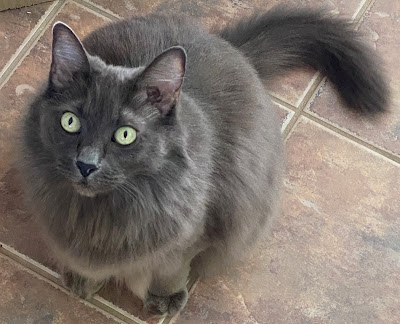
Dogs, eh? What about cats? I vote for cats being groke experts, especially if tuna or salmon is involved.

Is that a tuna sandwich in your hand??


Wednesday, May 27, 2020

Diner Lingo by Guest Author Camille Minichino


Please welcome guest author and good buddy, Camille Minichino. Camille authors several cozy mystery series under a variety of pseudonyms. Mousse and Murder is the first book in her most recent series, the Alaskan Diner Mysteries, written under the pen name of Elizabeth Logan. Camille notes that her idea of a gourmet dinner is a grilled cheese, fries, and a shake. (That’s a Jack Benny, frog sticks, and one in the hay.)
For more information, check out her website at minichino.com.  
---------------------------------------------------------------------

Who invented the battery?

A middle school science student would probably raise her hand and answer, “Volta!” maybe laughing at the confluence of the name and the unit of electromotive force. And for all practical purposes, she would be correct. It’s too cumbersome to go back to the Parthian Empire of 2000 years ago, and what’s known as the Baghdad battery. It’s beyond our grasp to name all the giants of engineering, ancient and modern, who brought us to where we are now, so we summarize and attribute the battery to Volta.

 I run up against this wall whenever I try to find the beginning—of a battery, of a revolution, even of something as large and concrete as a diner.

 The best I can do is go back to 1872 and credit Walter Scott, a horse-drawn wagon in Providence, Rhode Island, and a menu designed to feed night owls, whether workers finishing the late shift, or revelers looking for an off-hours meal.

The wagon evolved into “rolling restaurants,” with a few seats added inside, and then dining cars and finally, around 1924, permanently located “diners,” most maintaining the train-car look.


With a new style of restaurant came a new set of phrases, or “diner lingo,” the way a short order cook might communicate with her staff. Some call it shorthand, but diner lingo is often longer than the regular term for the menu item.

“A side of bad breath,” for example is not as succinct as “with onions.” And “a stack of Vermont” is longer than “pancakes.”

My guess: it’s more for adding fun to a job. Who doesn’t want to do that?

Probably among the best known call-outs are “Adam and Eve on a raft” (two eggs on toast) and “Battle Creek in a bowl” (corn flakes).

Other favorites of mine are:
  • “Burn the British” (toast an English muffin)
  •  “Cowboy” (western omelet)
  • “Cops and robbers” (coffee and donuts)
  • “In the alley” (on the side)
  • “Butcher’s revenge” (meatloaf)

A few phrases have been assimilated into our language, no longer recognized as diner-related, like sunny side up, BLT, OJ, and 86 it.

Post your favorites. But whatever you do, don’t be a camper*!

*One who stays at the table or counter for a long time, depriving the server of new tips.

Thursday, September 22, 2011

St. Louis: Bouchercon and Gooey Butter Cake


I recently returned from the big annual mystery fest known as Bouchercon. It moves, year to year, so every time I attend I get to visit a new place. This year (2011), it was in St. Louis.

St. Louis! The Gateway Arch! The monument to westward expansion!

Alas, though, I didn't experience the Arch.

But I did experience Gooey Butter Cake, which left a huge impression on me. Granted, not as big an impression as an impromptu Poisoned Pen Press author dinner-a-thon, or a wonderful meeting with mystery reviewer Teresa  Jacobsen who loved Mercury's Rise and said so in Library Journal ... but still a pretty big impression.

Big enough, it turns out, that it was the only photograph I took while in St. Louis:


My roomie, author Kathleen Ernst and I were determined to taste this uniquely St. Louis dish. Determined enough to set out Sunday morning, in the rain, in an ever-increasing spiral around the conference hotel, in search of a place that served gooey butter cake.

We found it, ordered it, devoured it. (Yes, the photo does kind of take the suspense out of this announcement, I know.) We had, specifically, raspberry lemon gooey butter cake. I wasn't sure what to expect from my first bite, but WOW! Extreme-sugar rush, is how I'd sum it up. Sugar, lots of it, and butter. A hint of lemon and really really sweet raspberry jam. I could feel the stuff sing in my teeth, hit my veins, and race straight to my brain. Strong coffee was required to temper the hit.

Back home again, I became curious. Does this stuff have a history?

Well, of course it does! Right here on the Helfer's Pastry site, and right here on What's Cooking America. I love the following description, penned on Helfer's Pastry page:

What starts off innocently enough as a plain yeast-raised coffeecake, erupts into a volcanic mass of chewy bright yellow lava, with snow banks of confectioners sugar covering crescenta and crevices. In the mouth, the goo clogs the gums, while the crusty edges glue to the teeth. You don't just swallow gooey butter cake, you work it down. 

Couldn't have said it better myself.

It apparently originated in St. Louis during the 1930s or 1940s, when a German baker added the wrong amounts of some ingredients and the inside of his coffee cake turned into a gooey, pudding-like filling. The sites provide a couple stories of the origin, and the What's Cooking America site features a recipe taken from I'll Have What They're Having - Legendary Local Cuisine.

Enjoy!