Showing posts with label slang-o-rama. Show all posts

Wednesday, March 30, 2022

Wednesday's Random Slang-o-rama: When the chips are down

When the chips are down....

.... the situation (according to Christine Ammer's The American Heritage Dictionary of Idioms) is urgent or desperate. Can  you guess how/when this phrase was coined?

>
>
>
>
>
>
>
>
>
>
>
>

Apparently this expression comes from poker (of course!). When all the bets have been made, and the chips—representing money—are physically put down, the hand is over and the players turn up their cards to see who has won. Ammer dates the phrase to the late 1800s, which is a little too vague for me.

Idiom Origins pushes it even later, to the early 20th century. (Oh dear.)

Well, for a phrase that's tossed around a lot (and is even the title to a song from the Broadway musical Hadestown, which is currently on tour):

So, folks, that's all I've got for when the chips are down.

The chips are down... no going back now!
By Unknown author - http://www.legendsofamerica.com/we-faro.html [1], Public Domain, https://commons.wikimedia.org/w/index.php?curid=7864393

Wednesday, March 31, 2021

Wednesday's Random Slang-o-rama: Tuckered out

 Not sure what happened to the month of March. It seems that it just arrived and now it's gone and, wow, I am all tuckered out.

Tuckered out is defined in John Stephen Farmer's Americanisms, Old and New (c. 1887) as "Wearied, tired out, fatigued."

The phrase has a definite Western ring to it, don't you think?

>
>
>
>
>
>
>
>
>
>
>
>

However, it dates way before cattle-drives, wagon trains, and so on, and isn't even "of the West." 

According to The Phrase Finder, "Tucker is a colloquial New England word, coined in the early 19th century, meaning 'become weary' and which ultimately derives from the Old English verb tuck, meaning 'punish; torment'." From more than a century-and-a-quarter earlier, Farmer in his Americanisms concurs, noting that the colloquialism "is most common in New England."

The Phrase Finder tracked the first appearance of tuckered out to this intriguing quote from the April 1839 Wisconsin Enquirer:

"I reckoned to have got to the tavern by sundown, but I haven't - as I'm prodigiously tuckered out." 

The Historically Speaking website has a nice collection of quotes featuring tuckered out, starting in 1962 and going back to 1845. This post also suggests that the phrase might have been in use by 1820. I'd pursue that further, but, well, I'm tuckered out, so I'll leave it as an exercise to those with more energy than I have at the moment...

The #DivaMissMia demonstrates what it means to be tuckered out.
Photo by Ann Parker


Wednesday, November 25, 2020

Wednesday's Random Slang-o-rama: Merrythought

 I was searching for something appropriate for (U.S.) Thanksgiving Day, when loyal Slang-o-rama reader Liz V pointed me toward a great blog post 11 charming old slang words you can use this Thanksgiving. So, in the spirit of the holiday, I am bringing merrythought to the table for your etymological consumption.

>
>
>
>
>
>
>
>
>
>

Acccording to the post, merrythought, meaning wishbone, dates waaay back to 16th century England and eventually made its way to the U.S. (New England and Virginia). The term eventually died out late 19th century, replaced by the current wishbone. The post noted a this from 1708: “the Original of the Name was doubtless from the Pleasant Fancies, that commonly arise upon the Breaking of that Bone.”

World Wide Words agrees, with an aside about wishbone:

The name of wishbone comes, of course, from the folk custom in which two people hold its ends and pull, the one left with the longer piece making a wish. Merrythought refers to an older version of the custom, in which it is assumed that the one left with the longer piece will get to marry first. So the bone-pulling ceremony resulted in what were euphemistically called "merry thoughts" among those taking part.

Wishing you and yours a safe and peace-filled Thanksgiving, whether you have a merrythought to pull or not!

Thankful for family, friends, turkey, and pumpkin pie!
Image by J Lloa from Pixabay


Wednesday, November 4, 2020

Wednesday's Random Slang-o-rama: Loose cannon


Having just wrapped up the 8th book in the Silver Rush series and rushed it off to the editor, I'm still awash (so to speak) in nautical slang, all while watching the election returns. I was looking for an idiom that might bridge the two worlds, and fell upon the phrase loose cannon.

Want to guess the etymology of that one?

>
>
>
>
>
>
>
>
>
>
>
>
>

From the Online Etymological Dictionary:

[I]n the figurative sense "wildly irresponsible person, potent person or thing freed from usual restraint," by 1896; in the literal sense an object of dread on old warships; the figurative use probably arose from a celebrated scene in a popular late novel by Victor Hugo: 
"You can reason with a bull dog, astonish a bull, fascinate a boa, frighten a tiger, soften a lion; no resource with such a monster as a loose cannon. You cannot kill it, it is dead; and at the same time it lives. It lives with a sinister life which comes from the infinite. It is moved by the ship, which is moved by the sea, which is moved by the wind. This exterminator is a plaything." [Victor Hugo, "Ninety Three," 1874]

Slinging Mud: Rude Nicknames, Scurrilous Slogans, and Insulting Slang from Two Centuries of American Policies by Rosemarie Ostler, credits Theodore Roosevelt with making this phrase popular around 1901. At a dinner one evening at his brother-in-law's house, while speculating on life after his term was up, Roosevelt apparently remarked, "I don't want to be the old cannon loose on the deck in the storm." Ostler also references Victor Hugo's novel Ninety-Three, so I think we'll let the laurels rest with Hugo...

Cannons: dangerous enough when fixed in place, but even worse when loose!
"Three ships offshore firing cannons." Gouache copy of 17th Century Netherlandish painting. http://www.abbottandholder-thelist.co.uk/, Public Domain, https://commons.wikimedia.org/w/index.php?curid=91348813

Wednesday, September 30, 2020

Wednesday's Random Slang-o-rama: Collie shangles

I fled to the past, searching for comfort and a bit of linguistic fun, and bumped into the intriguing phrase collie shangles. Have any of you heard of this bit of Victorian slang before?

>
>
>
>
>
>
>
>
>
>
>
>
>

Because it is definitely Victorian. According to a post titled A Dictionary Full of Victorian Slang, Queen Victoria herself brought this term into the light. The phrase and the definition appear in Passing English of the Victorian era: a dictionary of heterodox English, slang and phrase by James Redding Ware. Collie shangles appears in the Queen's journal More Leaves, published in 1884, as follows:

At five minutes to eleven rode off with Beatrice, good Sharp going with us, and having occasional collie shangles (a Scottish word for quarrels or rows, but taken from fights between dogs) with collies when we came near cottages. 

The perfect term to fling about the next time an exchange turns heated, don't you think? 

No collie shangles when in the presence of the Queen!
Photo of Queen Victoria with her dog "Sharp," the Border Collie, taken at Balmoral Castle
Unknown author - http://the-lothians.blogspot.com/2012/06/, Public Domain, Link

Wednesday, September 23, 2020

Wednesday's Random Slang-o-rama: Shilly-shally


If we lived in the year 1882, could we shilly-shally? Or, if we had to be historically accurate, would we have to dawdle, dally, hesitate, or vacillate instead? (All of which are perfectly good synonyms, by the way.)
>
>
>
>
>
>
>
>
>
>
>
>
>
>
>
>
>
>

According to The Phrase Finder, we'd be good to go. The term was out and about by 1700 in the form of shill-I shall-I. For those scratching their heads, the phrase's form reflects the question: "Shall I?" Shill-I was added for effect, in a process dubbed reduplication in linguistics, in which the root of a word (or part of it) or even the whole word is repeated exactly or with a slight change. (Another example of reduplication in action is the phrase heebie-jeebies.)

For first appearance in written form, The Phrase Finder points to this bit of dialogue from William Congreve's 1700 play The Way of the World:
I am somewhat dainty in making a resolution, because when I make it I keep it. I don't stand shill I, shall I, then; if I say't, I'll do't. 
This is no time to shilly-shally.
Image by Gerd Altmann from Pixabay 


Wednesday, September 16, 2020

Wednesday's Random Slang-o-rama: Needs must when the devil drives


I was zipping along writing a scene when the phrase needs must when the devil drives floated into my mind. It sounded like it would fit right in with what I was fashioning on the page, but I needed to be sure that (1) I understood the meaning and (2) it was "period" enough.
>
>
>
>
>
>
>
>
>
>
>
>
>
>
>
According to World Wide Words, this phrase—or rather, an early permutation—appears in 1420 in John Lydgate's Assembly of Gods, as follows: "He must nedys go that the deuell dryves." Something similar shows up in Shakespeare's All’s Well that Ends Well: "My poor body, madam, requires it: I am driven on by the flesh; and he must needs go that the devil drives."

World Wide Words adds that the semi-archaic needs must is an idiom in and of itself, meaning "necessity compels," and provided a nice definition of the entire phrase:
[I]f the devil drives you, you have no choice but to go, or in other words, sometimes events compel you to do something you would much rather not.
If you are curious about needs must, you can read more about it here, on The Grammarphobia Blog.

My takeaway: My fictional 1882 character could definitely think needs must when the devil drives, take a deep breath, and do what must be done.

Who's driving now?
By Roberts [artist] This file comes from the Bodleian Libraries, a group of research libraries in Oxford University. Public Domain, https://commons.wikimedia.org/w/index.php?curid=47060855

Wednesday, September 2, 2020

Wednesday's Random Slang-o-rama: To a T


When something is done exactly, or perfectly, it is done to a T. Or would that be to a tee or to a tea or to the tee or...?

I was pretty sure it was simply "a" capital "T" but embarked on a slang-o-rama journey to discover where this idiom came from and what the heck "T" meant in this context...

>
>
>
>
>
>
>
>
>
>
>
>

As to the origin of this very simple phrase, there are a lot of theories thrown around. T as in T-shirt? Nope, first use goes waaaay back before t-shirts. How about a sport-related tee? Once again, neither golf nor curling (the other sport where a tee is used) appears in conjunction with this phrase in its earliest uses.

The Phrase Finder delves into the myriad possibilities, before lighting upon the letter "T" itself, as the initial of a word, noting:

If this is the derivation then the word in question is very likely to be "tittle". A tittle is a small stroke or point in writing or printing and is now best remembered via the term jot or tittle. The best reason for believing that this is the source of the "T" is that the phrase 'to a tittle' existed in English well before 'to a T', with the same meaning; for example, in Francis Beaumont's Jacobean comedy drama The Woman Hater, 1607, we find: "Ile quote him to a tittle."  In this case, although there is no smoking gun, the "to a tittle" derivation would probably stand up in court as "beyond reasonable doubt".

The Word Detective agrees, and goes down the rabbit hole exploring the word "tittle."

Daily Writing Tips also has a nice post on the proper form of to a T, and its origins.

So, there you have it. You can have your tea while you wear a tee to tee and do it all to a T.

To a tea/T/tee.

Wednesday, August 5, 2020

Wednesday's Random Slang-o-rama: Bigwig


You probably know the term bigwig. A bigwig is someone who is mighty important... or at least views himself (or herself) as such.

So, does this term have anything to do with actual wigs?
>
>
>
>
>
>
>
>
>
>
>
No surprises here: It does!

According to the Online Etymological Dictionary, bigwig (or big-wig), meaning "great man, person of consequence," dates to 1781 and refers to the imposing wigs formerly worn by men of rank or authority.

The Grammarphobia Blog, in a post titled Wigs, Bigwigs, and big Whigs dives into this hairy topic with great enthusiasm, noting that the occasionally spotted big-whig is a misnomer. They track first use to 1703 in this passage spotted in a weekly journal called English Spy:
“Be unto him ever ready to promote his wishes … against dun or don—nob or big-wig—so may you never want a bumper of bishop.”
(Bumper of bishop? That's a new one on me! I think it has something to do with drinking some quantity of... something, but that's all I can determine. Anyone who has insight, please feel free to enlighten me. **)

Now this fellow is definitely a bigwig!
This image comes from Gallica Digital Library and is available under the digital ID btv1b8425660h, Public Domain, Link


** Update: And, someone did! Thank you, Liz, for ferreting out this definition of "bishop" from Green's Dictionary of Slang: a mixture of wine and water, topped off by a roasted orange, supposedly an episcopal favourite.

Wednesday, July 29, 2020

Wednesday's Random Slang-o-rama: Hold your horses


Well now, folks, just hang onto those reins and hold your horses.

That phrase sounds like something straight out of old Western movies, right? But horses have been around for a long time. Perhaps "holding" them goes waaaaay back and predates the Old West.

Well...
>
>
>
>
>
>
>
>
>
>
>
>
>

... according to The Phrase Finder, to hold your horses, in the sense of "be patient," is indeed a phrase born in the USA, around 1844:
In keeping with its American origin, it originally was written as 'hold your hosses' and it appears in print that way many times from 1844 onwards. In Picayune (New Orleans) September 1844, we have: "Oh, hold your hosses, Squire. There's no use gettin' riled, no how."
If it appears in the newspapers in 1844, you know it was being said for some time before that.

The American Dictionary of Idioms by Christine Ammer nudges it back to 1840, adding "This expression alludes to a driver making horses wait by holding the reins tightly."

Then there's Wikipedia being, well, Wikipedia, suggesting the origin could be earlier. Much earlier:
Literal meaning: comes from when in the 1600s when someone broke a law they would trample them with horses. The person in charge would say "Hold you horses" and then would tie the law breaker on to a piece of wood and lay him on the ground. Then the horses would come and trample him. 
Yikes!!

However, even Wikipedia goes with the first idiomatic use occurring in the US in the 1840s.

So, there you go. You may let your horses run free now.

Photo by Ivy Son from Pexels


Wednesday, July 22, 2020

Wednesday's Random Slang-o-rama: Twitterpated/Shatterpated


Ooooh I'd love to use twitterpated in my historical mystery circa 1882, but nope nope nope...
>
>
>
>
>
>
>
>
>
>
>
>
>
>

According to The Online Etymological Dictionary, twitterpated only came into being in 1942. (It sounds so much older, right?) What's more, it was Disney Studios that apparently coined it:
twitterpated: [F]irst attested in the Walt Disney movie "Bambi"... a past-participle adjective formed from twitter in the "tremulous excitement" noun sense (1670s) + pate (n.2) "head".  
Thumper: Why are they acting that way? 
Friend Owl: Why, don't you know? They're twitterpated. 
Flower, Bambi, Thumper: Twitterpated? 
Friend Owl: Yes. Nearly everybody gets twitterpated in the springtime. For example: You're walking along, minding your own business. You're looking neither to the left, nor to the right, when all of a sudden you run smack into a pretty face. Woo-woo! You begin to get weak in the knees. Your head's in a whirl. And then you feel light as a feather, and before you know it, you're walking on air. And then you know what? You're knocked for a loop, and you completely lose your head!
However, the word shatterpated is another story. This is what I found in the online 1828 Webster's Dictionary:
1. Disordered or wandering in intellect.
2. Heedless wild; not consistent.
Shatterpated also shows up in A Dictionary of the English LanguageIn which the Words are Deduced from Their Originals; and Illustrated in Their Different Significations, by Examples from the Best Writers: Together with a History of the Language, and an English Grammar, Volume 4 by Samuel Johnson and Henry John Todd, from 1818. The definition: inattentive; not consistent.

So, I'd better not include twitterpated characters in my fictional world of the 1880s, lest I be accused of being shatterpated.


This twitterpation must stop! (Or at least be moved to a different century.)
Les Amants dans la campagne by Gustave Courbet, 1844


Wednesday, July 15, 2020

Wednesday's Random Slang-o-rama: Hat in hand


I wrote the phrase hat in hand in my Silver Rush WIP, then had to stop and look it up. (Of course!)
>
>
>
>
>
>
>
>
>
>
>
>
>
>
>
According to Merriam-Webster, hat in hand, a phrase that indicates something is done "in an attitude of respectful humility," dates from 1821, putting it comfortably in the earlier part of the 19th century. The American Heritage Dictionary of Idioms by Christine Ammer includes cap in hand with a definition of "in a humble manner." Ammer places first use of the phrase circa 1700 and adds:
This expression alludes to removing one's headgear as a sign of respect and has survived the era of doffing one's hat.
[ASIDE: Doffing... love that word! Will have to find a place for it...]

In any case, doing something hat in hand is perfectly reasonable for my 1882-era characters, whether they proceed literally or figuratively.

This guy does not look like the "hat in hand" type.
General Étienne-Maurice Gérard (1816) by Jacques Louis David
The Metropolitan Museum

Wednesday, July 8, 2020

Wednesday's Random Slang-o-rama: Bobadil


Now here's one for the books: bobadil.

Any guesses as to what this word means?
>
>
>
>
>
>
>
>
>
>
>
>
>
>
>
>
>
>
According to Merriam-Webster, calling someone a bobadil is not a compliment. The word means braggart, especially a "cowardly braggart." The Online Etymological Dictionary points to the esteemable Ben Johnson as the originator of this word, naming a boastful character Bobadil in "Every Man in his Humour" (1598). So yes, it has been around for quite a while. 

Some words never go out of style...

There he goes again...
The Fool Who Sells Wisdom by Carle (Antoine Charles Horace) Vernet, 1818

Wednesday, July 1, 2020

Wednesday's Random Slang-o-rama: Kick up your heels at a shindig


How many of you plan to go to a shindig on July 4th and kick up your heels?

There's a lot of unintentional legwork in that question. Let's tackle both the word shindig and the phrase kick up your heels, and see if we can't wrestle them to the ground, slang-o-rama style.
>
>
>
>
>
>
>
>
>
>
>
>
Shindig, meaning "dance, party, lively gathering," gets a nod from the Online Etymological Dictionary, which notes it first appeared in 1871. According to OED, this word probably evolved from shindy "a spree, merrymaking" (1821)—which also refers to "a game like hockey"—or perhaps from shinty, which is the name of a Scottish game akin to hockey (1771). Merriam-Webster says shindig first danced onto the scene in 1842.

Hmmmm. I sense some uncertainty as to when shindig first arrived on the scene.

I checked Google Ngram Viewer for early appearances, did a little digging, and found it in Across the Atlantic: Letters from France, Switzerland, Germany, Italy, and England by Charles H. Haeseler, dated 1868. The following passage appears in a passage describing a snowball fight in the Alps:


As for kick up one's heels, nowadays we pretty much use it in the sense defined by Merriam-Webster: to show sudden delight or have a lively time. However, according to The American Heritage Dictionary of Idioms by Christine Ammer, its original meaning was much less... ah... lively:
kick up one's heels: Enjoy oneself... This expression originated about 1600 with a totally different meaning, "to be killed."
Ee-ow!! Although, perhaps in these days (and nights) of COVID-19, kicking up one's heels at a big ol' shindig where folks are all jammed together might result in a condition that is closer to the original meaning of the phrase.

So, whatever you do to celebrate the 4th, please stay safe and err on the side of caution. As for me, I'm going to see if I have a red-white-and-blue mask to wear that day if I should venture out in public.... 

If you attend a shindig on the 4th, please add a little distance while you kick up your heels...
WikiArt - 4th of July 1819 in Philadelphia by John Lewis Krimmel


Wednesday, June 24, 2020

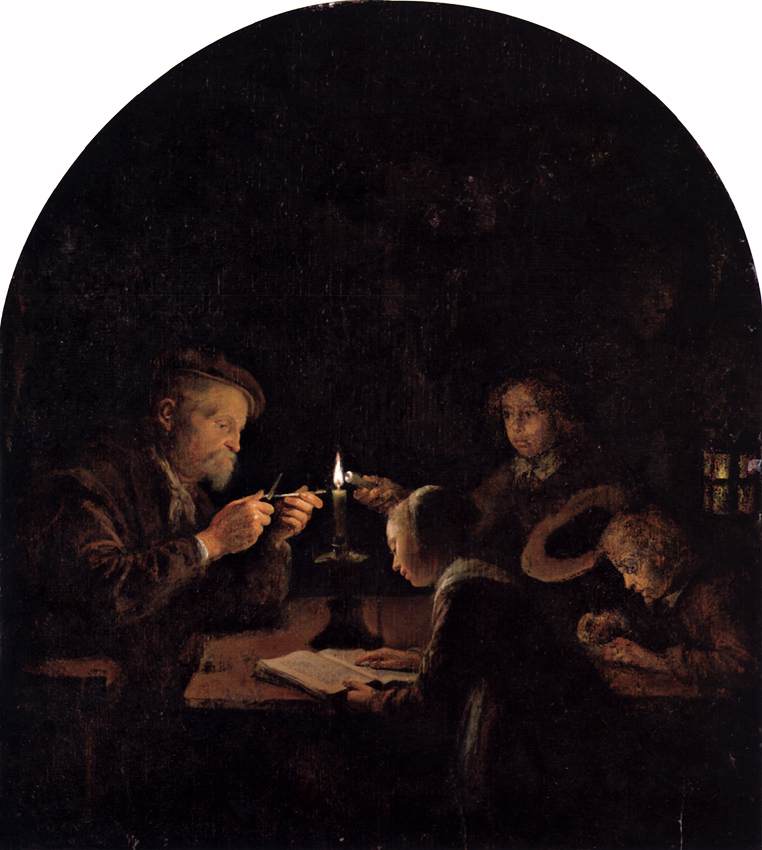
Wednesday's Random Slang-o-rama: The game is not worth the candle


I bumped up against the phrase the game is not worth the candle, and although I more or less understood it to mean "the game" (whatever it may be) isn't worth pursuing for whatever reason, I wasn't at all sure about the origin or timeframe.

So, off we go, on a little idiomatic journey....
>
>
>
>
>
>
>
>
>
>
>
My well-used copy of The American Heritage Dictionary of Idioms by Christine Ammer has this to say:
The game is not worth the candle. The returns from an activity or enterprise do not warrant the time, money, or effort required. This expression, which began as a translation of a term used by the French essayist Michel de Montaigne in 1580, alludes to gambling by candlelight, which involved the expense of illumination. If the winnings were not sufficient, they did not warrant the expense. Used figuratively, it was a proverb within a century.
The Phrase Finder also has a nice post about not worth the candle. The first known printed record of that phrase in English appeared in Sir William Temple's Works, circa 1690: "Perhaps the Play is not worth the Candle."

So, let me know: Was this little etymological diversion to your day sufficiently... illuminating? ;-)

If the hand you're dealt isn't worth the candle, just hold those cards a little closer to the flame.
By Gerrit Dou - Web Gallery of Art:   Image  Info about artwork, Public Domain, Link


Wednesday, June 17, 2020

Wednesday's Random Slang-o-rama: By the skin of one's teeth


When a character of mine managed to escape detection by the skin of her teeth, I stopped and thought about that a bit. Since when do teeth have skin? Maybe if they haven't been brushed in a long time? (eeeuw!) And where did that little phrase come from anyway?

Sooooo many distractions from focusing on plowing through Book #8!

But I don't want to use an anachronistic phrase if I can avoid it, so time to sink my teeth into by the skin of one's teeth.
>
>
>
>
>
>
>
>
>
>
>
>
>
>
To my vast relief, this appears to be a very old phrase. In fact, thousands of years old, according to The Grammarist:
By the skin of one’s teeth means just barely, by a narrow margin, just in time. The phrase by the skin of one’s teeth is found in the book of Job in the Old Testament of the Bible. Job is a character in the Bible who undergoes an abundance of suffering due to a challenge that Satan has made to God. Satan tries to break Job’s righteousness by bringing suffering upon him. Job laments his status through much of the book, including the phrase, “My bone cleaveth to my skin and to my flesh, and I am escaped with the skin of my teeth.” What exactly the phrase “escaped with the skin of my teeth” meant in Ancient Hebrew is unknown. It is assumed that the skin referred to in the term skin of my teeth is the enamel, though this is only a guess.
World Wide Words notes the idiom appeared first in the Geneva Bible of 1560 and is a direct translation of the original Hebrew:
Since teeth don’t have skin, the phrase is hard to make sense of; Bible translators and commentators have struggled with it down the centuries. The Douay-Rheims Bible has instead “My bone hath cleaved to my skin, and nothing but lips are left about my teeth.” Other writers have suggested that the reference is to the gums.... 
One modern writer has concluded: "The explanations for the last metaphor are multiple and unconvincing. Its meaning eludes us."
I guess all we can conclude is: 'tis a mystery!
Meeting deadlines by the skin of my teeth (i.e., barely)
Image by Dmitry Abramov from Pixabay


Wednesday, June 10, 2020

Wednesday's Random Slang-o-rama: Tin ear


A character in my work-in-progress claims to have a tin ear. I dutifully recorded it... and stopped.

And how did "tin" get all wrapped up with ears? And how old is that idiom, anyway? My books are set in the 1880s, long before author L. Frank Baum introduced the Tin Man in his 1900 book, The Wonderful Wizard of Oz.

So, I proceeded down my virtual version of the Yellow Brick Road to figure out the when, where, and why of the phrase tin ear.
>
>
>
>
>
>
>
>
>
>
>
>
>
According to the Online Etymological Dictionary, tin ear, meaning "lack of musical discernment," has been around since 1909.

The Stack Exchange has a lively discussion on this phrase and throws out several theories on its origin, including:
  • Ear trumpets made of tin 
  • Tin (plate) as cheap and nasty
  • Tin instruments or dropped items made of tin sounding horrible
  • A tale of using a piece of tin on a morse buzzer to amplify the sound
  • Tinnitus
One intrepid Stack Exchange responder noted:
The earliest record I can track of the use in print is in the novel Titan:A Romance, by Jean Paul Richter, published in translation from the German in 1863 and in the original language between 1800 and 1803. 
In that early 19th century novel, tin ear is synonymous with an ear trumpet. Alas, not the meaning I had in mind at all for my character who is in San Francisco in 1882.

Changes were required.

Now, the poor fellow no longer has a tin ear but is tone deaf (which I found in an 1876 tome and an 1880 magazine... good enough for my purposes!).


Not the tin ear I was hoping for, but pretty cool, nonetheless.
A collapsible Victorian ear trumpet made of tin made by Atkinson, Union Court, Holborn, London
See page for author / CC BY

Wednesday, June 3, 2020

Wednesday's Random Slang-o-rama: Saber-rattling


In these fraught times it seems there is a lot of saber-rattling going on. Which, of course, has me wondering about the when and why of this phrase. According to Merriam-Webster saber-rattling is "overtly and often exaggeratedly threatening actions or statements (such as verbal threats or ostentatious displays of military power) that are meant to intimidate an enemy by suggesting possible use of force."

Sabers have been around for a loooong time, so you might think this term dates back to when folks actually used these sharp-edged weapons to cause very real damage to their enemies.

At least, that's what I thought.
>
>
>
>
>
>
>
>
>
>
>
>
>
>
>
>
>
The Online Etymology Dictionary notes that "saber-rattling 'militarism' is attested from 1922." An M-W post, The History of 'Saber-rattling,' is a little fuzzy on the first use as well as the origin of the phrase:
Some think that it comes from the practice of 18th-century Hungarian cavalry units had of brandishing their sabers at opponents prior to charging. Others have said that it comes from the habit that military officers had in the early 20th century of ominously shaking their scabbard when issuing orders to subordinates. Our records indicate that the two words began seeing use in fixed fashion around 1880, making it unlikely that it was directly related to either of the causes given above.
Whether 19th century or 20th century, it's clearly a term that still is relevant to today...
Those sabers look pretty serious to me.
Image by Gerhard Gellinger from Pixabay


Wednesday, May 13, 2020

Wednesday's Random Slang-o-rama: Zounderkite


Here is an vintage word that is perfect for our times: zounderkite.

Any ideas as to what it means?

Go ahead, guess! (No fair peeking on Google.) And then, keep reading to see if you are right...

>
>
>
>
>
>
>
>
>
>
>
>
>
>
>
>
>
>
>
>
According to the Dictionary.com article Insults We Should Bring Back, zounderkite is a Victorian word meaning "idiot." It shows up in many lists of vintage curse words, including 22 Incredible Forgotten Curse Words from Way Back in the Day (which expands on the simple one-word definition with: "a complete idiot who constantly makes clumsy and awkward mistakes"), and BBC America's 10 Victorian Swears from the Real "Ripper Street" (which goes whole hog: "the kind of bumbling idiot that will end up making a disastrous mistake of the sort that beggars belief").

BBC America provided a source, which was a good thing, because this word did not appear in any of my hard copy dictionaries, including Webster's New Universal Unabridged Dictionary. However, their source—1811 Dictionary of the Vulgar Tongue—does not contain zounderkite.

What do they take me for, an idiot? That I would not check the source?

I turned to N-gram, thinking surely it would show up there. Nope. Nothing.

Determined, I delved a little further into Google Books, hoping to find a 19th century mention. I finally found it, I'm proud to say, in the 1876 A Glossary of Surrey Words (A Supplement to No. 12.) by Granville William Gresham Leveson Gower, in the Mid-Yorkshire section, where it appears between zookerins! and zounds! 
There it is! Proof, at last!

I think the scarcity of zounderkite in books in general might mean it was a word more spoken than written, at least in the past.

My thrashing about also turned up a Zounderkite family of fonts.
One just never knows what will turn up during Slang-o-rama research.


Wednesday, May 6, 2020

Wednesday's Random Slang-o-rama: Sail close to the wind


Those of you who are nautically inclined will no doubt know the origins and meaning of the phrase sail close to the wind, and why it has an air of danger about its definition. However, I do not, and since I'm mucking around with bits of maritime history as I trudge along drafting book #8 of the Silver Rush series, it seemed time to look this one up...
>
>
>
>
>
>
>
>
>
>
>
>
>
>
>
>
>
>
The American Heritage Dictionary of Idioms by Christine Ammer summarizes as follows:
sail close to the wind: Be on the verge of doing something illegal or improper, as in "She was sailing pretty close to the wind when she called him a liar." This term alludes to the danger incurred when literally sailing too close to (that is, in the direction of) the wind. Its figurative use dates from the first half of the 1800s.
Well, that's pretty cool! And I rather like the sample sentence. There are all kinds of folks my protagonist Inez could accuse of sailing close to the wind in my current work-in-progess. In fact, she could be probably be accused of the same.

There is a little more back'n forth about the phrase over at The Phrase Finder, to wit:
This is a true sailing expression. Sail boats have different characteristics, but all need wind. Some can harvest the wind better than others. If you sail close to the edge of direction that the wind is coming from you may well lose the wind altogether, but you may be able to make better progress than a boat that can't sail as well in such a difficult situation. Thus, if you can 'sail close to the wind' then you can benefit, but you enter a risky area and may lose all!
I looked around a bit more, but that was about all I could find that shed light on this particular phrase. At least, the timing gives me license to let my characters sail close to the wind—in some cases, with disastrous results.

Sailed too close to the wind? Or a reef?...
Shipwreck by Ivan Aivazovsky, 1854