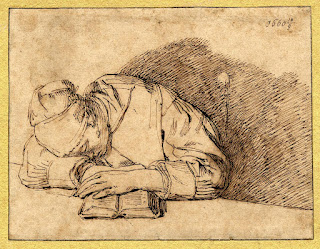
Ah, I'm late with this Slang-o-rama post, although I can hardly blame it on being quanked... more like being unorganized and losing track of what day it is.
"And quanked means... what?" you ask.
Allow me to elucidate (actually, I'll let the references at hand do that).
>
>
>
>
>
>
>
>
>
>
According to The Little Book of Lost Words by Joe Gillard, quanked is a 19th-century adjective meaning "exhausted or fatigued from hard work." I don't know if one could count sitting hunched over a keyboard as "hard work." It's not as if I'm digging ditches here! (Well, maybe metaphorical ditches, but that's a different subject.) This word proved pretty elusive on the internet. I did find quanked in Wiktionary, which noted the word was "UK, dialect, obsolete." Wiktionary also provided the reference "Dartnell and Goddard (1893)."
Where there is a reference, there is a path forward, so forward I go...
And sure enough, Google Books promptly offered up quanked in A Glossary of Words Used in the County of Wiltshire, Issues 1-2, by George Edward Dartnell and Edward Hungerford Goddard (1893). Words specific to the county of Wiltshire? I'd say that's pretty specific! And even though I'm deviating from strictly Slang-o-rama here (or maybe not), I just have to share this from the Preface:
The following pages must not be considered as comprising an exhaustive Glossary of our Wiltshire Folk-speech. The field is a wide one, and though much has been accomplished much more still remains to be done. None but those who have themselves attempted such a task know how difficult it is to get together anything remotely approaching a complete list of the dialect words used in a single small parish, to say nothing of a large county, such as ours. Even when the words themselves have been collected, the work is little more than begun. Their range in time and place, their history and etymology, the side-lights thrown on them by allusions in local or general literature, their relation to other English dialects, and a hundred such matters, more or less interesting, have still to be dealt with. However, in spite of many difficulties and hindrances, the results of our five years or more of labour have proved very satisfactory, and we feel fully justified in claiming for this Glossary that it contains the most complete list of Wiltshire words and phrases which has as yet been compiled. More than one-half of the words here noted have never before appeared in any Wiltshire Vocabulary, many of them being now recorded for the first time for any county, while in the case of the remainder much additional information will be found given, as well as numerous examples of actual folk-talk.
Note that the authors spent FIVE YEARS on collecting "folk-speech" from a single county. My mind boggles, and I get quanked just thinking about it...





 Posts
Posts


